








Photo credits: ScenTree SAS
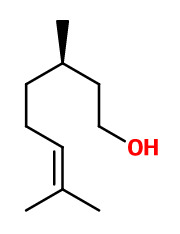
dl-Citronellol
Floral > Rosy > Fresh Flowers
3,7-dimethyloct-6-enol ; Elenol ; 3,7-dimethyloct-6-en-1-ol


Photo credits: ScenTree SAS
| Company | Ingredient Name | Learn more | Naturality | Certifications | MOQ | Purity |
|---|---|---|---|---|---|---|

|
Citronellol Natural
CT-501
|
Discover | Natural |


|
50 Kgs | 100 |

|
Natural Citronellol | Discover | Natural |
|
- | - |

|
CITRONELLOL 70
925961
|
Discover | Molecules |

|
- | - |

|
Citronellol 30 Gr | Discover | - | 30grs | - | |
|
Citronellol
30035053
|
Discover | Molecule | - | - | |

|
Citronellol | Discover | Synthetic Aroma Chemicals | - | - | |
|
|
Citronellol natural | Discover | Natural Aroma Chemicals | - | - |
CT-501

925961
30035053

General Presentation
-
CAS N° :
106-22-9 -
EINECS number :
203-375-0 -
FEMA number :
2309 -
FLAVIS number :
2,011
-
JECFA number :
1219 -
Volatility :
Heart -
Price Range :
€
Physico-chemical properties
-
Appearance :
Colorless liquid -
Density :
0,855 -
Refractive Index @20°C :
1,454 - 1,462 -
Optical rotation :
Donnée indisponible. -
Vapor pressure :
0,011828 mmHg @23°C -
Flash Point :
100°C (212°F)
-
Molecular formula :
C10H20O -
Molecular Weight :
156,27 g/mol -
Log P :
3,3 -
Fusion Point :
Donnée indisponible. -
Boiling Point :
225°C (437°F) -
Detection Threshold :
11 ppb à 2,2 ppm (0,00022%). 40 ppb pour sa forme lévogyre, plus puissante.
Chemistry & Uses
Uses in perfumery :
Citronellol is used in reconstitutions of rose and in citrus notes. Often provides an olfactory base for detergents. Used in soaps and home care products for its stability.
Year of discovery :
Data not available.
Natural availability :
Citronellol is present in many plants. It can mainly be extracted from Boronia citriodora (up to 80% of (+) - Citronellol) or Eucalyptus citriodora (from 15 to 20% of (+) - Citronellol). The laevorotatory isomer is more present in Damask Rose EO (and other roses) and Geranium EO. The extracts of all these plants allow to obtain Citronellol in its natural state.
| Ingredient | % min | % max |
|---|---|---|
| Citronella oil (Ceylon type) | 3 | 8.50 |
| Citronella oil (Java type) | 8.50 | 14 |
| Geranium oil (bourbon) | 18 | 26 |
| Geranium oil (China) | 32 | 43 |
| Geranium oil (Madagascar) | 18 | 26 |
| Geranium oil (Egypt) | 25 | 36 |
| Litsea cubeba oil | 0.50 | 1.50 |
| Rose absolute (centifolia) | 9 | |
| Rose absolute (damascena) | 5 | 10 |
| Rose water oil (damascena) | 1 | |
| Rose oil (damascena) (Turkey) | 34 | 49 |
| Rose oil (damascena) (Marocco) | 30 | 47 |
| Rose oil (damascena) (Bulgaria) | 20 | 34 |
| Rosemary PURE JUNGLE ESSENCE™ | 0.09 | |
| Douglas Fir oil | 1 | 5 |
Isomerism :
As already mentioned, the asymmetric carbon of Citronellol imposes a difference between its laevorotatory and dextrorotatory enantiomers. The smell of the laevorotatory isomer is more delicate, powerful and floral. Dihydromyrcenol, with a floral note, and Aldehyde C-10, less floral but more aldehydic and hesperidic, are both constitutional isomers of Citronellol.
Synthesis precursor :
Citronellol is a precursor to the synthesis of many molecules. For example, dehydrogenation of Citronellol provides Citronellal. Moreover, several esters are obtained by reacting various carboxylic acids with Citronellol in the presence of an acid catalyst.
Synthesis route :
The synthesis of Citronellol can be done in several ways. A catalytic hydrogenation of Citronellal allows to obtain it, taking care of the isomery of the Citronellal that is used (in the case of a natural Citronellal, its isomerism is guided by the plant from which it is extracted). A second synthetic route is made from Geraniol and Nerol or Citral by a regioselective hydrogenation. This regioselectivity is guided by catalysis (metallic or aminic) and the conditions of the reaction. The laevorotatory enantiomer of Citronellol can finally be prepared from dextrorotatory alpha-Pinene or beta-Pinene, whose hydrogenation allows to obtain (+)-cis-Pinane. A pyrogenation of this molecule allows to synthesize (+)-3,7-dimethyl-1,6-octadiene. Then, Citronellol is obtained by reaction of this product with triisobutylaluminium or diisobutylaluminium hydride, followed by an air oxidation and a hydrolysis.
Stability :
Terpenes tend to polymerize by oxydation.
Other comments :
Citronellol is also used in the composition of Rhodinol, extractable from Geranium EO.
Citronellol is one of the 26 allergens in perfumery.
Levorotatory Citronellol was used for the first time in perfumery in 1904, in La Rose Jascqueminot, by Coty.
Labelling
Allergens :
This ingredient is classified as an allergen under European Regulation 2023/1545, dated August 26, 2023.
Its presence must therefore be declared on product labels when it exceeds 0.001% in leave-on products and 0.01% in rinse-off products.
Signal word :
Danger
Hazard pictograms :
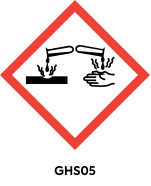
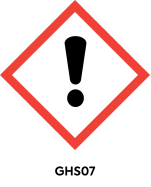
Precautionary statements :
| HAZARD | PRECAUTION |
|---|---|
| H315 Causes skin irritation.
H317 May cause an allergic skin reaction. H318 Causes serious eye damage. H412 Harmful to aquatic life with long lasting effects. |
P261 Avoid breathing dust/fume/gas/mist/vapours/spray. P273 Avoid release to the environment. P280 Wear protective gloves/protective clothing/eye protection/face protection. P305 + P351 + P338 IF IN EYES: Rinse cautiously with water for several minutes. Remove contact lenses, if present and easy to do. Continue rinsing. P310 Immediately call a POISON CENTER/doctor/… P333 + P313 If skin irritation or rash occurs: Get medical advice/attention. |
IFRA
IFRA 51th :
This ingredient is restricted by the 51th amendment
-
Restriction type :
RESTRICTION -
Cause of restriction :
DERMAL SENSITIZATION -
Amendment :
49
Quantitative limit on the use :
| Cat.1 | Cat.2 | Cat.3 | Cat.4 |
Cat.5
A
B
C
D
|
Cat.6 | |||
|---|---|---|---|---|---|---|---|---|
| 2,2 % | 0,67 % | 13 % | 12 % |
3,2 %
3,2 %
3,2 %
3,2 %
|
||||
|
Cat.5
A
B
C
D
|
Cat.6 | |||||||
|
3,2 %
3,2 %
3,2 %
3,2 %
|
7,3 % | |||||||
|
Cat.7
A
B
|
Cat.8 | Cat.9 |
Cat.10
A
B
|
Cat.11
A
B
|
Cat.12 | |||
|
25 %
25 %
|
1,3 % | 24 % |
87 %
87 %
|
48 %
48 %
|
||||
|
Cat.10
A
B
|
Cat.11
A
B
|
Cat.12 | ||||||
|
87 %
87 %
|
48 %
48 %
|
No Restriction | ||||||
Annexe I :
Some regulated synthetic ingredients are found in nature and in certain proportions in natural ingredients. This presence in nature has to be taken into account when calculating limits of use recommended by the IFRA. In case you do not know these concentrations, you can use the ones estimated by the IFRA. Here they are :
| List of regulated compounds contained in this ingredient | |||
|---|---|---|---|
| Ingredient Name | Botanical Name | CAS N° | Estimated Concentration |
| Schinus molle oil | Schinus areira L. | 68917-52-2 | 0,02 |
| Hibawood oil | Thujopsis dolabrata (Thunb. Ex L.f.) Sieb.& Zucc. | 68917-43-1 | 0,38 |
| Citron oil | Citrus medica L. | 68991-25-3 | 0,12 |
| Citronella oil, Ceylon type | Cymbopogon nardus (L.) Rendle | 8000-29-1 | 6 |
| Citronella oil, Java type | Cymbopogon winterianus Jowitt | 8000-29-1 | 11 |
| Spruce oil, Black | Picea mariana (Mill.) Britton | 8008-80-8 | 0,2 |
| Eucalyptus citriodora oil | Corymbia citriodora (Hook.) K.D. Hill & L.A. Johnson | 85203-56-1 | 7,37 |
| Orange flower oil, bitter (neroli and neroli bigarade) | Citrus aurantium L. spp. Amara Link | 8016-38-4 | 0,04 |
| Lemongrass oil, East Indian | Cymbopogon flexuosus (Nees ex Steudel) Will. Watson | 8007-02-1 | 0,25 |
| Lime oil distilled | Citrus aurantifolia (Christm.) Swingle | 8008-26-2 | 0,01 |
| Litsea cubeba oil | Litsea Cubeba(Lour.) Pers. | 68855-99-2 | 0,15 |
| Balm oil | Melissa officinalis L. | 8014-71-9 | 7,49 |
| Niaouli oil | Melaleuca viridiflora Sol. ex Gaertn. | 8014-68-4 | 0,1 |
| Pine, Pinus pumila, extract | Pinus Pumila (Pall) Regel | 0,1 | |
| Rose oil | Rosa x damascena Mill. | 8007-01-0 | 32,5 |
| Rose water stronger | Rosa x centifolia L. | 8007-01-0 | 1,2 |
| Rose absolute | Rosa x damascena Mill. | 90106-38-0 | 4,02 |
| Rose concrete | Rosa x damascena Mill. | 90106-38-0 | 4,7 |
| Thyme oil, red | Thymus vulgaris L. | 8007-46-3 | 0,02 |
| Verbena absolute | Lippia citriodora (L.) Kunth | 8024-12-2 | 0,45 |
| Bucchu absolute, betulina | Agathosma betulina (P.J.Bergius) Pillans | 84649-93-4 | 0,19 |
| Citrus hystrix extract | Citrus hystrix DC | 91771-50-5 | 3 |
| Marjoram oil, Spanish | Thymus mastichina L. | 8016-33-9 | 0,09 |
| Orange flower water absolute | Citrus aurantium L. spp. Amara Link | 8030-28-2 | 0,02 |
| Spruce oil, White | Picea abies (L.) H.Karst. | 91770-69-3 | 0,28 |
Disclaimer :
ScenTree is solely responsible for the information provided here.
To learn more about IFRA's standards : https://ifrafragrance.org/safe-use/library