





Photo credits: ScenTree SAS
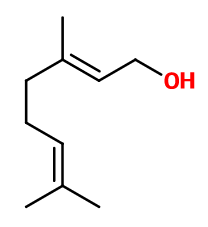
Geraniol
Floral > Rosy > Geranium > Citric
(2E)-3,7-dimethylocta-2,6-dien-1-ol ; 3,7-dimethyl-2,7-octadien-1-ol ; Geranyl alcohol ; Lemonol ; Meranol ; Rosoflor


Photo credits: ScenTree SAS
| Company | Ingredient Name | Learn more | Naturality | Certifications | MOQ | Purity |
|---|---|---|---|---|---|---|

|
Geraniol Natural 85%+
CT-201
|
Discover | Natural |


|
50 Kgs | 85 |
|
GERANIOL
F1885
|
Discover | Extrait |
|
- | - |

|
Geraniol 75% | Discover | Natural |
|
- | - |
|
|
Geraniol 85% | Discover | Natural |
|
- | - |
|
|
Geraniol 90% | Discover | Natural |
|
- | - |
|
|
Geraniol 98% | Discover | Natural |
|
- | - |
|
GERANIOL EXTRA
GER-1
|
Discover | - | 10 grs | 97.0 - 100.0 | |

|
GERANIOL 70 RC
945176
|
Discover | Molecules |


|
- | - |
|
Geraniol - 30 Gr | Discover | - | 30grs | - | |
|
|
GERANIOL 532 RC
945175
|
Discover | Molecules |
|
- | - |
|
GERANIOL EX PALMAROSA
4410000101
|
Discover | Naturel | - | - | |
|
Geraniol 60
30035070
|
Discover | Molecule | - | - | |
|
|
Geraniol 60 BMBCert™
30770690
|
Discover | Molecule | - | - | |
|
|
Geraniol Extra
30035071
|
Discover | Molecule | - | - | |
|
|
Geraniol Extra BMBCert™
30770691
|
Discover | Molecule | - | - | |

|
Geraniol | Discover | Synthetic Aroma Chemicals | - | - | |
|
|
Geraniol natural | Discover | Natural Aroma Chemicals | - | - |
CT-201

F1885
GER-1
945176
945175
4410000101
30035070
30770690
30035071
30770691

General Presentation
-
CAS N° :
106-24-1 -
EINECS number :
203-377-1 -
FEMA number :
2507 -
FLAVIS number :
2,012
-
JECFA number :
1223 -
Volatility :
Head/Heart -
Price Range :
€
Physico-chemical properties
-
Appearance :
Colorless liquid -
Density :
0,878 -
Refractive Index @20°C :
1,475 - 1,478 -
Optical rotation :
Donnée indisponible. -
Vapor pressure :
0,0075 mmHg @20°C 0,008507 mmHg @23°C -
Flash Point :
113°C (235,4°F)
-
Molecular formula :
C10H18O -
Molecular Weight :
154,25 g/mol -
Log P :
2,5 -
Fusion Point :
-15°C (5°F) -
Boiling Point :
229°C (444,2°F) -
Detection Threshold :
4 à 75 ppb (0,0000075%)
Chemistry & Uses
Uses in perfumery :
Geraniol is used in rose and geranium accords, for its fresh and rosy facet. Used to give more facets to fruity notes. Gives freshness to head notes and a rosy heart.
Year of discovery :
1926
Natural availability :
Natural Geraniol is mainly obtained from Palmarosa EO (contains up to 85% Geraniol), all kinds of Geranium EO and from Lemongrass EO (about 60% yield for this oil).
Isomerism :
Geraniol is a diastereoisomer of Nerol. However, the smell of Nerol is closer to Neroli EO and Magnolia Flower EO than Geraniol, which is more like Dmask Rose EO. Several other constitutional isomers of Geraniol exist: Linalool, Eucalyptol and Rose Oxide are among them. All have very different smells.
Synthesis precursor :
Geraniol is a precursor to the synthesis of many compounds of olfactory interest. A rearrangement in the presence of a copper catalyst allows to obtain Citronellal. The presence of a mineral acid allows to cyclize the molecule, to obtain Cyclogeraniol for example, if the alcohol function is protected. A partial hydrogenation gives Citronellol and a total hydrogenation synthesizes Tetrahydrogeraniol. Citral can be obtained by oxidation of the molecule. Finally, several esters can be synthesized by reaction with various carboxylic acids.
Synthesis route :
Geraniol can be obtained in different ways. A first solution is a hydrogenation of Citral, to synthesize a mixture of Geraniol and Nerol, often intermediate to the synthesis of vitamin A. Moreover, a pyrolysis of beta-Pinene allows to obtain Myrcene, which is converted into geranyl, neryl and linalyl chloride by adding hydrochloric acid (catalysed by copper chloride I and a quaternary ammonium salt, for example). The reaction of these intermediates with sodium acetate, followed by a saponification of the esters obtained, enables to obtain pure synthetic Geraniol, after a fractional distillation. Finally, Linalool can be subjected to a catalysis containing orthovanadates, to obtain Geraniol and Nerol, separable by fractional distillation. The majority of synthetic Geraniol produced today remain synthesized from alpha-Pinene, which gives Linalool, converted to linalyl borates and rearranged into geranyl and neryl borates, in the presence of a vanadate catalysis. Geraniol is obtained by hydrolysis of the esters and then by a fractional distillation.
Stability :
Terpenes tend to polymerize by oxydation.
Labelling
Allergens :
This ingredient does not contain any allergen.
Signal word :
Danger
Hazard pictograms :
Precautionary statements :
| HAZARD | PRECAUTION |
|---|---|
| H315 Causes skin irritation.
H317 May cause an allergic skin reaction. H318 Causes serious eye damage. |
P261 Avoid breathing dust/fume/gas/mist/vapours/spray. P280 Wear protective gloves/protective clothing/eye protection/face protection. P302 + P352 IF ON SKIN: Wash with plenty of water/… P305 + P351 + P338 IF IN EYES: Rinse cautiously with water for several minutes. Remove contact lenses, if present and easy to do. Continue rinsing. P362 Take off contaminated clothing. |
IFRA
IFRA 51th :
This ingredient is restricted by the 51th amendment
-
Restriction type :
RESTRICTION -
Cause of restriction :
DERMAL SENSITIZATION AND SYSTEMIC TOXICITY -
Amendment :
51
Quantitative limit on the use :
| Cat.1 | Cat.2 | Cat.3 | Cat.4 |
Cat.5
A
B
C
D
|
Cat.6 | |||
|---|---|---|---|---|---|---|---|---|
| 0,78 % | 0,25 % | 1,1 % | 4,7 % |
1,2 %
0,78 %
0,94 %
0,26 %
|
||||
|
Cat.5
A
B
C
D
|
Cat.6 | |||||||
|
1,2 %
0,78 %
0,94 %
0,26 %
|
0,16 % | |||||||
|
Cat.7
A
B
|
Cat.8 | Cat.9 |
Cat.10
A
B
|
Cat.11
A
B
|
Cat.12 | |||
|
0,78 %
0,78 %
|
0,26 % | 2,8 % |
1,1 %
5,3 %
|
0,26 %
0,26 %
|
||||
|
Cat.10
A
B
|
Cat.11
A
B
|
Cat.12 | ||||||
|
1,1 %
5,3 %
|
0,26 %
0,26 %
|
No restriction | ||||||
Annexe I :
Some regulated synthetic ingredients are found in nature and in certain proportions in natural ingredients. This presence in nature has to be taken into account when calculating limits of use recommended by the IFRA. In case you do not know these concentrations, you can use the ones estimated by the IFRA. Here they are :
| List of regulated compounds contained in this ingredient | |||
|---|---|---|---|
| Ingredient Name | Botanical Name | CAS N° | Estimated Concentration |
| Wormwood oil | Artemisia absinthium L. | 8008-93-3 | 0,1 |
| Armoise vulgaris oil | Artemisia vulgaris L. | 68991-20-8 | 1 |
| Juniper berry oil | Juniperus communis L. | 8002-68-4 | 0,1 |
| Schinus molle oil | Schinus areira L. | 68917-52-2 | 0,1 |
| Basil oil, chemotype linalool | Ocimum basilicum L. | 8015-73-4 | 0,2 |
| Bergamot oil expressed | Citrus bergamia Risso & Poit. | 8007-75-8 | 0,04 |
| Ho bark oil | Cinnamomum camphora (L.) J.Presl | 8022-91-1 | 0,03 |
| Ho Leaf oil | Cinnamomum camphora (L.) J.Presl | 8022-91-1 | 0,4 |
| Rosewood oil | Aniba rosaeodora (Ducke) var amazonica | 8015-77-8 | 0,8 |
| Cajuput oil | Melaleuca leucadendron L. | 8008-98-8 | 0,2 |
| Cananga oil | Cananga odorata (Lam.) Hook. f. & Thomson (forma macrophylla Steenis) | 68606-83-7 | 0,7 |
| Cardamom seed oil | Elettaria cardamomum (L.) Maton | 8000-66-6 | 1 |
| Carrot seed oil | Daucus carota L. | 8015-88-1 | 1,43 |
| Cassie absolute | Vachellia farnesiana (L.) Willd. | 8023-82-3 | 1 |
| Citron oil | Citrus medica L. | 68991-25-3 | 0,71 |
| Michelia alba flower oil | Michelia x alba DC. (champaca x montana) | 0,32 | |
| Michelia alba leaf oil | Michelia x alba DC. (champaca x montana) | 0,24 | |
| Cistus absolute | Cistus ladaniferus L. | 8016-26-0 | 0,01 |
| Labdanum oil | Cistus ladaniferus L. | 8016-26-0 | 0,12 |
| Lemon essence oil | Citrus limon (L.) Osbeck | 8008-56-8 | 0,09 |
| Lemon oil steam distilled | Citrus limon (L.) Osbeck | 8008-56-8 | 0,07 |
| Lemon oil, expressed | Citrus limon (L.) Burm. f. | 8008-56-8 | 0,1 |
| Lemon oil, terpeneless | Citrus limon (L.) Osbeck | 68648-39-5 | 2 |
| Citronella oil, Ceylon type | Cymbopogon nardus (L.) Rendle | 8000-29-1 | 17,7 |
| Citronella oil, Java type | Cymbopogon winterianus Jowitt | 8000-29-1 | 22 |
| Clove bud oil terpenes | Syzygium aromaticum (L.) Merr. & L.M.Perry | 8000-34-8 | 0,05 |
| Coriander herb oil | Corindrum sativum L. | 8008-52-4 | 0,8 |
| Coriander seed oil | Coriandrum sativum L. | 8008-52-4 | 1,6 |
| Orange oil, bitter | Citrus aurantium L. spp. Amara Link | 68916-04-1 | 0,02 |
| Eucalyptus citriodora oil | Corymbia citriodora (Hook.) K.D. Hill & L.A. Johnson | 85203-56-1 | 0,11 |
| Eucalyptus dives oil | Eucalyptus dives Shauer | 8000-48-4 | 0,13 |
| Eucalyptus radiata oil | Eucalyptus radiata Sieber ex DC oil | 92201-64-4 | 0,16 |
| Orange blossoms absolute | Citrus aurantium L. spp. Amara Link | 8016-38-4 | 0,49 |
| Orange flower oil, bitter (neroli and neroli bigarade) | Citrus aurantium L. spp. Amara Link | 8016-38-4 | 2,66 |
| Geranium absolute | Pelargonium graveolens l'Hertier ex Aiton | 8000-46-2 | 9 |
| Geranium oil | Pelargonium graveolens l'Hertier ex Aiton | 8000-46-2 | 17,7 |
| Geranium oil African | Pelargonium odoratissimum L'Heritier | 8000-46-2 | 17 |
| Ginger CO2 extract | Zingiber officinalle Roscoe | 8007-08-7 | 0,27 |
| Ginger oil | Zingiber officinale Rosc. | 8007-08-7 | 0,5 |
| Ginger oleoresin | Zingiber officinale Rosc. | 8007-08-7 | 0,1 |
| Gingergrass oil | Cymbopogon martinii (Roxb.) W.Watson var.sofia | 8023-92-5 | 0,04 |
| Hop oil | Humulus lupus L. | 8007-04-3 | 0,2 |
| Helichrysum absolute | Helichrysum angustifolium DC. | 8023-95-8 | 0,03 |
| Helichrysum oil | Helichrysum angustifolium DC. | 8023-95-8 | 0,05 |
| Jasmine grandiflorum absolute | Jasminum grandiflorum L. | 8022-96-6 | 0,02 |
| Laurel leaf oil | Laurus nobilis L | 8007-48-5 | 0,05 |
| Lavender concrete | Lavandula angustifolia angustifolia | 8000-28-0 | 0,1 |
| Lavender oil | Lavandula angustifolia angustifolia | 8000-28-0 | 0,48 |
| Spike lavender oil | Lavandula latifolia Medik. | 8016-78-2 | 0,2 |
| Lavandin abrialis oil | Lavandula x intermedia abrialis | 8022-15-9 | 0,3 |
| Lavandin absolute | Lavandula officinalis x Lavandula latifolia | 8022-15-9 | 0,08 |
| Lavandin oil | Lavandula officinalis x Lavandula latifolia | 8022-15-9 | 0,2 |
| Lemongrass oil, East Indian | Cymbopogon flexuosus (Nees ex Steudel) Will. Watson | 8007-02-1 | 5,25 |
| Lemongrass oil, West Indian | Cymbopogon citratus (DC) Stapf. | 8007-02-1 | 2,3 |
| Mastic oil | Pistacia lentiscus L. | 68991-39-9 | 0,05 |
| Lime oil distilled | Citrus aurantifolia (Christm.) Swingle | 8008-26-2 | 0,02 |
| Lime oil, expressed | Citrus aurantifolia (Christm.) Swingle | 8008-26-2 | 0,15 |
| Persian lime oil, expressed | Citrus latifolia Tanaka | 8008-26-2 | 0,12 |
| Litsea cubeba oil | Litsea Cubeba(Lour.) Pers. | 68855-99-2 | 1,1 |
| Lovage root oil | Levisticum officinale Koch | 8016-31-7 | 0,92 |
| Marjoram oil, sweet | Origanum majorana L. | 8015-01-8 | 0,3 |
| Balm oil | Melissa officinalis L. | 8014-71-9 | 3,79 |
| Mentha citrata oil | Mentha citrata Ehrhart | 68917-15-7 | 1,17 |
| Myrtle oil | Myrtus communis L. | 8008-46-6 | 0,4 |
| Osmanthus absolute | Osmanthus fragrans Lour. | 68917-05-5 | 1,2 |
| Osmanthus concrete | Osmanthus fragrans Lour. | 68917-05-5 | 1,2 |
| Palmarosa oil | Cymbopogon martinii (Roxb.) Wats | 8014-19-5 | 82,4 |
| Grapefruit oil, terpeneless | Citrus x paradisi Macfad. | 68916-46-1 | 0,1 |
| Petitgrain bigarade oil | Citrus aurantium L. spp. Amara Link | 8014-17-3 | 2,4 |
| Petitgrain oil, Paraguay | Citrus aurantium L. spp. Amara Link | 8014-17-3 | 2,77 |
| Petitgrain lemon oil | Citrus limon (L.) Burm. f. | 8048-51-9 | 2 |
| Fir needle oil, Siberian | Abies siberica Ledeb (Pinaceae) | 8021-29-2 | 0,03 |
| Rose oil | Rosa x damascena Mill. | 8007-01-0 | 17,7 |
| Rose water stronger | Rosa x centifolia L. | 8007-01-0 | 0,5 |
| Rose absolute | Rosa x damascena Mill. | 90106-38-0 | 1,64 |
| Rose concrete | Rosa x damascena Mill. | 90106-38-0 | 2,7 |
| Savory winter oil | Satureja montana L. | 0,33 | |
| Sage oil, Spanish | Salvia lavandifolia Vahl | 8022-56-8 | 0,3 |
| Clary sage absolute | Salvia sclarea L. | 8016-63-5 | 0,19 |
| Clary sage concrete | Salvia sclarea L. | 8016-63-5 | 0,2 |
| Clary sage oil | Salvia sclarea L. | 8016-63-5 | 1,2 |
| Thyme absolute | Thymus vulgaris L. | 8007-46-3 | 0,03 |
| Thyme oil, red | Thymus vulgaris L. | 8007-46-3 | 0,06 |
| Thyme oil, white | Thymus vulgaris L. | 8007-46-3 | 0,1 |
| Tuberose absolute | Poliantes tuberosa L. | 8024-05-3 | 0,1 |
| Tuberose concrete | Poliantes tuberosa L. | 8024-05-3 | 0,1 |
| Verbena absolute | Lippia citriodora (L.) Kunth | 8024-12-2 | 4,1 |
| Ylang ylang oil I | Cananga odorata (Lam.) Hook. f. &Thomson oil (forma genuine Steenis) | 8006-81-3 | 1,38 |
| Ylang ylang oil II | Cananga odorata (Lam.) Hook. f. &Thomson oil (forma genuine Steenis) | 8006-81-3 | 1,43 |
| Ylang ylang oil III | Cananga odorata (Lam.) Hook. f. &Thomson oil (forma genuine Steenis) | 8006-81-3 | 0,32 |
| Ylang, Ylang oil complete | Cananga odorata (Lam.) Hook. f. &Thomson oil (forma genuine Steenis) | 8006-81-3 | 0,67 |
| Ylang, Ylang oil extra | Cananga odorata (Lam.) Hook. f. &Thomson oil (forma genuine Steenis) | 8006-81-3 | 0,64 |
| Orange flower, bitter, concrete | Citrus aurantium L. | 72968-50-4 | 0,23 |
| Cardamom seed absolute | Elettaria cardamomum (L.) Maton | 96507-91-4 | 0,83 |
| Cardamom seed CO2 extract | Elettaria cardamomum (L.) Maton | 96507-91-4 | 0,8 |
| Citrus hystrix extract | Citrus hystrix DC | 91771-50-5 | 0,7 |
| Genet absolute | Spartium junceum L. | 90131-21-8 | 0,13 |
| Hyacinth absolute | Hyacinthus orientalis L. | 8023-94-7 | 0,03 |
| Jasmine officinale absolute | Jasminum officinale L. | 8024-43-9 | 0,1 |
| Kumquat oil, Fortunella margarita | Fortunella (Lour.) Swingle | 938464-05-2 | 0,2 |
| Lavandin grosso absolute | Lavandula angustifolia Mill. x Lavandula latifolia Medik. | 617-009-6 | 0,2 |
| Lavandin super oil | Lavendula super | 93685-88-2 | 0,5 |
| Lavender oil dentata | Lavandula dentata | 93165-50-5 | 0 |
| Linaloe wood oil | Bursera penicillata (DC.) Engl. | 8006-86-8 | 1 |
| Marjoram oil, Spanish | Thymus mastichina L. | 8016-33-9 | 0,13 |
| Marjoram oleoresin | Origanum majorana L. | 84082-58-6 | 0,1 |
| Orange flower water absolute | Citrus aurantium L. spp. Amara Link | 8030-28-2 | 8,84 |
| Orange flower, bitter, CO2 extract | Citrus aurantium L. | 8030-28-2 | 0,45 |
| Petitgrain bigarade absolute | Citrus aurantium L. | 8030-28-2 | 0,85 |
| Snakeroot oil | Asarum canadense L. | 8016-69-1 | 1 |
| Ylang-ylang absolute | Cananga odorata (Lam.) Hook.f.&Thomson forma genuina | 1 | |
Disclaimer :
ScenTree is solely responsible for the information provided here.
To learn more about IFRA's standards : https://ifrafragrance.org/safe-use/library