











Photo credits: ScenTree SAS
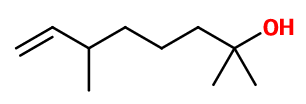
Dihydromyrcenol
Floral > Fresh Flowers > Rosy > Zesty
2,6-dimethyloct-7-en-2-ol ; DHM ; Dihydro myrcenol ; Dihydromyrcenate ; 2,6-dimethyloct-7-enol ; Floralym ; Lymolene ; Myrcetol


Photo credits: ScenTree SAS
| Company | Ingredient Name | Learn more | Naturality | Certifications | MOQ | Purity |
|---|---|---|---|---|---|---|
|
DIHYDROMYRCENOL
DI-1
|
Discover | - | 10 grs | 99.5 - 100 | |

|
DIHYDROMYRCENOL
938621
|
Discover | Molecules |


|
- | - |

|
Dihydromyrcenol - 30 Gr | Discover | - | 30grs | - | |

|
Dihydromyrcenol | Discover | Synthetic Aroma Chemicals | - | - |
DI-1

938621

General Presentation
-
CAS N° :
18479-58-8 -
EINECS number :
242-362-4 -
FEMA number :
Donnée indisponible. -
FLAVIS number :
2,144
-
JECFA number :
Donnée indisponible. -
Volatility :
Heart -
Price Range :
€€
Physico-chemical properties
-
Appearance :
Colorless liquid -
Density :
0,784 -
Refractive Index @20°C :
1,443 -
Optical rotation :
Donnée indisponible. -
Vapor pressure :
0,165 mmHg @25°C -
Flash Point :
77°C (170,6°F)
-
Molecular formula :
C10H20O -
Molecular Weight :
156,27 g/mol -
Log P :
3,25 -
Fusion Point :
Donnée indisponible. -
Boiling Point :
196°C (384,3°F) -
Detection Threshold :
Donnée indisponible.
Chemistry & Uses
Uses in perfumery :
Dihydromyrcenol is used in zesty and fougere accords, and to give a fresh nuance to fruity notes.
Year of discovery :
1956
Natural availability :
Dihydromyrcenol is very poorly present in nature. It is therefore in most cases the synthetic version that is used in perfumery.
Isomerism :
Dihydromyrcenol has an asymmetric carbon. However, it is the racemic mixture of the two enantiomers that is used in perfumery. Citronellol and Rosalava are constitutional isomers of Dihydromyrcenol. Both also have a rosy smell, more lemony for Citronellol and more intense for Rosalva®.
Synthesis precursor :
Dihydromyrcenol is an intermediary in the synthesis of Tetrahydromyrcenol and a reagent in the synthesis of Dihydromyrcenyl acetate and other esters of this alcohol.
Synthesis route :
The synthesis of Dihydromyrcenol starts from cis-pinane, which is pyrolyzed to give an intermediate product called Citronellene. To obtain Dihydromyrcenol, the process can be achieved in three different ways : the first one is to put hydrochloric acid in contact with Citronellene, followed by a hydrolysis. The second is the addition of formic acid to saponify the resulting Dihydromyrcenyl Formate. The last one is a direct acid hydrolysis in the presence of sulfuric acid.
Stability :
Terpenes tend to polymerize by oxydation.
Other comments :
Comparing it with Dimethyl Benzyl Carbinol and Dimetol®, Dihydromyrcenol has a more zesty note, reminiscent of numerous masculine perfumes.
Labelling
Allergens :
This ingredient does not contain any allergen.
Signal word :
Warning
Hazard pictograms :
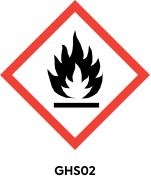
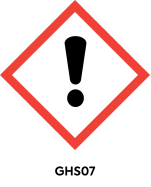
Precautionary statements :
| HAZARD | PRECAUTION |
|---|---|
| H227 Highly flammable liquid and vapour. H319 Causes serious eye irritation. |
P210 Keep away from heat, hot surfaces, sparks, open flames and other ignition sources. No smoking. P264 Wash ... thoroughly after handling. P280 Wear protective gloves/protective clothing/eye protection/face protection. P305 + P351 + P338 IF IN EYES: Rinse cautiously with water for several minutes. Remove contact lenses, if present and easy to do. Continue rinsing. P337 + P313 If eye irritation persists: Get medical advice/attention. P370 + P378 In case of fire: Use dry sand, dry chemical powder, or alcohol-resistant foam to extinguish the fire. P403 + P235 Store in a well-ventilated place. Keep cool. |
IFRA
IFRA 51th :
This ingredient is not restricted for the 51th amendment