











Photo credits: ScenTree SAS
Citronellal
Citrus > Citric > Green > Zesty
3,7-dimethyloct-6-enal ; Dihydrocitral ; 3,7-dimethyloct-6-en-1-al ; Rhodinal


Photo credits: ScenTree SAS
| Company | Ingredient Name | Learn more | Naturality | Certifications | MOQ | Purity |
|---|---|---|---|---|---|---|

|
Citronellal Natural 85%+
CT-101
|
Discover | Natural |


|
800 Kgs | 85 |
|
|
Citronellal Natural 95%+
CT-103
|
Discover | Natural |
|
720 Kgs | 95 |
|
|
Citronellal Natural 90%+
CT-102
|
Discover | Natural |
|
800 Kgs | 90 |

|
Natural Citronellal | Discover | Natural |
|
- | - |

|
CITRONELLAL
CITALL-1
|
Discover | - | 10 grs | - | |

|
Citronellal - 30gr | Discover | - | 30grs | - | |
|
Citronellal
30035052
|
Discover | Molecule | - | - | |
|
|
Citronellal BMBcert™
30786642
|
Discover | Molecule | - | - | |

|
Citronellal | Discover | Synthetic Aroma Chemicals | - | - |
CT-101

CT-103
CT-102
CITALL-1
30035052
30786642

General Presentation
-
CAS N° :
106-23-0 -
EINECS number :
203-376-6 -
FEMA number :
2307 -
FLAVIS number :
5,021
-
JECFA number :
1220 -
Volatility :
Head/Heart -
Price Range :
€€
Physico-chemical properties
-
Appearance :
Colorless liquid -
Density :
0,857 -
Refractive Index @20°C :
1,446 - 1,456 -
Optical rotation :
Donnée indisponible. -
Vapor pressure :
0,120 mmHg @20°C -
Flash Point :
86°C (186,8°F)
-
Molecular formula :
C10H18O -
Molecular Weight :
154,25 g/mol -
Log P :
3,62 -
Fusion Point :
Donnée indisponible. -
Boiling Point :
207°C (404,6°F) -
Detection Threshold :
Entre 31 et 100 ppb (0,00001%) selon les personnes
Chemistry & Uses
Uses in perfumery :
Citronellal is used in lemon and lemongrass reproductions and for a citral and fresh effect in citrus notes. Can be used in rosy notes.
Year of discovery :
Discovered in 1889.
Natural availability :
The essential oils most commonly used to collect Citronellal in its natural state are Lemongrass EO (up to 45%) or Eucalyptus citriodora (up to 80%). The addition of bisulfite salts improves the purity of the extraction.
| Ingredient | % min | % max |
|---|---|---|
| Citronella oil (Ceylon type) | 3 | 6 |
| Citronella oil (Java type) | 31 | 40 |
| Coriander seed oil | 2 | |
| Litsea cubeba oil | 1.50 |
Isomerism :
Citronellal has an asymmetric carbon that gives rise to two enantiomers. Both isomers have a rather similar smell, although they are not necessarily present in the same plants. Usually, it is the racemic mixture of the two isomers that is used in perfumery. Eucalyptol, Geraniol and Linalool are examples of constitutional isomers of Citronellal. Their smell is however very different, as it is more floral and camphorated for Eucalyptol.
Synthesis precursor :
Citronellal is a precursor to the synthesis of many other perfume compounds. Depending on the catalyst, its hydrogenation enables the obtention of Citronellol, dihydrocitronellal or dihydrocitronellol. An acid hydrolysis allows to synthesize Hydroxycitronellal. Cyclizing the molecule by acid catalysis also allows to obtain Pulegol, a precursor for the synthesis of L-Menthol. Finally, Citronellal forms a Schiff base by reaction with Methyl Anthranilate or Indole for example.
Synthesis route :
The synthesis of citronellal is made in several possible ways. The first is from Geraniol and Nerol: a rearrangement of these molecules in the presence of a catalyst that contains oxides of copper, chromium and barium allows to obtain Citronellal as final product. Citronellol, dehydrogenated under reduced pressure, in the presence of a bichromated copper steel catalyst, also allows to obtain Citronellal. The third possibility is a Citral hydrogenation catalysed by palladium.
Stability :
Aldehydes may form diethylacetals in alcoholic perfumes, with no real impact on their smell.
Terpenes tend to polymerize by oxydation.
Other comments :
Citronellal is one of the 26 allergens in perfumery.
Labelling
Allergens :
This ingredient does not contain any allergen.
Signal word :
Warning
Hazard pictograms :
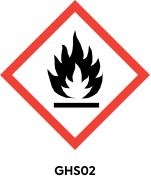

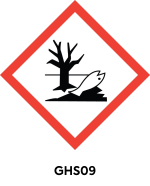
Precautionary statements :
| HAZARD | PRECAUTION |
|---|---|
| H227 Highly flammable liquid and vapour. H302 Harmful if swallowed. H315 Causes skin irritation. H317 May cause an allergic skin reaction. H319 Causes serious eye irritation. H335 May cause respiratory irritation. H411 Toxic to aquatic life with long lasting effects. |
P210 Keep away from heat, hot surfaces, sparks, open flames and other ignition sources. No smoking. P261 Avoid breathing dust/fume/gas/mist/vapours/spray. P264 Wash ... thoroughly after handling. P270 Do no eat, drink or smoke when using this product. P271 Use only outdoors or in a well-ventilated area. P272 Contaminated work clothing should not be allowed out of the workplace. P273 Avoid release to the environment. P280 Wear protective gloves/protective clothing/eye protection/face protection. P301 + P312 IF SWALLOWED: Call a POISON CENTER/doctor/… if you feel unwell. P302 + P352 IF ON SKIN: Wash with plenty of water/… P305 + P351 + P338 IF IN EYES: Rinse cautiously with water for several minutes. Remove contact lenses, if present and easy to do. Continue rinsing. P330 Rinse mouth. P333 + P313 If skin irritation or rash occurs: Get medical advice/attention. P337 + P313 If eye irritation persists: Get medical advice/attention. P362 Take off contaminated clothing. P370 + P378 In case of fire: Use dry sand, dry chemical powder, or alcohol-resistant foam to extinguish the fire. P391 Collect spillage. P403 Store in a well-ventilated place.05 Store locked up. P403 + P233 Store in a well-ventilated place. Keep container tightly closed. P403 + P235 Store in a well-ventilate P501 Dispose of contents/container to… |
IFRA
IFRA 51th :
This ingredient is restricted by the 51th amendment

-
Restriction type :
RESTRICTION -
Cause of restriction :
DERMAL SENSITIZATION AND SYSTEMIC TOXICITY -
Amendment :
49
Quantitative limit on the use :
| Cat.1 | Cat.2 | Cat.3 | Cat.4 |
Cat.5
A
B
C
D
|
Cat.6 | |||
|---|---|---|---|---|---|---|---|---|
| 0,41 % | 0,16 % | 0,026 % | 0,49 % |
0,33 %
0,051 %
0,1 %
0,017 %
|
||||
|
Cat.5
A
B
C
D
|
Cat.6 | |||||||
|
0,33 %
0,051 %
0,1 %
0,017 %
|
0,82 % | |||||||
|
Cat.7
A
B
|
Cat.8 | Cat.9 |
Cat.10
A
B
|
Cat.11
A
B
|
Cat.12 | |||
|
0,077 %
0,077 %
|
0,017 % | 1,4 % |
1,4 %
2,3 %
|
0,017 %
0,017 %
|
||||
|
Cat.10
A
B
|
Cat.11
A
B
|
Cat.12 | ||||||
|
1,4 %
2,3 %
|
0,017 %
0,017 %
|
No Restriction | ||||||
Annexe I :
Some regulated synthetic ingredients are found in nature and in certain proportions in natural ingredients. This presence in nature has to be taken into account when calculating limits of use recommended by the IFRA. In case you do not know these concentrations, you can use the ones estimated by the IFRA. Here they are :
| List of regulated compounds contained in this ingredient | |||
|---|---|---|---|
| Ingredient Name | Botanical Name | CAS N° | Estimated Concentration |
| Citron oil | Citrus medica L. | 68991-25-3 | 0,15 |
| Lemon essence oil | Citrus limon (L.) Osbeck | 8008-56-8 | 0,06 |
| Lemon oil steam distilled | Citrus limon (L.) Osbeck | 8008-56-8 | 0,07 |
| Lemon oil, expressed | Citrus limon (L.) Burm. f. | 8008-56-8 | 0,1 |
| Lemon oil, terpeneless | Citrus limon (L.) Osbeck | 68648-39-5 | 3 |
| Citronella oil, Ceylon type | Cymbopogon nardus (L.) Rendle | 8000-29-1 | 4,5 |
| Citronella oil, Java type | Cymbopogon winterianus Jowitt | 8000-29-1 | 36 |
| Eucalyptus citriodora oil | Corymbia citriodora (Hook.) K.D. Hill & L.A. Johnson | 85203-56-1 | 71,77 |
| Geranium oil | Pelargonium graveolens l'Hertier ex Aiton | 8000-46-2 | 0,15 |
| Ginger oil | Zingiber officinale Rosc. | 8007-08-7 | 0,4 |
| Lemongrass oil, East Indian | Cymbopogon flexuosus (Nees ex Steudel) Will. Watson | 8007-02-1 | 0,51 |
| Lemongrass oil, West Indian | Cymbopogon citratus (DC) Stapf. | 8007-02-1 | 0,3 |
| Lime oil, expressed | Citrus aurantifolia (Christman) Swingle | 8008-26-2 | 0,5 |
| Persian lime oil, expressed | Citrus latifolia Tanaka | 8008-26-2 | 1,39 |
| Litsea cubeba oil | Litsea Cubeba(Lour.) Pers. | 68855-99-2 | 1,1 |
| Balm oil | Melissa officinalis L. | 8014-71-9 | 6,88 |
| Grapefruit essence oil | Citrus x paradisi Macfad. | 8016-20-4 | 0,07 |
| Grapefruit oil | Citrus paradisi Macf. | 8016-20-4 | 0,1 |
| Grapefruit oil | Citrus x paradisi Macfad. | 8016-20-4 | 0,1 |
| Grapefruit oil, terpeneless | Citrus x paradisi Macfad. | 68916-46-1 | 3,2 |
| Grapefruit oil terpenes | Citrus x paradisi Macfad. | 68917-32-8 | 0,01 |
| Petitgrain bigarade oil | Citrus aurantium L. spp. Amara Link | 8014-17-3 | 0,05 |
| Petitgrain mandarin oil | Citrus reticulata Blanco | 8014-17-3 | 0,05 |
| Petitgrain lemon oil | Citrus limon (L.) Burm. f. | 8048-51-9 | 1 |
| Rose oil | Rosa x damascena Mill. | 8007-01-0 | 0,51 |
| Tangerine oil | Citrus reticulata blanco | 8016-85-1 | 0,1 |
| Citrus hystrix extract | Citrus hystrix DC | 91771-50-5 | 11,7 |
| Clementine oil | Citrus clementina Hort. Ex Tan | 93686-22-7 | 0,1 |
| Murcote oil, expressed | Citrus reticulata spp. murcote, Swingle | 93686-22-7 | 0,1 |
| Tangor oil, expressed | Citrus reticulata x Citrus sinensis | 93686-22-7 | 0,1 |
| Kumquat oil, Fortunella margarita | Fortunella (Lour.) Swingle | 938464-05-2 | 3 |
| Meyer lemon oil. cold pressed | Citrus x meyerii | 1370641-98-7 | 0,2 |
| Tangelo oil, expressed | Citrus x tangelo Ingram and Moore | 72869-73-9 | 0,1 |
Disclaimer :
ScenTree is solely responsible for the information provided here.
To learn more about IFRA's standards : https://ifrafragrance.org/safe-use/library