













Citronella oil (Java type)
Floral > Rosy > Geranium > Citric


| Company | Ingredient Name | Learn more | Naturality | Certifications | MOQ | Latin name | Treated part | Origin |
|---|---|---|---|---|---|---|---|---|

|
CITRONNELLE DE JAVA
B306F
|
Discover | Huile essentielle |

|
- | Cymbopogon winterianus Jowitt | Feuille | Ouganda |
|
|
CITRONNELLE DE JAVA
B305
|
Discover | Huile essentielle |
|
- | Cymbopogon winterianus Jowitt | Feuille | Paraguay |
|
|
CITRONNELLE DE JAVA
B301
|
Discover | Huile essentielle |
|
- | Cymbopogon winterianus Jowitt | Feuille | Indonésie |

|
Citronella Oil | Discover | Natural |


|
- | Cymbopogon winterianus | Leaves | Indonesia |

|
Citronella Oil Javatype | Discover | Essential Oils | - | - | - | - |
B306F

B305
B301

General Presentation
-
CAS N° :
8000-29-1 -
EINECS number :
294-954-7 -
FEMA number :
2308
-
Volatility :
Heart -
Price Range :
€
Physico-chemical properties
-
Appearance :
Yellow to pale yellow liquid -
Density :
0,880 - 0,902 @20°C -
Refractive Index @20°C :
1,466 - 1,477 @20°C -
Optical rotation :
-5° // +1° -
Vapor pressure :
Donnée indisponible. -
Flash Point :
Donnée indisponible. -
Acid Value :
Botanical informations
Botanical name :
Botanical profile :
Citronella is a herbaceous plant belonging to the Poaceae family and the Cymbopogon Spreng. genus, like lemongrass and palmarosa essential oils.
Chemotypes :
The genus Cymbopogon Spreng (the latin name is coming from the Greek kymbe, meaning boat, and pogon, meaning beard) includes nearly 75 species. Below is a list of the species used in perfumery.
Citronellas:
- Cymbopogon nardus (L.) Rendle - Citronella Ceylan EO, mainly found in Sri Lanka
- Cymbopogon winterianus Jowitt - Citronella Java EO, mainly found in Indonesia
- Cymbopogon pendulus (Nees ex Steud.) W.Watson - Citronella Jammu EO, mainly found in India
Lemongrass:
- Cymbopogon citratus (DC.) Stapf - West Indian lemongrass EO
- Cymbopogon flexuosus (Nees ex Steud.) W. Watson - East Indian lemongrass EO
Palmarosa:
- Cymbopogon martini (Roxb.) J.F. Wats. - Palmarosa EO, mainly found in India, Indonesia, and Brazil. Its scent is more rosy than the other species, notably due to its high concentration of geraniol.
Extractions & Uses
Extraction process :
Data not available.
Uses in perfumery :
Citronella Java essential oil, with its darker, woody, and dense profile, offers a distinct character compared to Citronella Ceylon EO. It finds application in the creation of aromatic blends, colognes, and watery/fruity notes. Also, it is valued for its insect-repellent properties in mosquito repellents.
Stability :
Data not available.
Major Components :
| Component | % min | % max |
|---|---|---|
| Citronellal | 31 | 40 |
| Geraniol | 20 | 25 |
| dl-Citronellol | 8.50 | 14 |
| Geranyl acetate | 2.50 | 5.50 |
| D-Limonene | 2 | 5 |
| DL-citronellyl acetate | 2 | 4 |
| D-germacrene | 1.50 | 3 |
| Gamma-cadinène | 1.50 | 2.50 |
| Elemol | 1.30 | 4.80 |
| Beta-elemene | 0.70 | 2.50 |
| Isopulegol | 0.50 | 1.70 |
| Linalool | 0.50 | 1.50 |
| Eugenol | 0.50 | 1 |
| Geranial | 0.30 | 1 |

Photo credits: ScenTree SAS
Other comments :
Data not available.
Labelling
Allergens :
This ingredient does not contain any allergen.
Signal word :
Danger
Hazard pictograms :

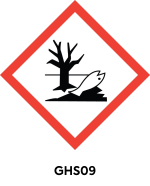
Precautionary statements :
| HAZARD | PRECAUTION |
|---|---|
| H318 Causes serious eye damage.
H411 Toxic to aquatic life with long lasting effects. |
IFRA
IFRA 51th :
This ingredient is not restricted for the 51th amendment