












Photo credits: ScenTree SAS
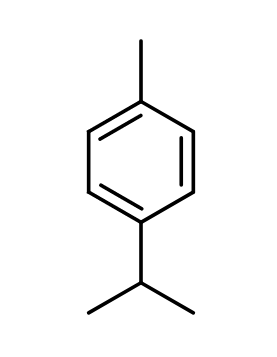
p-Cymene
Citrus > Zesty > Terpenic > Mandarin
4-cymene ; 1-isopropyl-4-methylbenzene ; 1-methyl-4-isopropylbenzene ; 4-isopropyltoluene ; p-Isopropyltoluene; para-isopropyltoluene ; 4-cymol ; Cumene ; Camphogen ; Cymol ; p-Cymol , p-cymène , Cymene ; Dolcymene


Photo credits: ScenTree SAS
| Company | Ingredient Name | Learn more | Naturality | Certifications | MOQ | Purity |
|---|---|---|---|---|---|---|
|
PARACYMENE
PARAC-1
|
Discover | - | 10 grs | 95.0 - 100.0 | |

|
PARACYMENE PERF
970354
|
Discover | Molecules |

|
- | - |

|
Paracymene | Discover | Synthetic Aroma Chemicals | - | - | |
|
|
Paracymene natural | Discover | Natural Aroma Chemicals | - | - |
PARAC-1

970354

General Presentation
-
CAS N° :
99-87-6 -
EINECS number :
202-796-7 -
FEMA number :
2356 -
FLAVIS number :
1,002
-
JECFA number :
1325 -
Volatility :
Head -
Price Range :
€
Physico-chemical properties
-
Appearance :
Colorless liquid -
Density :
0,855 - 0,860 @20°C 0,852 - 0,857 @25°C -
Refractive Index @20°C :
1,488 - 1,492 @20°C 1,486 - 1,490 @25°C -
Optical rotation :
Donnée indisponible. -
Vapor pressure :
2,700 mmHg @25°C -
Flash Point :
44°C (111,2°F)
-
Molecular formula :
C10H14 -
Molecular Weight :
134,22 g/mol -
Log P :
4,7 -
Fusion Point :
Donnée indisponible. -
Boiling Point :
176°C (348,8°F) -
Detection Threshold :
Donnée indisponible.
Chemistry & Uses
Uses in perfumery :
Year of discovery :
Data not available.
Natural availability :
Paracymene is found in a very large number of oils. It is one of the most important terpenes in perfumery. It is therefore possible to find this ingredient in its natural state as well as in the overwhelming majority of current chromatography.
| Ingredient | % min | % max |
|---|---|---|
| Angelica root oil | 6 | |
| Citron oil | 1 | |
| Lemon oil (expressed) (Usa (Coast)) | 0.05 | 0.35 |
| Lemon oil (expressed) (Usa (Desert)) | 0.01 | 0.35 |
| Lemon oil (expressed) (Spain) | 0.40 | |
| Lemon oil (expressed) (Italia) | 0.05 | 0.35 |
| Lemon oil (expressed) (Ivory Coast / Brazil) | 0.05 | 0.35 |
| Cumin seed oil | 3 | 17 |
| Eucalyptus globulus oil | 1 | 2 |
| Eucalyptus globulus oil rectified (70-75% Folded) | 1 | 6 |
| Eucalyptus globulus oil rectified (80-85% Folded) | 1 | 4 |
| Lime oil distilled | 6 | |
| Myrrh resinoid | 5 | |
| Origanum oil | 4 | 10 |
| Petitgrain mandarin oil | 4 | 6 |
| Rosemary oil (Marocco & Tunisia) | 0.50 | 2.50 |
| Rosemary oil (Spain) | 1 | 2 |
| Thyme oil (red) (CT Thymol) | 5 | 15 |
| Sichuan pepper absolute | 1 | 5 |
| Eucalyptus PURE JUNGLE ESSENCE™ | ||
| Forest Pepper PURE JUNGLE ESSENCE™ | 5 | 10 |
| Zygis thyme oil | 14 | 28 |
Isomerism :
Paracymene is the most common isomer, however, orthocymene and metacymene also exist in smaller amounts. They are not widely used in perfumery.
Synthesis precursor :
p-cymene is as a starting material for p-cresol production via the Hock-Lange synthesis pathway La tonalide® aussi first cyclialkylated with neohexene followed by acetylation of the resulting tetralin Acetophenone - Par condensing cymene with acetyl chloride in the presence of AlCl3 Gamma-terpinene - from p-cymene by the action of sodium and alcohol in liquid ammonia. Moskene resulted from condensing p-cymene with i-butyl alcohol in the presence of sulfuric acid and nitrating the resulting product (Barbier, 1932) The first reported "the active odor principle" of Phantolid was outlined for the reaction of ί-amyl alcohol and cymene in the presence of sulfuric acid (Weber et al, 1955) - Process remplacé par un autre + optimisé
Synthesis route :
It has been described that cymene can be produced by alkylation of toluene with either propylene or isopropyl alcohol. Methods for direct conversion of terpenes into cymene have also been described. These methods include for example conversion by acidic clays, oxidation with Cr(VI) compounds and transition metal based reactions. Vapour reactions using pure terpenes and Pd catalysts or Zn/Cr catalysts have been reported.
Stability :
Data not available.
Other comments :
The quality featured here is a quality containing 100% renewable carbon.
Labelling
Allergens :
This ingredient does not contain any allergen.
Signal word :
Danger
Hazard pictograms :
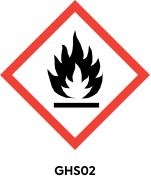
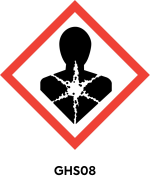
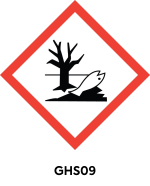

Precautionary statements :
| HAZARD | PRECAUTION |
|---|---|
| H226 Flammable liquid and vapour.
H304 May be fatal if swallowed and enters airways. H331 Toxic if inhaled. H411 Toxic to aquatic life with long lasting effects. |
IFRA
IFRA 51th :
This ingredient is not restricted for the 51th amendment