











Cumin seed oil
Spicy > Warm Spices > Dry Woods > Anisic
Cuminum cyminum L.
Synonyms : Cuminum odorum Salisb. // Cuminum officinale Garsault


| Company | Ingredient Name | Learn more | Naturality | Certifications | MOQ | Latin name | Treated part | Origin |
|---|---|---|---|---|---|---|---|---|

|
CUMIN
E7187
|
Discover | Huile essentielle |

|
- | Cuminum cyminum L | Graine | Egypte, Turquie |
|
CUMIN EO
CUHE-1
|
Discover | Naturel | 10 grs | - | - | - | |

|
Huile essentielle de Cumin - 30 gr | Discover | - | 30grs | - | - | - | |

|
Cumin Seed Oil | Discover | Essential Oils | - | - | - | - |
E7187

CUHE-1

General Presentation
-
CAS N° :
8014-13-9 -
EINECS number :
84775-51-9 -
FEMA number :
2343
-
Volatility :
Heart -
Price Range :
€€€
Physico-chemical properties
-
Appearance :
Pale yellow liquid -
Density :
0,900 - 0,940 @20°C -
Refractive Index @20°C :
1,490 - 1,515 @20°C -
Optical rotation :
+1° // +12° -
Vapor pressure :
Donnée indisponible. -
Flash Point :
Donnée indisponible. -
Acid Value :
Botanical informations
Botanical name :
Cuminum cyminum L.
Synonyms : Cuminum odorum Salisb. // Cuminum officinale Garsault
Botanical profile :
Cumin is a plant of the Apiaceae family and the genus Cuminum L.
The Apiaceae family includes a large number of spices, such as angelica, caraway, cumin, as well as dill, anise, and fennel.
Chemotypes :
In addition to Cuminum cyminum L., which is true cumin, there is a very little cultivated variety called Cuminum setifolium L.
Extractions & Uses
Extraction process :
Cumin grows in a warm and sunny climate on a well-drained soil.
The planting of cumin is done in early spring (April), flowering in summer and the harvest is done in early autumn. At maturity, the fruits of the plant become dry, brown and had a particular scent. Inside, the egg-shaped seed is collected and used for perfumery.
The seed is dried and extracted by steaming. At the end of the process, the essential oil is collected in a essencier by decantation with a yield of about 3%.
Uses in perfumery :
Used in woody, spicy, fougere and leather notes for a sensual effect. Mixed with oriental and floral-powdery notes for women's perfumes.
Stability :
Cuminaldehyde can form diethylacetals in stability tests, without modifying the raw material’s smell
The terpenes identified in this raw material can polymerize when they are oxidized
Major Components :
| Component | % min | % max |
|---|---|---|
| Cuminaldehyde | 15 | 46 |
| Gamma-Terpinene | 14 | 32 |
| Beta-pinene | 7 | 20 |
| p-Cymene | 3 | 17 |
| p-Mentha-1,3-dièn-7-al | 2.80 | 22 |
| p-Mentha-1,4-dièn-7-al | 1.50 | 16 |
| Alpha-phellandrene | 2.50 | |
| Alpha-pinene | 0.30 | 2 |
| Beta-phellandrene | 0.20 | 0.50 |
| D-Limonene | 0.20 | 0.50 |
| Myrcene | 0.10 | 1.50 |
| Alpha-Terpinene | 0.10 | 0.30 |
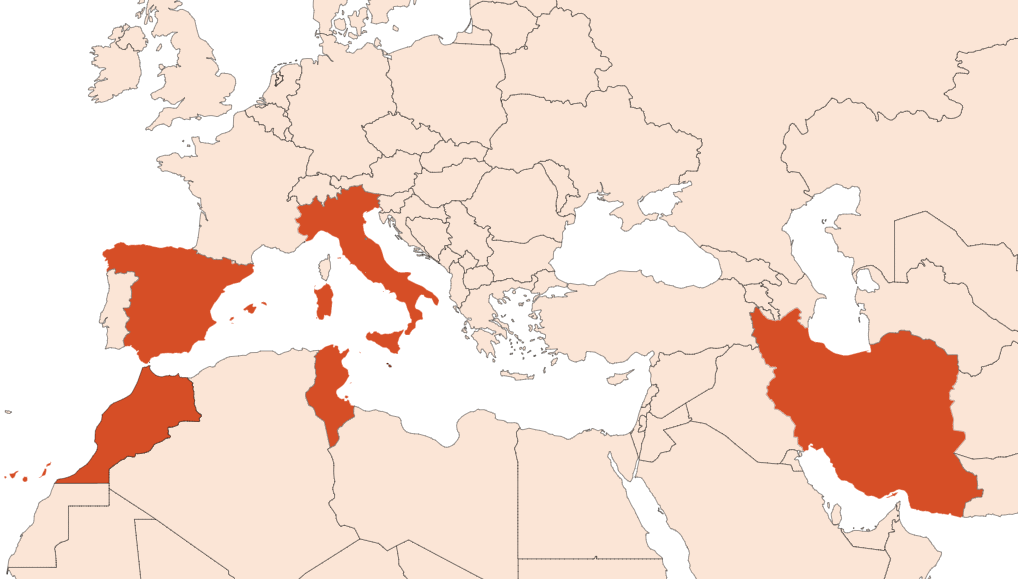
Photo credits: ScenTree SAS
Other comments :
Although generally called "seed", the cumin part that is used is actually a fruit. Actually, this part of the plant is composed of the seed and its pericarp.
In Iran, it is possible to observe a production of cumin water, obtained by distillation of crushed fruits.
The essential oil of cumin is the main source of natural Cuminaldehyde, precursor in the synthesis of Mayol®, with the smell of lily of the valley. The content of aromatic aldehydes is one of the quality markers of the EO which must be between 40 and 52%. This ingredient is often confused with caraway because of their great visual similarities.
Cumin is the main curry spice, accompanied by ginger, coriander, cinnamon, pepper, fenugreek, bay, black pepper, cardamom, clove, mustard seeds and nutmeg.
Although generally called "seed", the cumin part that is used is actually a fruit. Actually, this part of the plant is composed of the seed and its pericarp.
In Iran, it is possible to observe a production of cumin water, obtained by distillation of crushed fruits.
The essential oil of cumin is the main source of natural Cuminaldehyde, precursor in the synthesis of Mayol®, with the smell of lily of the valley. The content of aromatic aldehydes is one of the quality markers of the EO which must be between 40 and 52%. This ingredient is often confused with caraway because of their great visual similarities.
Cumin is the main curry spice, accompanied by ginger, coriander, cinnamon, pepper, fenugreek, bay, black pepper, cardamom, clove, mustard seeds and nutmeg.
Labelling
Allergens :
Signal word :
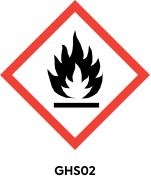
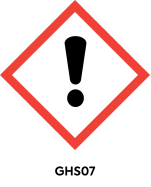
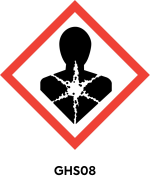
Danger
Hazard pictograms :
Precautionary statements :
| HAZARD | PRECAUTION |
|---|---|
| H226 Flammable liquid and vapour.
H304 May be fatal if swallowed and enters airways. H315 Causes skin irritation. H317 May cause an allergic skin reaction. H412 Harmful to aquatic life with long lasting effects. |
P210 Keep away from heat, hot surfaces, sparks, open flames and other ignition sources. No smoking. P233 Keep container tightly closed. P241 Use explosion-proof [electrical/ventilating/lighting/…] equipment. P242 Use non-sparking tools. P243 Take action to prevent static discharges. P261 Avoid breathing dust/fume/gas/mist/vapours/spray. |
IFRA
IFRA 51th :
This ingredient is restricted by the 51th amendment

-
Restriction type :
RESTRICTION -
Cause of restriction :
PHOTOTOXICITY -
Amendment :
49
Quantitative limit on the use :
| Cat.1 | Cat.2 | Cat.3 | Cat.4 |
Cat.5
A
B
C
D
|
Cat.6 | |||
|---|---|---|---|---|---|---|---|---|
| 0,4 % | 0,4 % | 0,4 % | 0,4 % |
0,4 %
0,4 %
0,4 %
0,4 %
|
||||
|
Cat.5
A
B
C
D
|
Cat.6 | |||||||
|
0,4 %
0,4 %
0,4 %
0,4 %
|
0,4 % | |||||||
|
Cat.7
A
B
|
Cat.8 | Cat.9 |
Cat.10
A
B
|
Cat.11
A
B
|
Cat.12 | |||
|
No Restriction
0,4 %
|
0,4 % | No Restriction |
No Restriction
0,4 %
|
No Restriction
0,4 %
|
||||
|
Cat.10
A
B
|
Cat.11
A
B
|
Cat.12 | ||||||
|
No Restriction
0,4 %
|
No Restriction
0,4 %
|
No Restriction | ||||||
Annexe I :
Some regulated synthetic ingredients are found in nature and in certain proportions in natural ingredients. This presence in nature has to be taken into account when calculating limits of use recommended by the IFRA. In case you do not know these concentrations, you can use the ones estimated by the IFRA. Here they are :
| List of regulated compounds contained in this ingredient | ||
|---|---|---|
| Regulated ingredient name | CAS N° | Estimated Concentration |
| Cuminaldehyde | 122-03-2 | 21 |
| p-Isopropylbenzyl alcohol | 536-60-7 | 0,2 |
Restricted ingredients due to phototoxicity considerations: notes
The Standard is set due to the phototoxic effects of Cumin oil. For more detailed information on the application of this Standard, please refer to the note on phototoxic ingredients in chapter 1 of the Guidance for the use of IFRA Standards.
If the level of furocoumarins is unknown, the restriction level specified in this IFRA Standard applies.
Combination effects of phototoxic ingredients are only taken into consideration for the furocoumarin-containing fragrance ingredients (extracts) listed in the IFRA Standard of Citrus oils and other furocoumarins containing essential oils.
If combinations of furocoumarin-containing phototoxic fragrance ingredients (extracts) are used, the use levels must be reduced accordingly. The sum of the concentrations of all furocoumarin-containing phototoxic fragrance ingredients (extracts), expressed in of their recommended upper concentration level in the consumer product shall not exceed 100.
Disclaimer :
ScenTree is solely responsible for the information provided here.
To learn more about IFRA's standards : https://ifrafragrance.org/safe-use/library