









Star anise oil
Herbal > Anisic > Warm Woods
Illicium verum Hook.fil.
Synonyms : llicium san-ki Perr. // Illicium stellatum Makino


| Company | Ingredient Name | Learn more | Naturality | Certifications | MOQ | Latin name | Treated part | Origin |
|---|---|---|---|---|---|---|---|---|

|
Star Anise Oil
SA-001
|
Discover | Natural |


|
50 Kgs | Illicium Verum | Seed | Indonesia |

|
ANIS ETOILE
B080
|
Discover | Huile essentielle |

|
- | Illicium verum Hook. f. | Graine | Vietnam |

|
Huile essentielle de Badiane - 30 Gr | Discover | - | 30grs | - | - | - | |

|
STAR ANISE Rectified Essential Oil
M_0020014
|
Discover | Naturel | - | - | - | - | |

|
Anise Seed Oil (China Star) | Discover | Essential Oils | - | - | - | - | |
|
|
Aniseed Terpenes | Discover | Synthetic Aroma Chemicals | - | - | - | - |
SA-001

B080
M_0020014

General Presentation
-
CAS N° :
8007-70-3 -
EINECS number :
283-872-7 -
FEMA number :
2094
-
Volatility :
Heart -
Price Range :
€€
Physico-chemical properties
-
Appearance :
Colorless liquid -
Density :
0,979 - 0,985 @20°C -
Refractive Index @20°C :
1,553 - 1,556 @20°C -
Optical rotation :
-2° // +2° -
Vapor pressure :
Donnée indisponible. -
Flash Point :
96°C (204,8°F) -
Acid Value :
Botanical informations
Botanical name :
Illicium verum Hook.fil.
Synonyms : llicium san-ki Perr. // Illicium stellatum Makino
Botanical profile :
Star anise is the fruit of the star anise tree, from the family of the Illicaceae and the genus Illicium L.
Chemotypes :
Illisium L. is a genus containing more than fifty species.
In the F&F industry, we only use Illicium verum Hook.fil.
Illicium anisatum L., also known as Japanese star anise, is a highly toxic species that is not cultivated for essential oil extraction or culinary purposes. However, it is used as incense in East Asian countries. This variety also contains safrole and eugenol, compounds not found in Illicium verum Hook.fil., which can be used to detect adulteration, for example.
Extractions & Uses
Extraction process :
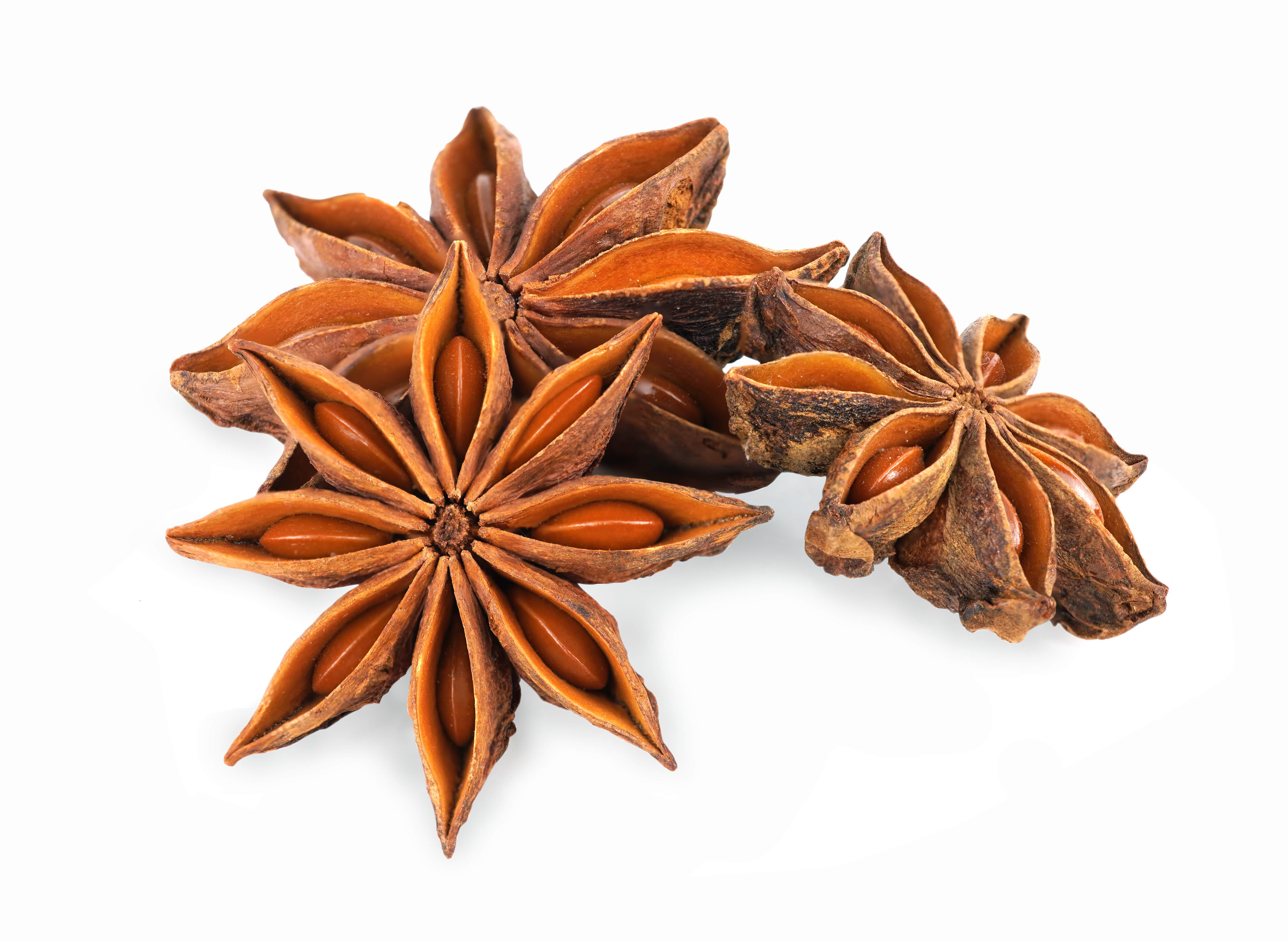
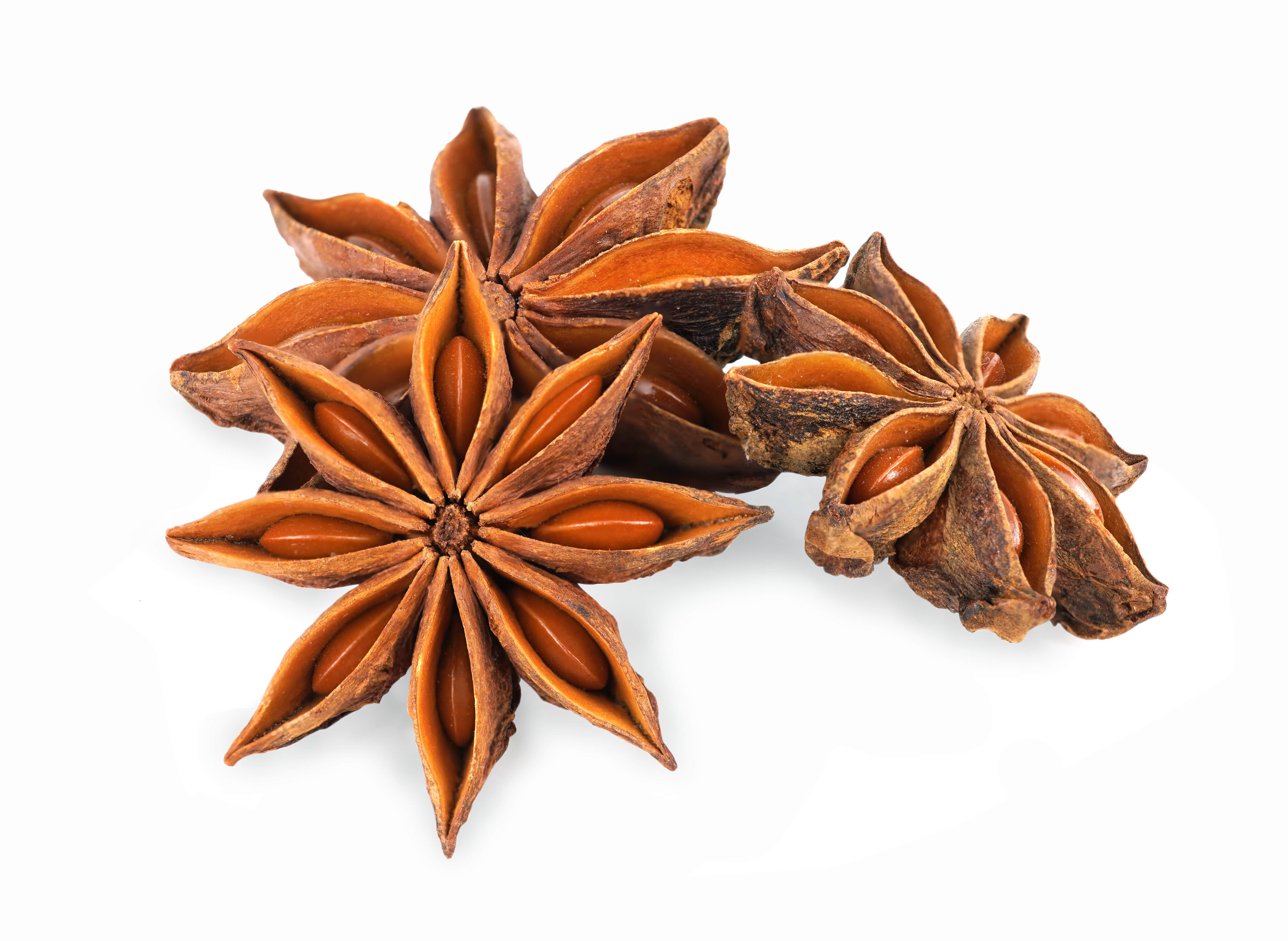
This spice is famous worldwide for its taste but also for its essential oil. It owes its name to its peculiar form consisting of a woody follicle with eight carpels, each containing a seed. The tree on which this star grows can reach 10 meters tall.
The propagation of a star anise crop is done by sowing seeds, directly visible in the fruits. The tree is cultivated outside of the field at first and planted in the field, every five meters, after three years of growth.
Harvests occur two to three times a year, in April and October. The fruits are usually picked green and sun-dried for 7 to 8 hours, until they become red-brown and lose 75% of their weight. The older the tree, the more important the harvest: a 15 year old tree can reach 20kg of fruit per year.
To collect the essential oil, seeds and bark (or seeds alone) are steam distilled for about : 48h for fresh fruits (yield: 2 to 4%) or 60h for dry fruits (yield: 8 to 9%).
Extraction can also be done with volatile solvents or with supercritical CO2 with a yield of about 10% but a higher quality of essential oil.
From the same botanical variety
Uses in perfumery :
Gives depth to fougere, citrus, aromatic and chypre notes. Also used in spicy bouquets, liquorice notes and to give naturalness to green notes.
Stability :
Aromatic compounds can be chromophoric and cause a coloration of the oil, especially in alkaline bases
The terpenes identified in this raw material can polymerize when they are oxidized
Major Components :
| Component | % min | % max |
|---|---|---|
| (E)-Anethole | 86 | 93 |
| Estragole | 0.60 | 6 |
| D-Limonene | 0.20 | 6 |
| Linalool | 0.20 | 2.50 |
| Foeniculine | 0.10 | 3 |
| Alpha-pinene | 0.10 | 1.50 |
| (Z)-Anethole | 0.10 | 1 |
| Beta-caryophyllene | 0.80 | |
| Alpha-phellandrene | 0.70 | |
| Anisic aldehyde | 0.10 | 0.50 |
| Alpha-Terpineol | 0.30 | |
| (E)-Alpha-bergamotene | 0.06 | 0.60 |
| (Z)-Alpha-bergamotene | 0.04 | 0.09 |
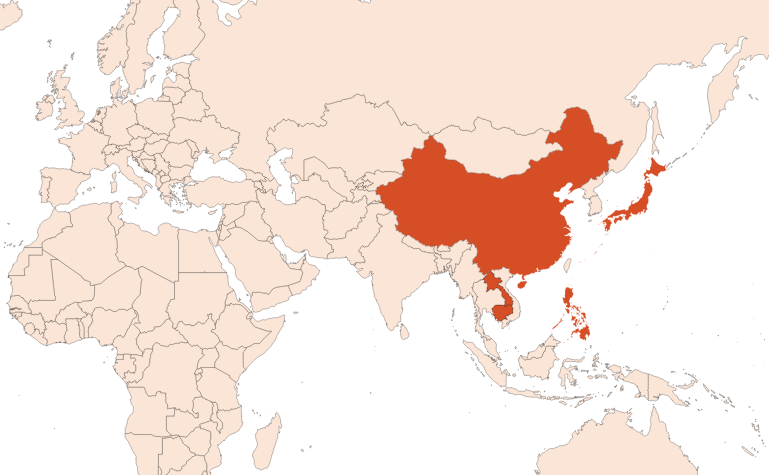
Photo credits: ScenTree SAS
Other comments :
Be careful, this plant is quite different from the green anise (Pimpenella anisum). They don't even have the same Order (Apiales from green anise, Austrobaileyales from star anise)
The essential oil of star anise is distinguished from the green anise oil by its Fenchone content.
The adulteration of the essential oil is possible by adding synthetic Anethole (less expensive) which is the essential oil of Japanese star anise (more toxic ...), although its use is highly regulated. Controls are made by chemical analysis to check its rate.
The essential oil of star anise is generally used to isolate the natural Anethole. The essential oil can be subjected to an ozonolysis process to remove anisaldehyde. In this operation, almost all the anethole included in the essential oil is converted to anisaldehyde.
Labelling
Allergens :
Signal word :
Warning
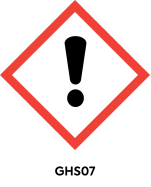
Hazard pictograms :

Precautionary statements :
| HAZARD | PRECAUTION |
|---|---|
| H317 May cause an allergic skin reaction.
H341 Suspected of causing genetic defects. H351 Suspected of causing cancer. H412 Harmful to aquatic life with long lasting effects. |
P201 Obtain special instructions before use. P202 Do not handle until all safety precautions have been read and understood. P261 Avoid breathing dust/fume/gas/mist/vapours/spray. P302 + P352 IF ON SKIN: Wash with plenty of water/… P405 Store locked up. P501 Dispose of contents/container to… |
IFRA
IFRA 51th :
This ingredient is not restricted for the 51th amendment