






Jasmine Grandiflorum absolute
Floral > White Flowers > Jasmine > Solar > Animalic
Jasminum grandiflorum L.
Synonyms : Jasmin aureum D.Don, 1825 // Jasminum floribundum f. decipiens DiCapua


| Company | Ingredient Name | Learn more | Naturality | Certifications | MOQ | Latin name | Treated part | Origin |
|---|---|---|---|---|---|---|---|---|
|
JASMIN
F1529
|
Discover | Absolue |

|
- | Jasminum grandiflorum L. | Fleur | Inde |
|
|
JASMIN
F1527
|
Discover | Absolue |
|
- | Jasminum grandiflorum L. | Fleur | Egypte |
|
|
JASMIN
506
|
Discover | Absolue | - | Jasminum grandiflorum L. | Fleur | Egypte | |
|
|
JASMIN
F1528A
|
Discover | Absolue | - | Jasminum grandiflorum L. | Fleur | Egypte, Inde, Maroc | |
|
JASMINE GRANDIFLORUM ABS 100% P&N
JHA-1
|
Discover | Naturel | 10 grs | - | - | - | |

|
JASMINE ABS
952146
|
Discover | Naturals | - | JASMINUM GRANDIFLORUM | - | - | |
|
|
JASMINE EGYPT ABS
952155
|
Discover | Naturals | - | JASMINUM GRANDIFLORUM | - | - | |

|
Absolue de Jasmin Grandiflorum - 30 gr | Discover | - | 30grs | - | - | - | |

|
JASMINE Absolute
M_0062454
|
Discover | Naturel | - | - | - | - | |
|
|
JASMINE Absolute France
M_0062454
|
Discover | Naturel | - | - | - | - | |
|
|
JASMINE Absolute India
M_0067359
|
Discover | Naturel | - | - | - | - | |

|
JASMINE ABSOLUTE
4410000021
|
Discover | Naturel | - | - | - | - | |

|
Jasmine Absolute Egyptian | Discover | Absolutes, Extracts, Oleoresins, Vegetable Oils | - | - | - | - | |
|
|
Jasmine Absolute Indian | Discover | Absolutes, Extracts, Oleoresins, Vegetable Oils | - | - | - | - | |

|
Jasmin Absolute | Discover | Absolute | - | - | - | - |
F1529

F1527
506
F1528A
JHA-1
952146
952155
M_0062454
M_0062454
M_0067359
4410000021

General Presentation
-
CAS N° :
8022-96-6 -
EINECS number :
282-993-5 -
FEMA number :
2598
-
Volatility :
Heart -
Price Range :
€€€€€
Physico-chemical properties
-
Appearance :
Orange liquid -
Density :
-
Refractive Index @20°C :
Donnée indisponible. -
Optical rotation :
-
Vapor pressure :
Donnée indisponible. -
Flash Point :
Donnée indisponible. -
Acid Value :
Botanical informations
Botanical name :
Jasminum grandiflorum L.
Synonyms : Jasmin aureum D.Don, 1825 // Jasminum floribundum f. decipiens DiCapua
Botanical profile :
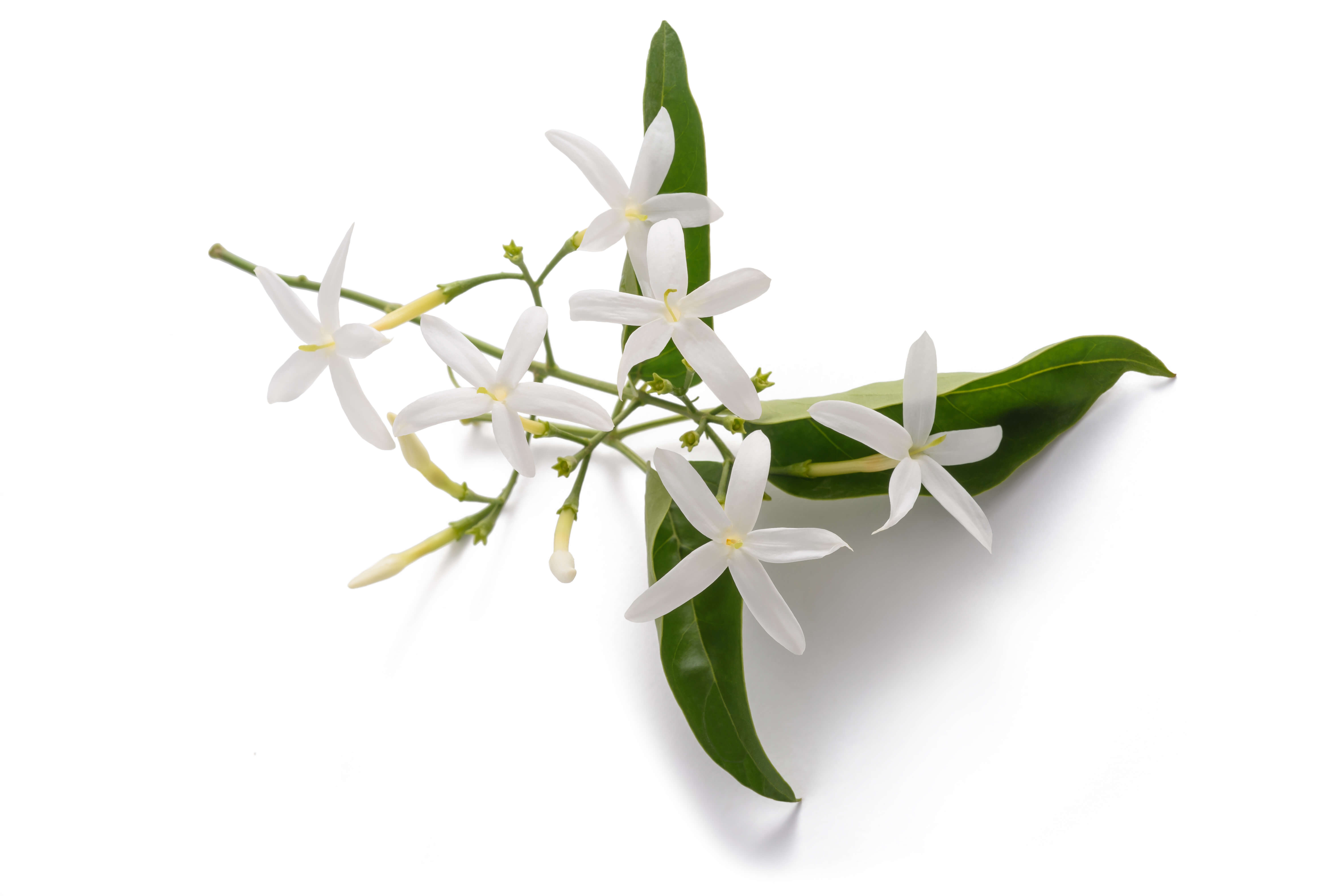
Jasminum, whether sambac, grandiflorum, or auriculatum, is a white-flowered shrub that can grow from 1 to 3 meters tall, often forming hedges in cultivated fields. It belongs to the Oleaceae family and the genus Jasminum L.
Chemotypes :
In perfumery, we use three species from the Jasminum L. genus :
- Jasminum grandiflorum L. (Jasmine Grandiflorum Absolute / Jasmine Grandiflorum Concrete) found for example in Grasse or Egypt.
- Jasminum sambac (L.) Aiton (Jasmine Sambac Absolute / Jasmine Sambac Concrete) mostly cultivated in India.
These two varieties are easily recognizable as grandiflorum has large and rounded flowers while those of sambac are thinner and longer.
- Jasminum auriculatum Vahl (Jasmine Auriculatum Absolute / Jasmine Auriculatum Concrete) mainly cultivated in India.
Extractions & Uses
Extraction process :
The iconic small white flowers of jasmine mainly bloom during the summer season. They are usually handpicked before dawn and quickly processed because of their fragility and quickly lose their scent. Harvest takes place from June to December, with plants aged between 3 to 10 years. On average, around 5-6 tons per hectare are harvested each year in India, compared to 10-15 tons per hectare in Egypt.
While enfleurage was the ancient extraction method, the most common technique today is solvent extraction, using hexane or petroleum ether. These methods yield to Jasmine Grandiflorum Concrete (yield ≈0.5% from fresh flowers) and, after glazing and filtering the waxes, Jasmine Grandiflorum Absolute (yield 50-70% from the concrete).
It is very rare for producers to work with Jasmine Grandiflorum EO as steam distillation is not efficient and the scent is mainly considered as uninteresting. However, there are CO2 supercritical extracts of Jasmine Grandiflorum, which provide better olfactory quality but at a higher cost. In recent years, the enfleurage processes has also been highlighted, although volumes are very low.
Uses in perfumery :
Used in combination with other flowers in a floral bouquet, or alone for a solar note and for its typicity. Its smell is most noticeable in gourmet perfumes, but less so in a fresh, floral scent.
Stability :
Solubility issues in perfumes
The esters identified in this raw material can form their corresponding acid in stability tests
Major Components :
- Benzyl acetate (40 - 65%)
- Linalool (8 - 10%)
- Farnesene (7 - 10%)
- Eugenol (5 - 8%)
- (Z)-jasmone (5 - 7%)
- Indole (4 - 7%)
- Benzyl benzoate (2 - 5%)
- (Z)-3-hexenyl benzoate (1 - 4%)

Photo credits: ScenTree SAS
Other comments :
Along with the rose, jasmine is one of the most emblematic flowers of perfumery.
Nowadays, the main producers are in Egypt or India. However, the city of Grasse, whose plant has in part made its reputation, continues to produce on a smaller scale. The cultivation of jasmine is also part of Grasse's know-how, classified as Intangible Cultural Heritage (ICH) by the UNESCO.
Jasmine extracts are certified 100% organic. This is mainly the case for its uses in aromatherapy.
In India, in the region of Coimbatore, 90% of the jasmine culture is dedicated to the production of extracts for perfumery. Other parts of the country grow jasmine for other purposes.
Usually, five hours of a picker's work gives an average of three to four kilograms of jasmine. Given the hard work required by this crop, the land rarely exceeds more than half a hectare of surface.
Jasmine cultivation is not subject to the use of pesticides and fertilizers to accelerate plant growth.
In Egypt, jasmine is the second largest source of agricultural income. In non-cultivation periods, the land is used to grow salad, peas and clover.
Along with the rose, jasmine is one of the most emblematic flowers of perfumery.
Nowadays, the main producers are in Egypt or India. However, the city of Grasse, whose plant has in part made its reputation, continues to produce on a smaller scale. The cultivation of jasmine is also part of Grasse's know-how, classified as Intangible Cultural Heritage (ICH) by the UNESCO.
Jasmine extracts are certified 100% organic. This is mainly the case for its uses in aromatherapy.
In India, in the region of Coimbatore, 90% of the jasmine culture is dedicated to the production of extracts for perfumery. Other parts of the country grow jasmine for other purposes.
Usually, five hours of a picker's work gives an average of three to four kilograms of jasmine. Given the hard work required by this crop, the land rarely exceeds more than half a hectare of surface.
Jasmine cultivation is not subject to the use of pesticides and fertilizers to accelerate plant growth.
In Egypt, jasmine is the second largest source of agricultural income. In non-cultivation periods, the land is used to grow salad, peas and clover.
Labelling
Allergens :
This ingredient is classified as an allergen under European Regulation 2023/1545, dated August 26, 2023.
Its presence must therefore be declared on product labels when it exceeds 0.001% in leave-on products and 0.01% in rinse-off products.
Signal word :
Warning
Hazard pictograms :
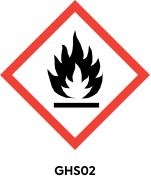
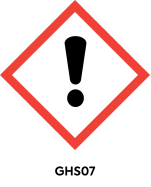
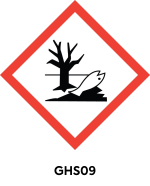
Precautionary statements :
| HAZARD | PRECAUTION |
|---|---|
| H315 Causes skin irritation. H317 May cause an allergic skin reaction. H411 Toxic to aquatic life with long lasting effects. EUH 208 Contains (name of sensitising substance). May produce an allergic reaction. |
P261 Avoid breathing dust/fume/gas/mist/vapours/spray. P264 Wash ... thoroughly after handling. P272 Contaminated work clothing should not be allowed out of the workplace. P273 Avoid release to the environment. P280 Wear protective gloves/protective clothing/eye protection/face protection. P302 + P352 IF ON SKIN: Wash with plenty of water/… P321 Specific treatment (see ... on this label). P332 + P313 If skin irritation occurs: Get medical advice/attention. P333 + P313 If skin irritation or rash occurs: Get medical advice/attention. P362 Take off contaminated clothing. P363 Wash contaminated clothing before reuse. P391 Collect spillage. P501 Dispose of contents/container to… |
IFRA
IFRA 51th :
This ingredient is restricted by the 51th amendment
-
Restriction type :
RESTRICTION -
Cause of restriction :
DERMAL SENSITIZATION -
Amendment :
49
Quantitative limit on the use :
| Cat.1 | Cat.2 | Cat.3 | Cat.4 |
Cat.5
A
B
C
D
|
Cat.6 | |||
|---|---|---|---|---|---|---|---|---|
| 0,11 % | 0,032 % | 0,65 % | 0,6 % |
0,15 %
0,15 %
0,15 %
0,15 %
|
||||
|
Cat.5
A
B
C
D
|
Cat.6 | |||||||
|
0,15 %
0,15 %
0,15 %
0,15 %
|
0,35 % | |||||||
|
Cat.7
A
B
|
Cat.8 | Cat.9 |
Cat.10
A
B
|
Cat.11
A
B
|
Cat.12 | |||
|
1,2 %
1,2 %
|
0,063 % | 1,2 % |
4,2 %
4,2 %
|
2,3 %
2,3 %
|
||||
|
Cat.10
A
B
|
Cat.11
A
B
|
Cat.12 | ||||||
|
4,2 %
4,2 %
|
2,3 %
2,3 %
|
No Restriction | ||||||
Annexe I :
Some regulated synthetic ingredients are found in nature and in certain proportions in natural ingredients. This presence in nature has to be taken into account when calculating limits of use recommended by the IFRA. In case you do not know these concentrations, you can use the ones estimated by the IFRA. Here they are :
| List of regulated compounds contained in this ingredient | ||
|---|---|---|
| Regulated ingredient name | CAS N° | Estimated Concentration |
| Benzaldehyde | 100-52-7 | 0,02 |
| Eugenol | 97-53-0 | 1,53 |
| Eugenol | 97-53-0 | 1 |
| Eugenol | 97-53-0 | 1,53 |
| Geraniol | 106-24-1 | 0,02 |
| Isoeugenol | 97-54-1 | 0,12 |
| Benzyl salicylate | 118-58-1 | 0,17 |
| Benzyl salicylate | 118-58-1 | 0,17 |
| Benzyl benzoate | 120-51-4 | 10,07 |
| Benzyl benzoate | 120-51-4 | 5 |
| Benzyl benzoate | 120-51-4 | 10,07 |
| Benzyl alcohol | 100-51-6 | 1,08 |
| Benzyl alcohol | 100-51-6 | 1,08 |
| Benzyl cyanide | 140-29-4 | 0,02 |
| Benzyl cyanide | 140-29-4 | 0,02 |
| Cresol (unspecified) | 1319-77-3 | 0,016 |
| Cresol (unspecified) | 1319-77-3 | 0,7 |
Disclaimer :
ScenTree is solely responsible for the information provided here.
To learn more about IFRA's standards : https://ifrafragrance.org/safe-use/library