








Photo credits: ScenTree SAS
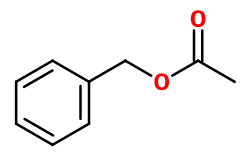
Benzyl acetate
Floral > White Flowers > Solar > Benzyl
Phenylméthyl acetate ; Acetoxytoluene ; Benteine ; Benzyl Ethanoate ; Acetic acid benzyl ester ; Acetic phenyl methyl ester ; Benzene methanol acetate ; Benzene methanol ethanoate ; Benzyl alcohol acetate


Photo credits: ScenTree SAS
| Company | Ingredient Name | Learn more | Naturality | Certifications | MOQ | Purity |
|---|---|---|---|---|---|---|
|
BENZYL ACETATE
AB-1
|
Discover | - | 10 grs | 99.5 - 100 | |
|
Acetate de Benzyle - 30 Gr | Discover | - | 30grs | - | |
|
Benzyl Acetate | Discover | Synthetic Aroma Chemicals | - | - | |
|
|
Benzyl Acetate natural | Discover | Natural Aroma Chemicals | - | - |
AB-1


General Presentation
-
CAS N° :
140-11-4 -
EINECS number :
205-399-7 -
FEMA number :
2135 -
FLAVIS number :
9,014
-
JECFA number :
23 -
Volatility :
Head -
Price Range :
€
Physico-chemical properties
-
Appearance :
Colorless liquid -
Density :
1,1 -
Refractive Index @20°C :
1,501 - 1,504 -
Optical rotation :
Donnée indisponible. -
Vapor pressure :
0,1643 mmHg @25°C -
Flash Point :
91°C (195,8°F)
-
Molecular formula :
C9H10O2 -
Molecular Weight :
150,18 g/mol -
Log P :
1,96 -
Fusion Point :
-51°C (-59,8°F) -
Boiling Point :
206°C (402,8°F) -
Detection Threshold :
2 et 270 ppb (0,000027%)
Chemistry & Uses
Uses in perfumery :
Benzyl acetate is used in floral reconstructions, especially in jasmine, ylang-ylang and monoï notes.
Year of discovery :
Discovered in 1853. Benzyl acetate was first isolated from jasmine absolute during the 10's by german scientists Albert Hesse and Friedrich Müller, because this extract contains 20 to 35% of this molecule.
Natural availability :
Today, natural Benzyl acetate can be extracted from Grandiflorum Jasmine Absolute (and other origins), Ylang-Ylang Extra EO or Narcissus Absolute.
| Ingredient | % min | % max |
|---|---|---|
| Champaca absolute | 3 | 5 |
| Jasmine Grandiflorum absolute | 40 | 65 |
| Jasmine Grandiflorum concrete | 50 | 70 |
| Jasmine Sambac absolute | 15 | 20 |
| Jasmine Sambac concrete | ||
| Ylang ylang oil extra (Comorres & Mayotte) | 11 | 17.50 |
| Ylang ylang oil extra (Madagascar) | 5.50 | 14 |
| Ylang ylang oil I (Comorres & Mayotte) | 6 | 14 |
| Ylang ylang oil I (Madagascar) | 2.80 | 10 |
| Ylang ylang oil III (Comorres & Mayotte) | 4 | 8 |
| Ylang ylang oil III (Madagascar) | 0.10 | 2.20 |
Isomerism :
Para-Cresyl acetate is a constitutional isomer of Benzyl acetate. Both have the same formula, but para-Cresyl acetate is much more animalic and less floral-jasmine than Benzyl acetate.
Synthesis precursor :
Benzyl acetate is not a precursor to the synthesis of another compound of olfactory interest.
Synthesis route :
Nowadays, Benzyl acetate is synthesized by an esterification reaction from acetic acid and Benzyl Alcohol, in the presence of an acid catalyst such as concentrated sulfuric acid.
Stability :
acetates may form acetic acid through time.
Most of the time, the occurrence of a benzenic cycle in a molecule causes a coloration of this molecule through time
Other comments :
Benzyl acetate has a different polarity than Benzylacetone. However, both molecules have a very similar smell. This is the case of several esters, correlated with their analogous ketone.
Labelling
Allergens :
This ingredient does not contain any allergen.
Signal word :
Warning
Hazard pictograms :
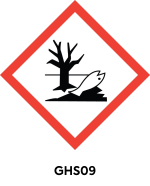
Precautionary statements :
| HAZARD | PRECAUTION |
|---|---|
| H412 Harmful to aquatic life with long lasting effects. | P273 Avoid release to the environment.
P501 Dispose of contents/container to… |
IFRA
IFRA 51th :
This ingredient is not restricted for the 51th amendment