















Photo credits: ScenTree SAS
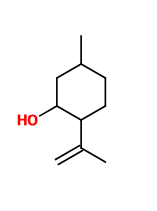
Isopulegol
Herbal > Minty > Sulfuric > Icy
(1R, 2S, 5R)-5-methyl-2-(1-methylethenyl)-cyclohexanol


Photo credits: ScenTree SAS


General Presentation
-
CAS N° :
89-79-2 -
EINECS number :
201-940-6 -
FEMA number :
2962 -
FLAVIS number :
Donnée indisponible.
-
JECFA number :
755 -
Volatility :
Base -
Price Range :
Data not available.
Physico-chemical properties
-
Appearance :
Colorless liquid -
Density :
0,91 -
Refractive Index @20°C :
Donnée indisponible. -
Optical rotation :
Donnée indisponible. -
Vapor pressure :
0,104 mmHg @20°C -
Flash Point :
Donnée indisponible.
-
Molecular formula :
C10H18O -
Molecular Weight :
154,25 g/mol -
Log P :
2,4 -
Fusion Point :
Donnée indisponible. -
Boiling Point :
211°C (411,8°F) -
Detection Threshold :
Donnée indisponible.
Chemistry & Uses
Uses in perfumery :
Year of discovery :
Data not available.
Natural availability :
Isopulegol is a molecule commonly found in nature. It is present in concentrations from 0.5% to 1.7% in citronella Java EO, as well as in several species of the Citrus genus as well as the majority of essential oils from the Mentha genus. It can also be found in Abies balsamea, Picea mariana, and various eucalyptus species.
| Ingredient | % min | % max |
|---|---|---|
| Citronella oil (Java type) | 0.50 | 1.70 |
| Combava oil | 3 |
Isomerism :
Data not available.
Synthesis precursor :
Koumalactone can be obtained from isopulegol through epoxidation. Dihydromintlactone can be obtained from isopulegol via ozonolysis. Menthol can also be derived from isopulegol. The process is as follows: Citral -> Distillation to separate Geranial/Neral -> Chiral catalysis to produce (R)-Citronellal -> Acid catalysis to create isopulegol -> Hydrogenation to produce (-)-Menthol.
Synthesis route :
Isopulegol can be obtained thanks to acidic catalysis of (R)-Citronellal
Stability :
Isopulegol is quite stable in all kind of applications
Other comments :
Data not available.
Labelling
Allergens :
This ingredient does not contain any allergen.
Signal word :
Warning
Hazard pictograms :

Precautionary statements :
| HAZARD | PRECAUTION |
|---|---|
| H302 Harmful if swallowed.
H315 Causes skin irritation. H319 Causes serious eye irritation. |
IFRA
IFRA 51th :
This ingredient is not restricted for the 51th amendment