









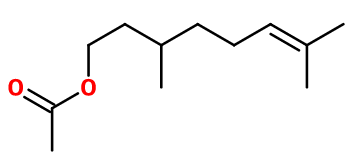
Photo credits: ScenTree SAS
DL-citronellyl acetate
Floral > Rosy > Green Fruits > Aquatic
Citronellyl acetate ; 3,7-dimethyloct-6-enyl acetate ; acetate de 3,7-dimethyloct-6-enyl ; Citronellyl ethanoate ; Acetic acid citronellyl ester ; Citronellol acetate ; 3,7-dimethyloct-6-enol acetate ; 3,7-dimethyloct-6-enyl ethanoate ; 3,7-dimethyloct-6-enol ethanoate


Photo credits: ScenTree SAS
| Company | Ingredient Name | Learn more | Naturality | Certifications | MOQ | Purity |
|---|---|---|---|---|---|---|

|
Citronellyl Acetate | Discover | Molecule |


|
- | - |
|
CITRONELLYL ACETATE
CIAR-1
|
Discover | - | 10 grs | 96.0 - 100.0 | |

|
CITRONELLYL ACETATE DRT
900791
|
Discover | Molecules |

|
- | - |

|
Acetate de Citronellyle - 30 Gr | Discover | - | 30grs | - | |
|
Citronellyl Acetate
30035076
|
Discover | Molecule | - | - | |
|
|
Citronellyl Acetate BMBcert™
30786719
|
Discover | Molecule | - | - | |

|
Citronellyl Acetate | Discover | Synthetic Aroma Chemicals | - | - |

CIAR-1
900791
30035076
30786719

General Presentation
-
CAS N° :
150-84-5 -
EINECS number :
205-775-0 -
FEMA number :
2311 -
FLAVIS number :
9,012
-
JECFA number :
57 -
Volatility :
Head/Heart -
Price Range :
€€
Physico-chemical properties
-
Appearance :
Colorless liquid -
Density :
0,891 -
Refractive Index @20°C :
1,440 - 1,450 -
Optical rotation :
Donnée indisponible. -
Vapor pressure :
0,0194 mmHg @23°C 0,0135 mmHg @25°C -
Flash Point :
93°C (199,4°F)
-
Molecular formula :
C12H22O2 -
Molecular Weight :
198,31 g/mol -
Log P :
4,22 -
Fusion Point :
Donnée indisponible. -
Boiling Point :
240°C (464°F) -
Detection Threshold :
Donnée indisponible.
Chemistry & Uses
Uses in perfumery :
Citronellyl acetate is used for a fruity note in rose, lily of the valley and lavender accords for example.
Year of discovery :
Data not available.
Natural availability :
Citronellyl acetate is naturally present in Lemongrass EO, Geranium EO and Rose de Mai Absolute, and therefore is extractable in order to obtain natural Citronellyl acetate.
Isomerism :
The asymmetric carbon of Citronellol gives it two different smells if its enantiomers are separated: the (R)-(+)-Citronellyl acetate is fruity and rosy, while the (S)-(-)-Citronellyl acetate is more aldehydic, dirty and lemony. In perfumery, those two enantiomers can be used separately. In most cases, a mixture of the two is used. Menthanyl acetate, Verdox® and Vertenex® are constitutional isomers of Citronellyl acetate. However, Menthanyl acetate is much more reminiscent of Bergamot EO, and Verdox® and Vertenex® are woodier.
Synthesis precursor :
Citronellyl acetate is not a precursor to the synthesis of another compound of olfactory interest.
Synthesis route :
Citronellyl acetate can be synthesized by an esterification reaction between Citronellol and acetic acid or acetic anhydride, in an acid medium. It can also be synthesized from 3,7-dimethylocta-1,6-diene, obtained naturally by pyrolysis of alpha-Pinene. This synthesis is made in three steps: a Markovnikov addition reaction using hydrochloric acid, a Kharasch reaction, also called anti-Markovnikov reaction, with hydrobromic acid, followed by an acetolysis reaction using sodium ethanoate.
Stability :
acetates may form acetic acid through time
Other comments :
Citronellyl acetate has a less green apple note than Geranyl acetate or Neryl acetate. May contain traces of Citronellol and/or Geraniol and therefore a check must be made as it becomes a possible allergen.
Labelling
Allergens :
This ingredient does not contain any allergen.
Signal word :
Warning
Hazard pictograms :
Precautionary statements :
| HAZARD | PRECAUTION |
|---|---|
| H315 Causes skin irritation.
H319 Causes serious eye irritation. H411 Toxic to aquatic life with long lasting effects. |
P264 Wash ... thoroughly after handling. P273 Avoid release to the environment. P280 Wear protective gloves/protective clothing/eye protection/face protection. P337 + P313 If eye irritation persists: Get medical advice/attention. P391 Collect spillage. P501 Dispose of contents/container to… |
IFRA
IFRA 51th :
This ingredient is restricted by the 51th amendment
-
Restriction type :
RESTRICTION -
Cause of restriction :
DERMAL SENSITIZATION AND SYSTEMIC TOXICITY -
Amendment :
51
Quantitative limit on the use :
| Cat.1 | Cat.2 | Cat.3 | Cat.4 |
Cat.5
A
B
C
D
|
Cat.6 | |||
|---|---|---|---|---|---|---|---|---|
| 0,49 % | 0,15 % | 2,0 % | 2,7 % |
0,70 %
0,70 %
0,70 %
0,23 %
|
||||
|
Cat.5
A
B
C
D
|
Cat.6 | |||||||
|
0,70 %
0,70 %
0,70 %
0,23 %
|
0,82 % | |||||||
|
Cat.7
A
B
|
Cat.8 | Cat.9 |
Cat.10
A
B
|
Cat.11
A
B
|
Cat.12 | |||
|
2,4 %
2,4 %
|
0,23 % | 5,4 % |
0,41 %
16 %
|
0,23 %
0,23 %
|
||||
|
Cat.10
A
B
|
Cat.11
A
B
|
Cat.12 | ||||||
|
0,41 %
16 %
|
0,23 %
0,23 %
|
No restriction | ||||||
Annexe I :
Some regulated synthetic ingredients are found in nature and in certain proportions in natural ingredients. This presence in nature has to be taken into account when calculating limits of use recommended by the IFRA. In case you do not know these concentrations, you can use the ones estimated by the IFRA. Here they are :
| List of regulated compounds contained in this ingredient | |||
|---|---|---|---|
| Ingredient Name | Botanical Name | CAS N° | Estimated Concentration |
| Juniper berry oil | Juniperus communis L. | 8002-68-4 | 0,19 |
| Schinus molle oil | Schinus areira L. | 68917-52-2 | 0,14 |
| Schinus terebenthifolius CO2 extract | Schinus terebenthifolius Raddi | 949495-68-5 | 0,25 |
| Basil oil, chemotype linalool | Ocimum basilicum L. | 8015-73-4 | 0,1 |
| Lemon oil, terpeneless | Citrus limon (L.) Osbeck | 68648-39-5 | 1,72 |
| Citronella oil, Ceylon type | Cymbopogon nardus (L.) Rendle | 8000-29-1 | 0,9 |
| Citronella oil, Java type | Cymbopogon winterianus Jowitt | 8000-29-1 | 3 |
| Eucalyptus citriodora oil | Corymbia citriodora (Hook.) K.D. Hill & L.A. Johnson | 85203-56-1 | 1,81 |
| Geranium absolute | Pelargonium graveolens l'Hertier ex Aiton | 8000-46-2 | 0,41 |
| Geranium oil | Pelargonium graveolens l'Hertier ex Aiton | 8000-46-2 | 0,5 |
| Geranium oil African | Pelargonium odoratissimum L'Heritier | 8000-46-2 | 0,8 |
| Ginger CO2 extract | Zingiber officinalle Roscoe | 8007-08-7 | 0,17 |
| Lemongrass oil, East Indian | Cymbopogon flexuosus (Nees ex Steudel) Will. Watson | 8007-02-1 | 0,23 |
| Balm oil | Melissa officinallis L. | 8014-71-9 | 1,35 |
| Nutmeg oil | Myristica fragrans Houtt. | 8008-45-5 | 0,13 |
| Grapefruit oil, terpeneless | Citrus x paradisi Macfad. | 68916-46-1 | 0,31 |
| Petitgrain lemon oil | Citrus limon (L.) Burm. f. | 8048-51-9 | 0,2 |
| Rose oil | Rosa x damascena Mill. | 8007-01-0 | 0,55 |
| Rose water stronger | Rosa x centifolia L. | 8007-01-0 | 0,02 |
| Rose absolute | Rosa x damascena Mill. | 90106-38-0 | 0,13 |
| Rose concrete | Rosa x damascena Mill. | 90106-38-0 | 0,03 |
| Abies alba cone oil | Abies alba Mill. | 8021-27-0 | 0,05 |
| Bucchu absolute, betulina | Agathosma betulina (P.J.Bergius) Pillans | 84649-93-4 | 0,15 |
| Citrus hystrix extract | Citrus hystrix DC | 91771-50-5 | 0,4 |
| Tagetes minuta oil | Tagetes minuta L. | 616-989-2 | 0,43 |
Disclaimer :
ScenTree is solely responsible for the information provided here.
To learn more about IFRA's standards : https://ifrafragrance.org/safe-use/library