












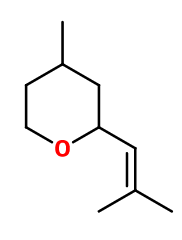
Photo credits: ScenTree SAS
Rose oxide
Floral > Rosy > Green > Metallic
4-methyl-2-(2-methylprop-1-enyl)oxane ; 2-isobutenyl-4-methyltetrahydropyran ; Geranium oxyde ; 2-(2-methylprop-1-enyl)-4-methyltetrahydropyran ; Tetrahydro-4-methyl-2-(2-methylpropenyl)-pyran ; Rosenoxide ; Rosoxide


Photo credits: ScenTree SAS
| Company | Ingredient Name | Learn more | Naturality | Certifications | MOQ | Purity |
|---|---|---|---|---|---|---|

|
ROSE OXIDE 90.10
ROX-1
|
Discover | - | 10 grs | 99 - 100 | |
|
|
ROSE OXIDE 70.30
ROXO-1
|
Discover | - | 10 grs | - | |

|
Rose Oxide - 30 Gr | Discover | - | 30grs | - | |

|
Rose Oxide 70
30365220
|
Discover | Molecule | - | - | |
|
|
Rose Oxide 90
30365218
|
Discover | Molecule | - | - | |
|
|
Rose Oxide 90 BMBcert™
30785436
|
Discover | Molecule | - | - | |

|
Rose Oxide 98% (90/10) | Discover | Synthetic Aroma Chemicals | - | - |
ROX-1

ROXO-1
30365220
30365218
30785436

General Presentation
-
CAS N° :
16409-43-1 -
EINECS number :
240-457-5 -
FEMA number :
3236 -
FLAVIS number :
13,037
-
JECFA number :
1237 -
Volatility :
Head -
Price Range :
€€€
Physico-chemical properties
-
Appearance :
Colorless liquid -
Density :
0,875 -
Refractive Index @20°C :
Donnée indisponible. -
Optical rotation :
Donnée indisponible. -
Vapor pressure :
Donnée indisponible. -
Flash Point :
70°C (158°F)
-
Molecular formula :
C10H18O -
Molecular Weight :
154,25 g/mol -
Log P :
3,3 -
Fusion Point :
< -100 °C (< -148°F) -
Boiling Point :
-
Detection Threshold :
Donnée indisponible.
Chemistry & Uses
Uses in perfumery :
Rose Oxide is used in rose reconstitutions, to bring the greeny flower stem note. Also used in geranium notes, for a fruity nuance. Contributes to a raw vegetable side, and enhances fruity note of litchi, exotic and red fruits.
Year of discovery :
Discovered in 1961 by scientists Casimir Seidel and Max Stoll.
Natural availability :
The natural Rose Oxide is present in Damask Rose EO (and other roses) and can be extracted from it.
Isomerism :
There are two enantiomers of Rose Oxide, whose synthesized proportion may vary depending on the synthesis parameters. Dextrorotatory Rose Oxide is spicier when the laevorotatory enantiomer is more metallic. Both enantiomers are often used separately in perfumes. Linalool, Geraniol and Eucalyptol are among the constitutional isomers of Rose Oxide. Their smell is however very different, whether it is floral-fresh, rosy or camphorated.
Synthesis precursor :
Rose Oxide is not a precursor to the synthesis of another compound of olfactory interest.
Synthesis route :
Rose Oxide is synthesized from Citronellol. The chosen enantiomer of Citronellol guides the enantiomeric form of the final product. A photo-oxidation is carried out on Citronellol to synthesize the two allylic hydroperoxides associated with this molecule. The two corresponding diols are obtained by a catalytic hydrogenation. Finally, the two compounds are put in an acid medium (with dilute sulfuric acid for example) in order to obtain a mixture of the two possible isomers of Rose Oxide. The unreacted diols are separated from the reaction medium by a fractional distillation. Using dextrorotatory Citronellol for this synthesis yields a 7 : 3 mixture of the cis : trans isomers of Rose Oxide. If the dehydration step is carried out with a stronger acid, an even greater proportion of cis isomer can be obtained. Another synthetic route consists of several stages of halogenation and dehalogenation of Citronellol.
Stability :
Stable in perfumes and diverse functional bases
Other comments :
Comparing it to other green and rosy notes, Rose Oxide does not have such metallic notes as Diphenyl Oxide or Benzophenone.
Labelling
Allergens :
This ingredient does not contain any allergen.
Signal word :
Warning
Hazard pictograms :


Precautionary statements :
| HAZARD | PRECAUTION |
|---|---|
| H315 Causes skin irritation.
H319 Causes serious eye irritation. H361 Suspected of damaging fertility or the unborn child. |
P280 Wear protective gloves/protective clothing/eye protection/face protection. P302 + P352 IF ON SKIN: Wash with plenty of water/… P305 + P351 + P338 IF IN EYES: Rinse cautiously with water for several minutes. Remove contact lenses, if present and easy to do. Continue rinsing. P308 + P313 IF exposed or concerned: Get medical advice/attention. P332 + P313 If skin irritation occurs: Get medical advice/attention. P337 + P313 If eye irritation persists: Get medical advice/attention. |
IFRA
IFRA 51th :
This ingredient is not restricted for the 51th amendment