
















Photo credits: ScenTree SAS
Aldehyde C-8
Aldehydes > Orange
Octanal ; Caprylic aldehyde ; Octaldehyde ; Oktanal


Photo credits: ScenTree SAS


General Presentation
-
CAS N° :
124-13-0 -
EINECS number :
204-683-8 -
FEMA number :
2797 -
FLAVIS number :
5,009
-
JECFA number :
98 -
Volatility :
Head -
Price Range :
€€
Physico-chemical properties
-
Appearance :
Colorless liquid -
Density :
0,822 -
Refractive Index @20°C :
1,412 - 1,418 -
Optical rotation :
Donnée indisponible. -
Vapor pressure :
0,600 mmHg @20°C 2,070 mmHg @25°C -
Flash Point :
52°C (125,6°F)
-
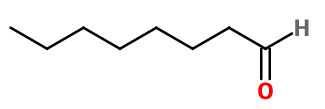
Molecular formula :
C8H16O -
Molecular Weight :
128,21 g/mol -
Log P :
2,9 -
Fusion Point :
14°C (57,2°F) -
Boiling Point :
170°C (338°F) -
Detection Threshold :
0,6276 ng/l air
Chemistry & Uses
Uses in perfumery :
Aldehyde C-8 is used in floral-aldehydic notes, citrus reproductions and top notes in general for the aldehydes metallic characteristic note. Top notes booster.
Year of discovery :
Data not available.
Natural availability :
Aldehyde C-8 is naturally present in many citrus extracts such as Bergamot EO or Sweet Orange EO, from which it can be extracted.
| Ingredient | % min | % max |
|---|---|---|
| Coriander herb oil | 5 | |
| Mandarin oil (yellow) | 1 | |
| Mandarin oil (red) | 1 | |
| Mandarin oil (green) | 1 | |
| Orange oil (Bitter) (USA) | 0.20 | |
| Orange oil (Bitter) (Ecuador) | 0.30 | |
| Orange oil (Bitter) (Mediterranean) | 0.10 | |
| Orange cold pressed (Sweet) | 0.10 | 0.60 |
| Orange oil rectified (Sweet) | 0.50 | |
| Grapefruit oil | 0.20 | 0.80 |
Isomerism :
1,3 Octenol and Methyl Hexyl Ketone are constitutional isomers of Aldehyde C-8. However, their smell is very different, as they are more earthy and reminiscent of mushroom.
Synthesis precursor :
Aldehyde C-8 forms a Schiff base by reaction with Methyl Anthranilate or Indole for example. It can also be used for condensation with another aldehyde or ketone to form the desired alcene.
Synthesis route :
Aldehyde C-8 is an aliphatic aldehyde. Like the other aldehydes, it can be synthesized by reaction of octyl halides (chloride, for example) and dimethyl sulfoxide (DMSO), followed by an alkaline treatment with sodium bicarbonate. Other synthetic routes exist such as a reduction of Rosenmund from octylic acid, using an acid chloride.
Stability :
Aldehydes may form diethylacetals in alcoholic perfumes, with no real impact on their smell
Other comments :
Aldehyde C-8, on the contrary to Aldehyde C-7, has a direct aldehydic smell. comparing it to Aldehyde C-9, the latter has more zesty and fresh facets. Aldehyde C-8 is more neutral.
Labelling
Allergens :
This ingredient does not contain any allergen.
Signal word :
Warning
Hazard pictograms :



Precautionary statements :
| HAZARD | PRECAUTION |
|---|---|
| H226 Flammable liquid and vapour.
H315 Causes skin irritation. H319 Causes serious eye irritation. H411 Toxic to aquatic life with long lasting effects. |
P210 Keep away from heat, hot surfaces, sparks, open flames and other ignition sources. No smoking. P273 Avoid release to the environment. P280 Wear protective gloves/protective clothing/eye protection/face protection. P303 + P361 + P353 IF ON SKIN (or hair): Take off immediately all contaminated clothing. Rinse skin with water [or shower]. P337 + P313 If eye irritation persists: Get medical advice/attention. P370 + P378 In case of fire: Use… to extinguish. |
IFRA
IFRA 51th :
This ingredient is not restricted for the 51th amendment