










Grapefruit oil
Citrus > Zesty > Grapefruit


| Company | Ingredient Name | Learn more | Naturality | Certifications | MOQ | Latin name | Treated part | Origin |
|---|---|---|---|---|---|---|---|---|

|
PAMPLEMOUSSE
B715
|
Discover | Huile essentielle |

|
- | Citrus paradisi Macfadyen | Zeste | Paraguay |
|
|
PAMPLEMOUSSE
717
|
Discover | Huile essentielle | - | Citrus paradisi Macfadyen | Zeste | Israel | |

|
GRAPEFRUIT CP 5X
946979
|
Discover | Naturals |

|
- | CITRUS PARADISI | - | - |

|
Huile essentielle de Fleur de Pamplemoussier - 30 gr | Discover | - | 30grs | - | - | - | |

|
GRAPEFRUIT Essential Oil
M_0020345
|
Discover | Naturel | - | - | - | - | |
|
|
GRAPEFRUIT Rectified Essential Oil
M_0062213
|
Discover | Naturel | - | - | - | - | |
|
|
GRAPEFRUIT Rectified Essential Oil
M_0050991
|
Discover | Naturel | - | - | - | - | |
|
|
GRAPEFRUIT Rectified Essential Oil
M_0066118
|
Discover | Naturel | - | - | - | - | |

|
Grapefruit Oil 10 x Fold | Discover | Essential Oil | - | Citrus paradisi M. | - | - | |
|
|
Grapefruit Oil 5 x Fold | Discover | Essential Oil | - | Citrus paradisi M. | - | - | |
|
|
Grapefruit Oil CP Pink | Discover | Essential Oil | - | Citrus paradisi M. | - | - | |
|
|
Grapefruit Oil CP White | Discover | Essential Oil | - | Citrus paradisi M. | - | - | |

|
Grapefruit Oil Pink/White | Discover | Essential Oils | - | - | - | - |
B715

717
946979
M_0020345
M_0062213
M_0050991
M_0066118

General Presentation
-
CAS N° :
8016-20-4 -
EINECS number :
90045-43-5 -
FEMA number :
2530
-
Volatility :
Head -
Price Range :
€€
Physico-chemical properties
-
Appearance :
Colorless liquid -
Density :
0,850 - 0,860 @20°C -
Refractive Index @20°C :
1,460 - 1,479 @20°C -
Optical rotation :
+91° // +96° -
Vapor pressure :
Donnée indisponible. -
Flash Point :
43°C (109,4°F) -
Acid Value :
Botanical informations
Botanical name :
Botanical profile :
The grapefruit is the fruit of the grapefruit tree, which belongs to the Rutaceae family and the genus Citrus L.
The Rutaceae family includes all citrus fruits, as well as plants such as buchu and amyris.
Chemotypes :
The Citrus L. genus, which includes the vast majority of citrus fruits, contains a large number of varieties used in perfumery:
- Citrus × aurantium L.: Bitter orange tree, cultivated in Spain and Florida. Orange oil expressed (Bitter) / Orange oil (Bitter) / Petitgrain bigarade oil / Petitgrain bigarade absolute / Petitgrain oil (Paraguay) / Orange flower absolute (Bitter) / Orange flower concrete (Bitter) / Orange flower SFE (Bitter)
- Citrus × aurantiifolia (Christm.) Swingle: The lime tree, mostly cultivated in Mexico. Lime oil expressed / Lime oil distilled
- Citrus × bergamia Risso: The bergamot tree, a hybrid of lemon and bitter orange, cultivated for its fruit and petitgrain oils. Bergamot oil expressed / Petitgrain bergamot absolute.
- Citrus hystrix DC.: Kaffir lime, grown in Thailand and India. Kaffir lime oil.
- Citrus × junos Siebold ex Yu.Tanaka: Yuzu, produced in Japan and Korea. Yuzu oil / Citrus junos oil / Citrus junos extract
- Citrus × limon (L.) Burm.fil.: The lemon tree, cultivated in Italy for its fruit and leafy branches. Lemon oil / Lemon oil (distilled, rectified) / Petitgrain lemon oil
- Citrus × paradisi Macfad.: The grapefruit tree, of Malay origin, cultivated in Brazil and Israel for its fruit’s essential oil. Grapefruit oil / Grapefruit flower oil / Grapefruit oil expressed
- Citrus sinensis L.: The sweet orange tree, widely cultivated in Brazil and California, is the most used citrus in perfumery. Orange flower absolute (Sweet) / Orange flower concrete (Sweet) / Orange flower SFE (Sweet) / Orange cold pressed (Sweet)
- Citrus reticulata Blanco: The mandarin tree, especially cultivated in Italy for its fruit and petitgrain (leaf oil). Mandarin oil (red) / Mandarin oil (yellow) / Mandarin oil (green) / Petitgrain mandarin oil. Its hybrid with sweet orange gave rise to the clementine (Clementine oil).
- Citrus medica L.: The citron tree, grown in Sicily. Citron oil.
Extractions & Uses
Extraction process :
Grapefruit is a fruit that can grow up to 15 centimetres in diameter. The cultivation of this fruit requires sunshine and great periods of heat.
The fruits are grown from January to June. A second harvest can happen if the weather conditions are favourable. Harvest can be done manually or mechanically according to the growers. In the case of a mechanical cultivation, a tractor passes between the tree rows to shake the fruits and collect them into a receptacle. The fruits are transported to the factory where they are sorted and washed with water.
The second step is to squeeze the essential oil of the citrus zest in a sfumatrice. Then, the essential oil and zest debris are washed away to a centrifuge to separate the oil from the water and the waxes. After that, the essential oil is collected.
The yield of grapefruit essential oil is between 0.16 and 0.2%.
Grapefruit can be deterpened by fractional distillation of the essential oil to separately collect grapefruit terpenes and a deterpenated essential oil, which concentrates the essential oil aldehydes, giving it more power.
Uses in perfumery :
Used in fresh, citrusy and cologne notes for a fruity facet.
Stability :
Solubility issues in perfumes
Citruses tend to fade through time in perfumes
Limonene tends to convert into Carvone through time, and to give a minthy note to the oil
Major Components :
- D-Limonene (92 - 96%)
- Myrcene (1,5 - 2,5%)
- Aldehyde C-8 (0,2 - 0,8%)
- Alpha-pinene (0,2 - 0,6%)
- Beta-caryophyllene (0,2 - 0,5%)
- Sabinene (0,1 - 0,6%)
- Aldehyde C-10 (0,1 - 0,6%)
- Beta-pinene (0,05 - 0,2%)
- Aldehyde C-9 (0,04 - 0,1%)
- Neral (0,02 - 0,04%)
- Nootkatone (0,01 - 0,8%)
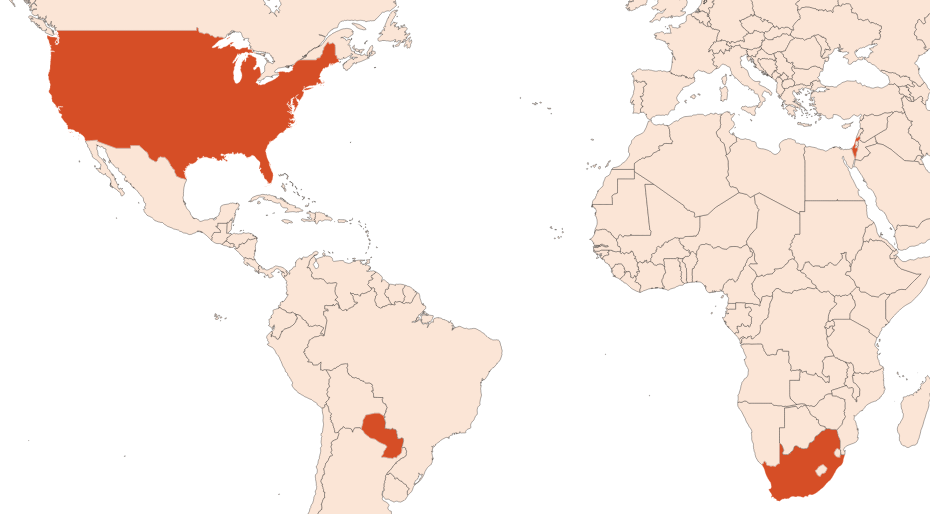
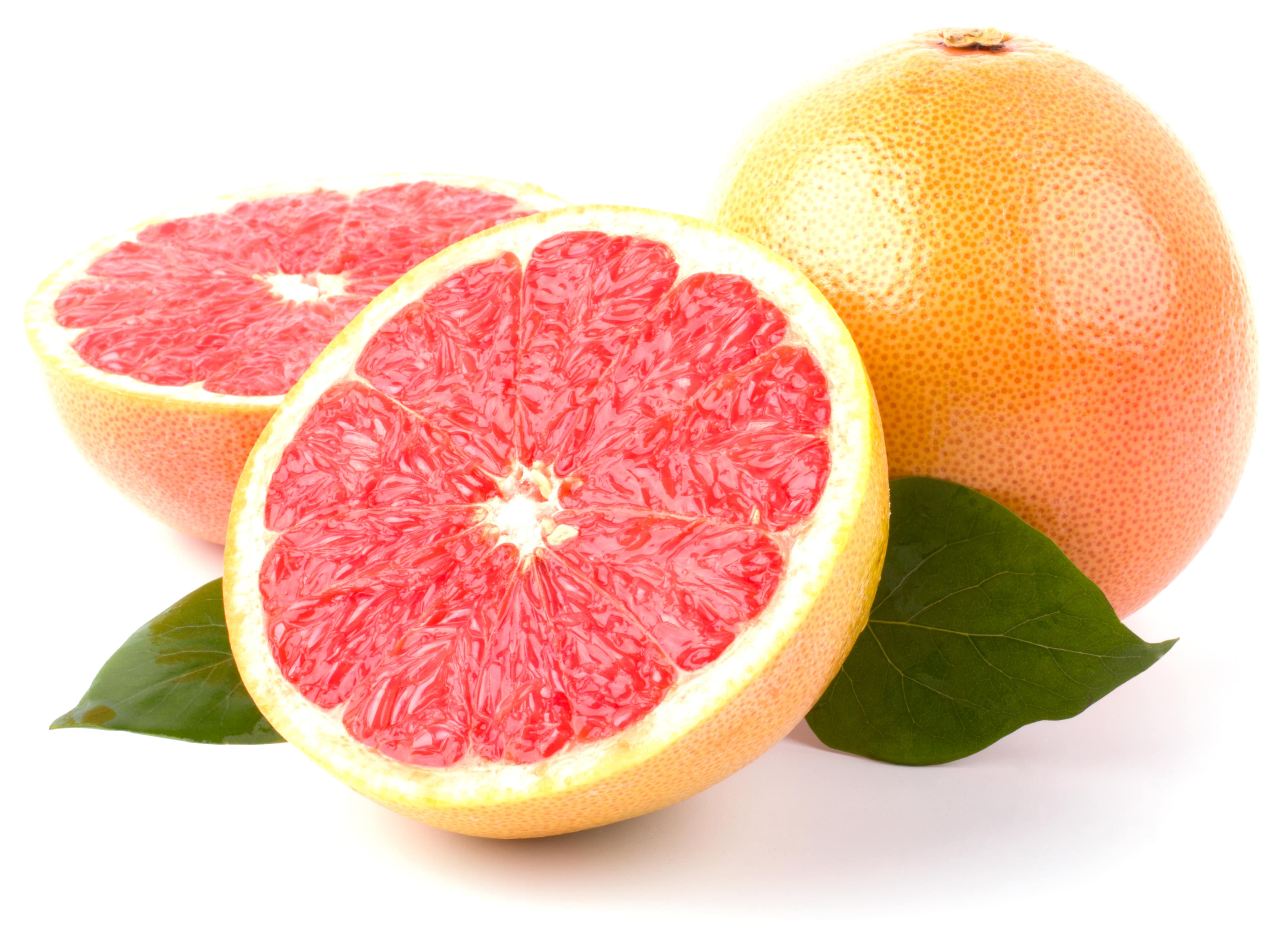
Photo credits: ScenTree SAS
Other comments :
Grapefruit comes from a hybridization between grapefruit and Sweet Orange EO. It was crossed for the first time in 1750 in Barbados, hence its original name of "Barbados grapefruit". Its name is taken from Dutch.
Florida is the largest producer of grapefruit.
Grapefruit can be used to extract natural D-Limonene, although orange is preferred, as it concentrates more.
The molecule that gives grapefruit its olfactory typicity is Nootkatone, present at 1% in the essential oil.
Citrus currently suffer from a disease called "citrus greening". This disease is deadly for citrus fruits and no treatment exists. It is transmitted by a vector insect that attacks young shoots: the psylla. This results in the premature death of many trees and therefore the decline in the general production of the essential oil and its quality (reduction of the D-Limonene level).
Grapefruit comes from a hybridization between grapefruit and Sweet Orange EO. It was crossed for the first time in 1750 in Barbados, hence its original name of "Barbados grapefruit". Its name is taken from Dutch.
Florida is the largest producer of grapefruit.
Grapefruit can be used to extract natural D-Limonene, although orange is preferred, as it concentrates more.
The molecule that gives grapefruit its olfactory typicity is Nootkatone, present at 1% in the essential oil.
Citrus currently suffer from a disease called "citrus greening". This disease is deadly for citrus fruits and no treatment exists. It is transmitted by a vector insect that attacks young shoots: the psylla. This results in the premature death of many trees and therefore the decline in the general production of the essential oil and its quality (reduction of the D-Limonene level).
Labelling
Allergens :
Signal word :
Danger
Hazard pictograms :
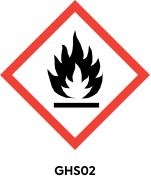
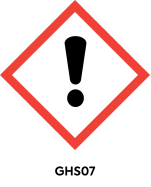
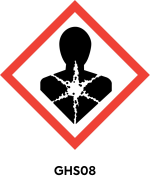
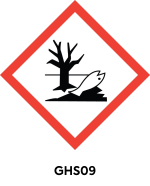
Precautionary statements :
| HAZARD | PRECAUTION |
|---|---|
| H226 Flammable liquid and vapour.
H304 May be fatal if swallowed and enters airways. H315 Causes skin irritation. H317 May cause an allergic skin reaction. H410 Very toxic to aquatic life with long lasting effects. |
P210 Keep away from heat, hot surfaces, sparks, open flames and other ignition sources. No smoking. P233 Keep container tightly closed. P240 Ground and bond container and receiving equipment. P241 Use explosion-proof [electrical/ventilating/lighting/…] equipment. P242 Use non-sparking tools. P243 Take action to prevent static discharges. P261 Avoid breathing dust/fume/gas/mist/vapours/spray. P264 Wash ... thoroughly after handling. P272 Contaminated work clothing should not be allowed out of the workplace. P273 Avoid release to the environment. P280 Wear protective gloves/protective clothing/eye protection/face protection. P301 + P310 IF SWALLOWED: Immediately call a POISON CENTER/doctor/… P302 + P352 IF ON SKIN: Wash with plenty of water/… P303 + P361 + P353 IF ON SKIN (or hair): Take off immediately all contaminated clothing. Rinse skin with water [or shower]. P321 Specific treatment (see ... on this label). P331 Do NOT induce vomiting. P332 + P313 If skin irritation occurs: Get medical advice/attention. P333 + P313 If skin irritation or rash occurs: Get medical advice/attention. P362 Take off contaminated clothing. P363 Wash contaminated clothing before reuse. P370 + P378 In case of fire: Use… to extinguish. P391 Collect spillage. P403 + P235 Store in a well-ventilated place. Keep cool. P405 Store locked up. P501 Dispose of contents/container to… |
IFRA
IFRA 51th :
This ingredient is restricted by the 51th amendment

-
Restriction type :
RESTRICTION -
Cause of restriction :
PHOTOTOXICITY -
Amendment :
49
Quantitative limit on the use :
| Cat.1 | Cat.2 | Cat.3 | Cat.4 |
Cat.5
A
B
C
D
|
Cat.6 | |||
|---|---|---|---|---|---|---|---|---|
| 4 % | 4 % | 4 % | 4 % |
4 %
4 %
4 %
4 %
|
||||
|
Cat.5
A
B
C
D
|
Cat.6 | |||||||
|
4 %
4 %
4 %
4 %
|
4 % | |||||||
|
Cat.7
A
B
|
Cat.8 | Cat.9 |
Cat.10
A
B
|
Cat.11
A
B
|
Cat.12 | |||
|
No Restriction
4 %
|
4 % | No Restriction |
No Restriction
4 %
|
No Restriction
4 %
|
||||
|
Cat.10
A
B
|
Cat.11
A
B
|
Cat.12 | ||||||
|
No Restriction
4 %
|
No Restriction
4 %
|
No Restriction | ||||||
Restricted ingredients due to phototoxicity considerations: notes
The Standard is set due to the phototoxic effects of Grapefruit oil expressed. For more detailed information on the application of this Standard, please refer to the note on phototoxic ingredients in chapter 1 of the Guidance for the use of IFRA Standards.
If the level of furocoumarins is unknown, the restriction level specified in this IFRA Standard applies.
Combination effects of phototoxic ingredients are only taken into consideration for the furocoumarin-containing fragrance ingredients (extracts) listed in the IFRA Standard of Citrus oils and other furocoumarins containing essential oils.
If combinations of furocoumarin-containing phototoxic fragrance ingredients (extracts) are used, the use levels must be reduced accordingly. The sum of the concentrations of all furocoumarin-containing phototoxic fragrance ingredients (extracts), expressed in of their recommended upper concentration level in the consumer product shall not exceed 100.
For qualities of the expressed oil in which the less volatile components have been concentrated by partial or total removal of the terpene fraction, this limit should be reduced in proportion to the degree of concentration.
Disclaimer :
ScenTree is solely responsible for the information provided here.
To learn more about IFRA's standards : https://ifrafragrance.org/safe-use/library