







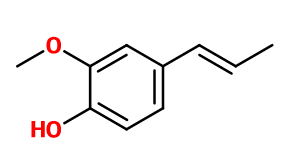
Photo credits: ScenTree SAS
Isoeugenol
Spicy > Warm Spices > Eugenol > Yellow Fruits
2-methoxy-4-prop-1-en-2-ylphenol ; 4-hydroxy-3-methoxy-1-propen-1-yl benzene ; 4- hydroxy-3-methoxy-1-propenyl benzene ; 4- hydroxy-3-methoxypropenyl benzene ; 2-methoxy-4-(1-methylethenyl)phenol ; 2-methoxy-4-(1-methylvinyl)phenol ; 2-methoxy-4-(1-propenyl)phenol ; 3-methoxy-4-hydroxy-1-propen-1-yl benzene ; 2-methoxy-4-propenyl phenol ; 4-propenyl guaiacol


Photo credits: ScenTree SAS
| Company | Ingredient Name | Learn more | Naturality | Certifications | MOQ | Purity |
|---|---|---|---|---|---|---|

|
Isoeugenol Trans 92%
CL-702
|
Discover | Natural |


|
800 Kgs | 92 |
|
|
Isoeugenol Trans 88%
CL-701
|
Discover | Natural |
|
800 Kgs | 88 |

|
Isoeugenol Trans-Iso 88% | Discover | Natural |
|
- | - |
|
|
Isoeugenol Trans-Iso 92% | Discover | Natural |
|
- | - |
|
ISOEUGENOL
ISOE-1
|
Discover | - | 10 grs | trans > 92% | |

|
Iso Eugénol - 30 Gr | Discover | - | 30grs | - | |

|
ISOEUGENOL
M_0053263
|
Discover | Synthétique | - | - | |

|
Iso Eugenol | Discover | Synthetic Aroma Chemicals | - | - |
CL-702

CL-701
ISOE-1
M_0053263

General Presentation
-
CAS N° :
97-54-1 -
EINECS number :
202-590-7 -
FEMA number :
2468 -
FLAVIS number :
4,004
-
JECFA number :
1260 -
Volatility :
Heart -
Price Range :
€€
Physico-chemical properties
-
Appearance :
Pinkish liquid -
Density :
1,087 -
Refractive Index @20°C :
1,572 - 1,577 @25°C -
Optical rotation :
Donnée indisponible. -
Vapor pressure :
0,003 mmHg @20°C -
Flash Point :
112°C (233,6°F)
-
Molecular formula :
C10H12O2 -
Molecular Weight :
164.20 g/mol -
Log P :
2,65 -
Fusion Point :
Donnée indisponible. -
Boiling Point :
270°C (518°F) -
Detection Threshold :
100 ppb (0,00001%)
Chemistry & Uses
Uses in perfumery :
Isoeugenol is used in carnation, spicy and ambery notes, often combined with Eugenol. Often replaced by Acetyl-Isoeugenol, unregulated.
Year of discovery :
Data not available.
Natural availability :
In many cases, naturally present Isoeugenol is accompanied by Eugenol, which is present in greater quantities in the following raw materials. Isoeugenol can be extracted from Clove Bud EO (1%), betel leaf (about 10%) or Ylang-Ylang Extra EO, or other fractions (up to 0.5% depending on the fractions).
| Ingredient | % min | % max |
|---|---|---|
| Red seaweed SFE | ||
| Clove bud oil | 1 | |
| Eucalyptus PURE JUNGLE ESSENCE™ |
Isomerism :
Isoeugenol has two diastereomers with a similar smell. It is the mixture of these two isomers that is the most used in perfumery. The trans isomer is nevertheless the most present in this mixture, as it is thermodynamically more stable. Eugenol is an isomer of Isoeugenol, as the double bond present in the two molecules is simply relocated from one molecule to another. Its smell is less fruity but more woody and vanillic. Styrallyl acetate and Frambinone® are examples of constitutional isomers of Isoeugenol. Their smell is however very different.
Synthesis precursor :
Isoeugenol is a precursor to the synthesis of several compounds of olfactory interest. Catalytic hydrogenation of the molecule allows to obtain Dihydoeugenol. In the past, Vanillin was produced by an oxidation reaction on Isoeugenol. The alcohol function of the molecule can finally be used for several esterification reactions, to obtain Isoeugenyl acetate for example.
Synthesis route :
Isoeugenol can be produced from Eugenol. Forming sodium or potassium salts from Eugenol allows to isomerize the molecule by heating it in order to obtain Isoeugenol by an acid treatment. This isomerization can also be obtained directly by a ruthenium or rhodium catalysis.
Stability :
Becomes red under the effect of light. This raw material is not convenient in every functional base : can't be used in a candle or shower gel base.
Labelling
Allergens :
This ingredient is classified as an allergen under European Regulation 2023/1545, dated August 26, 2023.
Its presence must therefore be declared on product labels when it exceeds 0.001% in leave-on products and 0.01% in rinse-off products.
Oral care products can contain up to 0.003% of isoeugenol before labelling becomes mandatory
Signal word :
Warning
Hazard pictograms :

Precautionary statements :
| HAZARD | PRECAUTION |
|---|---|
| H317 May cause an allergic skin reaction. |
IFRA
IFRA 51th :
This ingredient is restricted by the 51th amendment
-
Restriction type :
RESTRICTION -
Cause of restriction :
DERMAL SENSITIZATION AND SYSTEMIC TOXICITY -
Amendment :
49
Quantitative limit on the use :
| Cat.1 | Cat.2 | Cat.3 | Cat.4 |
Cat.5
A
B
C
D
|
Cat.6 | |||
|---|---|---|---|---|---|---|---|---|
| 0,019 % | 0,0057 % | 0,12 % | 0,11 % |
0,027 %
0,027 %
0,027 %
0,009 %
|
||||
|
Cat.5
A
B
C
D
|
Cat.6 | |||||||
|
0,027 %
0,027 %
0,027 %
0,009 %
|
0,063 % | |||||||
|
Cat.7
A
B
|
Cat.8 | Cat.9 |
Cat.10
A
B
|
Cat.11
A
B
|
Cat.12 | |||
|
0,22 %
0,22 %
|
0,009 % | 0,21 % |
0,21 %
0,75 %
|
0,009 %
0,009 %
|
||||
|
Cat.10
A
B
|
Cat.11
A
B
|
Cat.12 | ||||||
|
0,21 %
0,75 %
|
0,009 %
0,009 %
|
No Restriction | ||||||
Annexe I :
Some regulated synthetic ingredients are found in nature and in certain proportions in natural ingredients. This presence in nature has to be taken into account when calculating limits of use recommended by the IFRA. In case you do not know these concentrations, you can use the ones estimated by the IFRA. Here they are :
| List of regulated compounds contained in this ingredient | |||
|---|---|---|---|
| Ingredient Name | Botanical Name | CAS N° | Estimated Concentration |
| Cinnamon bark CO2 extract | Cinnamomum verum J. Presl syn. C. zeylanicum Blume | 8015-91-6 | 0,05 |
| Cinnamon bark oil | Cinnamomum zeylanicum Blume | 8015-91-6 | 0,02 |
| Cinnamon leaf oil | Cinnamomum zeylanicum Blume | 8015-91-6 | 0,13 |
| Cassia bark oil | Cinnamomum cassia [L.] J. Presl syn. C. aromaticum Nees | 8007-80-5 | 0,1 |
| Cassia oil | Cinnamomum cassia [L.] J. Presl syn. C. aromaticum Nees | 8007-80-5 | 0,1 |
| Champaca absolute | Michelia champaca L. | 8006-76-6 | 0,03 |
| Clove leaf oil | Syzygium aromaticum L. | 8000-34-8 | 0,1 |
| Jasmine grandiflorum absolute | Jasminum grandiflorum L. | 8022-96-6 | 0,12 |
| Lemongrass oil, East Indian | Cymbopogon flexuosus (Nees ex Steudel) Will. Watson | 8007-02-1 | 0,47 |
| Lemongrass oil, West Indian | Cymbopogon citratus (DC) Stapf. | 8007-02-1 | 0,5 |
| Lovage root oil | Levisticum officinale Koch | 8016-31-7 | 0,06 |
| Nutmeg oil | Myristica fragrans Houtt. | 8008-45-5 | 0,5 |
| Pine Scotch, resinoid | Pinus sylvestris L. | 0,01 | |
| Tuberose absolute | Poliantes tuberosa L. | 8024-05-3 | 1,5 |
| Tuberose concrete | Poliantes tuberosa L. | 8024-05-3 | 1,5 |
| Ylang ylang oil I | Cananga odorata (Lam.) Hook. f. &Thomson oil (forma genuine Steenis) | 8006-81-3 | 0,51 |
| Ylang ylang oil II | Cananga odorata (Lam.) Hook. f. &Thomson oil (forma genuine Steenis) | 8006-81-3 | 0,24 |
| Ylang ylang oil III | Cananga odorata (Lam.) Hook. f. &Thomson oil (forma genuine Steenis) | 8006-81-3 | 0,54 |
| Ylang, Ylang oil complete | Cananga odorata (Lam.) Hook. f. &Thomson oil (forma genuine Steenis) | 8006-81-3 | 0,52 |
| Ylang, Ylang oil extra | Cananga odorata (Lam.) Hook. f. &Thomson oil (forma genuine Steenis) | 8006-81-3 | 0,99 |
| Clove bud absolute | Syzygium aromaticum (L.) Merr. & L.M.Perry | 616-772-2 | 0,01 |
| Jasmine officinale absolute | Jasminum officinale L. | 8024-43-9 | 0,1 |
| Ylang-ylang absolute | Cananga odorata (Lam.) Hook.f.&Thomson forma genuina | 0,5 | |
| Benzoin resinoid, Siam | Styrax tonkinensis (Pierre) Craib ex Hartwick | 0,1 | |
| Benzoin resinoid, Sumatra | Styrax benzoin Dryand. | 0,01 | |
Disclaimer :
ScenTree is solely responsible for the information provided here.
To learn more about IFRA's standards : https://ifrafragrance.org/safe-use/library