












Fir needle oil (Siberia)
Woody > Coniferous > Fresh Woods > Agrestic > Camphoric
Abies sibirica Ledeb.
Synonyms : Abies krylovii Golub // Picea sibirica Godr.


| Company | Ingredient Name | Learn more | Naturality | Certifications | MOQ | Latin name | Treated part | Origin |
|---|---|---|---|---|---|---|---|---|

|
PIN DE SIBERIE
764
|
Discover | Huile essentielle | - | Abies sibirica L. | Aiguille | Autriche | |
|
PINE SIBERIA EO
PINSIB-1
|
Discover | Naturel | 10 grs | - | - | - | |

|
Fir Needle Oil Siberian | Discover | Essential Oils | - | - | - | - | |
|
|
Pine Siberian | Discover | Essential Oils | - | - | - | - |
764

PINSIB-1

General Presentation
-
CAS N° :
8021-29-2 -
EINECS number :
294-351-9 -
FEMA number :
2905
-
Volatility :
Head/Heart -
Price Range :
€€
Physico-chemical properties
-
Appearance :
Yellow to amber liquid -
Density :
0,895 - 0,912 @20°C -
Refractive Index @20°C :
1,468 - 1,473 @20°C -
Optical rotation :
-25° // -40° -
Vapor pressure :
Donnée indisponible. -
Flash Point :
Donnée indisponible. -
Acid Value :
Max 1
Botanical informations
Botanical name :
Abies sibirica Ledeb.
Synonyms : Abies krylovii Golub // Picea sibirica Godr.
Botanical profile :
The Siberian pine is a tree of the Pinaceous family and the genus Abies Mill.
Chemotypes :
The genus Abies Mill. includes approximately 110 species of fir trees. Among those used in perfumery, we can mention:
Abies balsamea (L.) Mill.: Fir balsam absolute / Fir needle oil
Abies sibirica Ledeb.: Fir needle oil (Siberia)
Abies alba Mill.: Abies alba oil / Abies alba absolute
Abies sachalinensis (F.Schmidt) Mast.: Abies sachalinensis oil
The Nordmann fir (Abies nordmanniana (Steven) Spach), from the Caucasus, is commonly used as a Christmas tree.
The Dense fir (Abies spectabilis (D.Don) Mirb.) from the Himalayas
The Manchurian and Korean fir (Abies nephrolepis (Trautv. ex Maxim.) Maxim.)
The Giant fir of Vancouver, Canada (Abies grandis (Douglas ex D.Don) Lindl.)
Extractions & Uses
Extraction process :
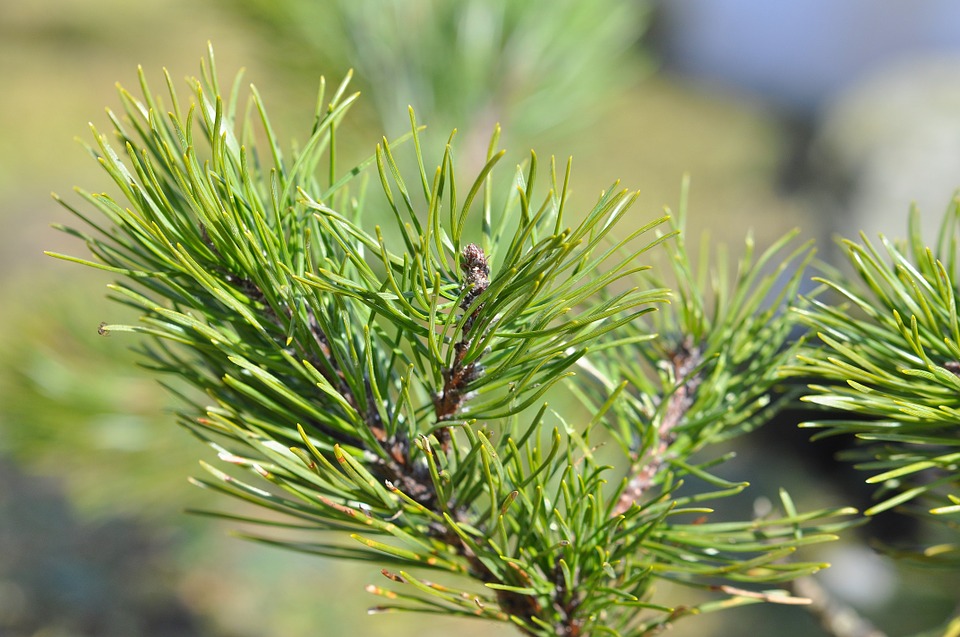
The Siberian pine is a tree with a slow growth that can reach up to 50 meters tall. Its trunk can reach 1 meter in diameter. Its needles are arranged one by one on the twigs which makes it a fir tree rather than a pine tree. The needles contain most of the fragrant principle of the plant.
From June to October, the needle twigs are cut off the tree, while they contain a maximum of essential oil. They are stored in a large container to be brought to the factory. They are dried before they are steam distilled. The extraction is carried out for several hours under pressure and the Pine Siberian essential oil is collected at the end of the process by decantation of the water.
An absolute, more resinous, balsamic and tenacious, can be obtained by a volatile solvent extraction of the same branches.
Uses in perfumery :
Useful in fresh, marine, fougere, woody and masculine notes.
Stability :
The esters identified in this raw material can form their corresponding acid in stability tests
The terpenes identified in this raw material can polymerize when they are oxidized
Major Components :
| Component | % min | % max |
|---|---|---|
| Bornyl acetate | 20 | 35 |
| Camphene | 15 | 26 |
| Alpha-pinene | 10 | 22 |
| Delta-3-Carene | 9 | 15 |
| D-Limonene | 4 | 10 |
| Beta-phellandrene | 1.50 | 5 |
| Santène | 1.50 | 3.50 |
| Tricyclène | 1.50 | 3.50 |
| Beta-pinene | 1 | 3.50 |
| Bornéol | 1 | 3 |
| Beta-caryophyllene | 0.50 | 2 |
| Alpha-humulene | 0.30 | 0.90 |
| Isobornyl acetate | 0.10 |
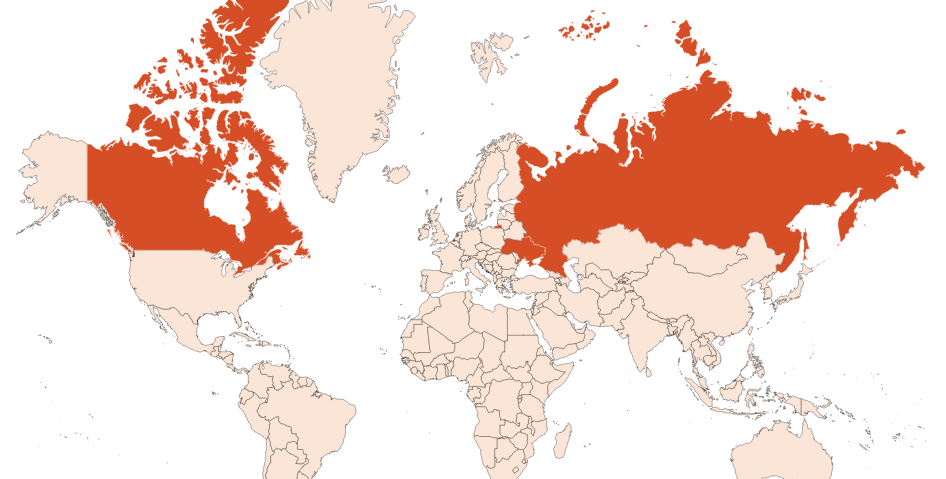
Photo credits: ScenTree SAS
Other comments :
This tree naturally grows in the mountainous regions of Russia. It grows mainly at altitudes between 1900 and 2400 meters. It can withstand temperatures around -58 °F.
The difference between a pine and a fir lies in the arrangement of the needles. If they are tied one by one to the twigs, it's a fir tree. If they are grouped together, it's a pine tree. The Siberian pine is actually a fir tree.
This tree naturally grows in the mountainous regions of Russia. It grows mainly at altitudes between 1900 and 2400 meters. It can withstand temperatures around -58 °F.
The difference between a pine and a fir lies in the arrangement of the needles. If they are tied one by one to the twigs, it's a fir tree. If they are grouped together, it's a pine tree. The Siberian pine is actually a fir tree.
Labelling
Allergens :
Signal word :
Danger
Hazard pictograms :
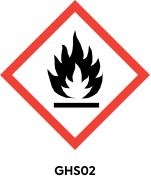
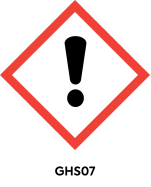
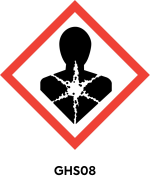
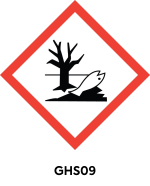
Precautionary statements :
| HAZARD | PRECAUTION |
|---|---|
| H226 Flammable liquid and vapour.
H304 May be fatal if swallowed and enters airways. H315 Causes skin irritation. H317 May cause an allergic skin reaction. H319 Causes serious eye irritation. H400 Very toxic to aquatic life. H410 Very toxic to aquatic life with long lasting effects. |
P262 Do not get in eyes, on skin, or on clothing. P273 Avoid release to the environment. P280 Wear protective gloves/protective clothing/eye protection/face protection. P301 + P330 + P331 IF SWALLOWED: rinse mouth. Do NOT induce vomiting. P302 + P352 IF ON SKIN: Wash with plenty of water/… P305 + P351 + P338 IF IN EYES: Rinse cautiously with water for several minutes. Remove contact lenses, if present and easy to do. Continue rinsing. |
IFRA
IFRA 51th :
This ingredient is restricted by the 51th amendment
Annexe I :
Some regulated synthetic ingredients are found in nature and in certain proportions in natural ingredients. This presence in nature has to be taken into account when calculating limits of use recommended by the IFRA. In case you do not know these concentrations, you can use the ones estimated by the IFRA. Here they are :
| List of regulated compounds contained in this ingredient | ||
|---|---|---|
| Regulated ingredient name | CAS N° | Estimated Concentration |
| Geraniol | 106-24-1 | 0,03 |
| alpha-Bisabolol | 515-69-5 | 0,2 |
| Longifolene | 475-20-7 | 0,09 |
Disclaimer :
ScenTree is solely responsible for the information provided here.
To learn more about IFRA's standards : https://ifrafragrance.org/safe-use/library