











Cistus oil
Balsamic Ambery > Ambery Cistus > Smoky Woods
Cistus ladanifer L.
Synonyms : Cistus ladaniferus L. // Cistus ladanifer f. immaculatus Dans.


| Company | Ingredient Name | Learn more | Naturality | Certifications | MOQ | Latin name | Treated part | Origin |
|---|---|---|---|---|---|---|---|---|

|
CISTE
N0300
|
Discover | Huile essentielle |

|
- | Cistus ladaniferus L. | Feuille, Rameau | Espagne |
|
|
CISTE
B275
|
Discover | Huile essentielle |
|
- | Cistus ladaniferus L. | Feuille, Rameau | Espagne |
|
|
CISTE
F0860
|
Discover | Huile essentielle |

|
- | Cistus ladaniferus L. | Feuille, Rameau | Espagne |

|
CISTUS OIL
925115
|
Discover | Naturals | - | CISTUS LADANIFERUS | - | - | |

|
Huile essentielle de Ciste - 30 gr | Discover | - | 30grs | - | - | - |
N0300

B275
F0860
925115

General Presentation
-
CAS N° :
8016-26-0 -
EINECS number :
89997-74-0 -
FEMA number :
2608
-
Volatility :
Base -
Price Range :
€€€€
Physico-chemical properties
-
Appearance :
Yellow liquid -
Density :
0,895 - 0,945 @20°C -
Refractive Index @20°C :
1,470 - 1,490 @20°C -
Optical rotation :
-20° // 0° -
Vapor pressure :
Donnée indisponible. -
Flash Point :
45°C (113°F) -
Acid Value :
Botanical informations
Botanical name :
Cistus ladanifer L.
Synonyms : Cistus ladaniferus L. // Cistus ladanifer f. immaculatus Dans.
Botanical profile :
The cistus belongs to the Cistaceae family and to the genus Cistus L.
Chemotypes :
The genus Cistus L. includes about 20 different species, the majority of which exudes fragrant gum.
Among these, the most used are:
Cistus ladaniferus var. albiflorus, var. maculatos, var. stenoiphyllus, which produce the resin used in perfumes.
Cistus creticus L., with rose to purple petals, surronding a tuft of stamens.
Cistus salviifolius L., with white petals.
Cistus parviflorus Lam., with pale rose petals.
Extractions & Uses
Extraction process :
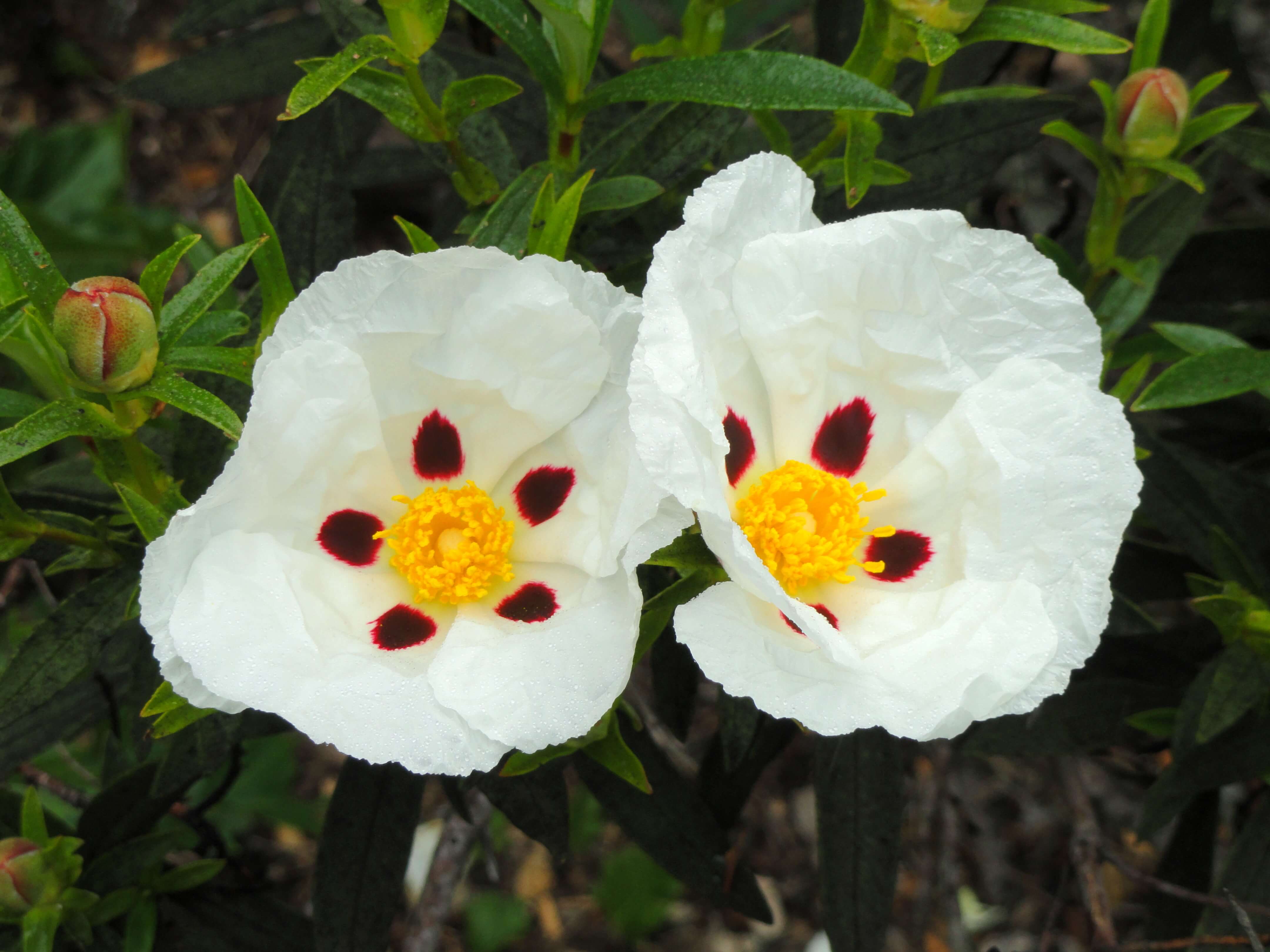
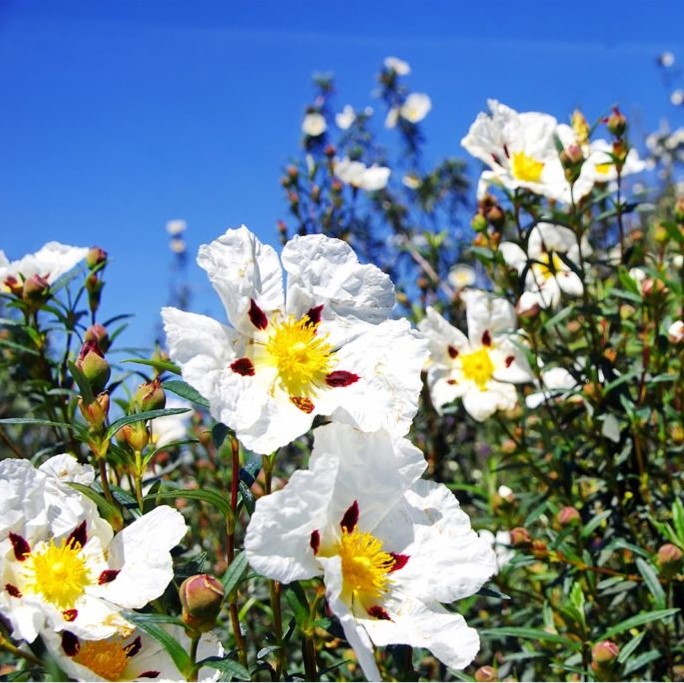
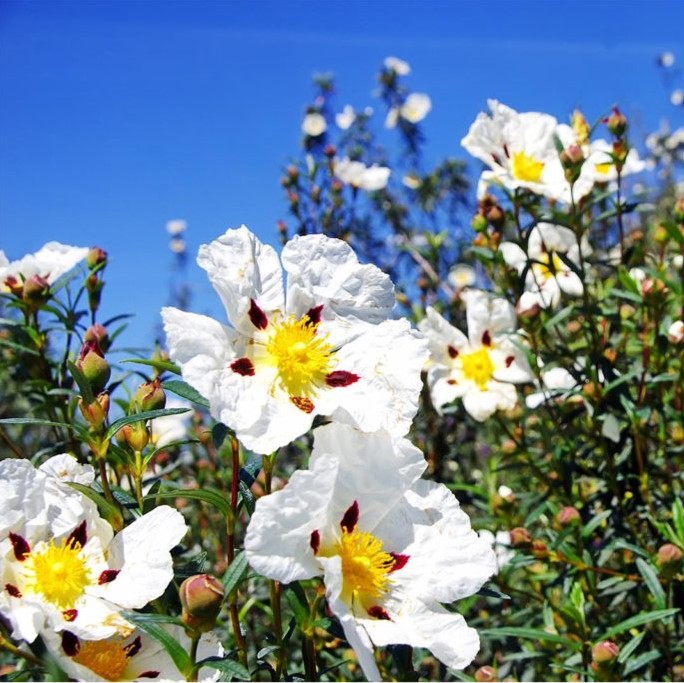
In April, Cistus ladaniferus fields are covered with the famous white flowers, but they don't smell and are very delicate (they only last a few days). It is necessary to wait a few months, around May-June, for a new shoot to appear. This new branch protects itself from the sun - and from the summer heat of southern Spain - by secreting a very fragrant viscous gum. We use the latter in perfumery.
In July, from dawn to noon, new branches are cut with a sickle, bundled and taken to the factory to extract the gum. It will then be necessary to wait another 3 years to harvest the cistus again.
The branches and twigs of the shrub are also used to obtain the essential oil. They are dried and immersed in a bath of boiling water to exude the oils and collect them on the surface. The plant can also be extracted by steam distillation to obtain an essential oil after a few hours of extraction, with a yield of 6 to 7 ‰ for a Spanish cistus and up to 1 ‰ for a French cistus.
From the same botanical variety
Uses in perfumery :
Used in all types of perfumes, for amber, chypre and fougere notes. Used to support floral notes.
Stability :
Solubility issues in perfumes
The terpenes identified in this raw material can polymerize when they are oxidized
Major Components :
| Component | % min | % max |
|---|---|---|
| Viridiflorol | 10 | 15 |
| Delta-cadinène | 3 | |
| Camphor | 3 | |
| Bornyl acetate | 2 | |
| Cubénol | 2 | |
| Ethyl phenylpropanoate | 0.10 |
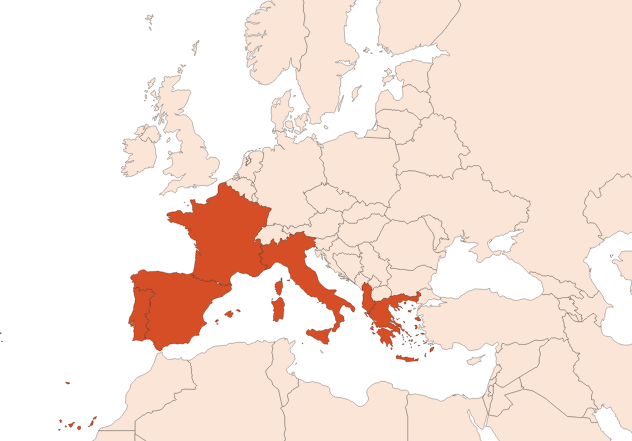
Photo credits: ScenTree SAS
Other comments :
Cistus is a shrub about two meters high, with pink, red or white flowers depending on the variety.
Cistus harvesting on an industrial scale was first done in the region of Salamanca, and was then exported to the South of Spain, along Portugal, to Andalusia, vers the greatest cultures in Europe can be found.
Bases are obtained by deriving ciste-labdanum: Dynamone is obtained by cracking (breaking bonds of heavier molecules) and Ambrarome Absolute is obtained by pyrogenation among others.
The essential oil is more powerful, rising and terpenic but less ambered, warm and resinous than the absolute. The absolute is also cheaper than the essential oil.
Cistus is a shrub about two meters high, with pink, red or white flowers depending on the variety.
Cistus harvesting on an industrial scale was first done in the region of Salamanca, and was then exported to the South of Spain, along Portugal, to Andalusia, vers the greatest cultures in Europe can be found.
Bases are obtained by deriving ciste-labdanum: Dynamone is obtained by cracking (breaking bonds of heavier molecules) and Ambrarome Absolute is obtained by pyrogenation among others.
The essential oil is more powerful, rising and terpenic but less ambered, warm and resinous than the absolute. The absolute is also cheaper than the essential oil.
Labelling
Allergens :
Signal word :
Danger
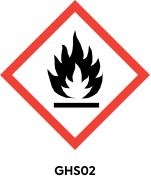
Hazard pictograms :
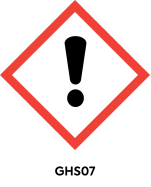
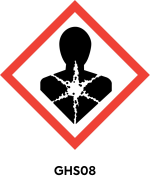
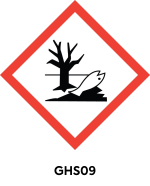
Precautionary statements :
| HAZARD | PRECAUTION |
|---|---|
| H226 Flammable liquid and vapour. H302 Harmful if swallowed. H304 May be fatal if swallowed and enters airways. H315 Causes skin irritation. H317 May cause an allergic skin reaction. H411 Toxic to aquatic life with long lasting effects. |
P210 Keep away from heat, hot surfaces, sparks, open flames and other ignition sources. No smoking. P273 Avoid release to the environment. P280 Wear protective gloves/protective clothing/eye protection/face protection. P301 + P312 IF SWALLOWED: Call a POISON CENTER/doctor/… if you feel unwell. P302 + P352 IF ON SKIN: Wash with plenty of water/… P332 If skin irritation occurs, contact doctor |
IFRA
IFRA 51th :
This ingredient is not restricted for the 51th amendment