













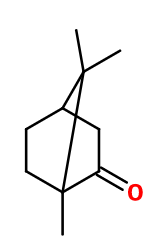
Photo credits: ScenTree SAS
Camphor
Herbal > Camphoric
1,7,7-trimethylbicyclo[2.2.1]heptan-2-one ; Alphanon ; Bornan-2-one ; 2-oxo-bornane ; 2-bornanone ; 2-camphanone ; Root bark oil ; 1,7,7-trimethyl norcamphor ; 1,7,7-trimethylnorbornan-2-one


Photo credits: ScenTree SAS
| Company | Ingredient Name | Learn more | Naturality | Certifications | MOQ | Purity |
|---|---|---|---|---|---|---|

|
CAMPHRE RACEMIC
CAMR-1
|
Discover | - | 10 grs | >=96.0 | |

|
CAMPHRE
205
|
Discover | Huile essentielle | - | - | |

|
Camphre - 30gr | Discover | - | 30grs | - | |

|
Camphor Powder | Discover | Synthetic Aroma Chemicals | - | - | |
|
|
Camphor Powder USP/EP (d,l) | Discover | Synthetic Aroma Chemicals | - | - |
CAMR-1

205

General Presentation
-
CAS N° :
76-22-2 -
EINECS number :
200-945-0 -
FEMA number :
4513 -
FLAVIS number :
Donnée indisponible.
-
JECFA number :
Donnée indisponible. -
Volatility :
Head -
Price Range :
€€
Physico-chemical properties
-
Appearance :
White solid -
Density :
0,992 -
Refractive Index @20°C :
Donnée indisponible. -
Optical rotation :
Donnée indisponible. -
Vapor pressure :
0,652 mmHg @25°C -
Flash Point :
64°C (147,2°F)
-
Molecular formula :
C10H16O -
Molecular Weight :
152,23 g/mol -
Log P :
2,41 -
Fusion Point :
176°C (348,8°F) -
Boiling Point :
204°C (399,2°F) -
Detection Threshold :
Donnée indisponible.
Chemistry & Uses
Uses in perfumery :
Camphor is used for a fresh and terpenic effect in all types of compositions.
Year of discovery :
1904
Natural availability :
Camphor is found in many plants such as basil (camphorated chemotype), camphor sage and Cardamom EO among others. The Camphor tree HE (same species as HoWood EO) remains its main source in its natural state.
Isomerism :
There are two enantiomers of Camphor, both very present in nature. The most common is Camphor (+), dextrorotatory. It is very often this one that is used in perfumery. Citral and Isocyclocitral® are constitutional isomers of Camphor. Their smell is however very different: one is citraly, the other is green.
Synthesis precursor :
Camphor is an intermediate in the synthesis of Camphene and Borneol, among others.
Synthesis route :
Camphor is produced by a fractional distillation of Camphor Leaf EO. Its synthesis is made by dehydration of isoborneol, which has been synthesized from Isobornyl acetate. This dehydrogenation is done thanks to a copper catalysis.
Stability :
Stable in perfumes and diverse functional bases
Other comments :
Camphor is a 'trigeminal' raw material. This means that it involves the trigeminal nerve, responsible for a motor and sensitive function for humans. In the case of Camphor, smelling it gives the nose a sensation of cold.
Labelling
Allergens :
This ingredient is classified as an allergen under European Regulation 2023/1545, dated August 26, 2023.
Its presence must therefore be declared on product labels when it exceeds 0.001% in leave-on products and 0.01% in rinse-off products.
Signal word :
Warning
Hazard pictograms :



Precautionary statements :
| HAZARD | PRECAUTION |
|---|---|
| H228 Flammable solid.
H302 Harmful if swallowed. H332 Harmful if inhaled. H371 May cause damage to organs. |
P210 Keep away from heat, hot surfaces, sparks, open flames and other ignition sources. No smoking. P260 Do not breathe dust/fume/gas/mist/vapours/spray. P301 + P312 IF SWALLOWED: Call a POISON CENTER/doctor/… if you feel unwell. P330 Rinse mouth. P370 + P378 In case of fire: Use… to extinguish. |
IFRA
IFRA 51th :
This ingredient is not restricted for the 51th amendment