














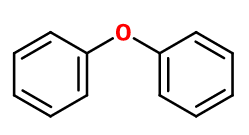
Photo credits: ScenTree SAS
| Company | Ingredient Name | ID | Comments | Naturality | Certifications | MOQ | Purity |
|---|---|---|---|---|---|---|---|

|
DIPHENYL OXYDE | DIO-1 |
Visit website

|
- |


|
10 grs | 99.0 - 100.0 |

|
Diphenyl Oxide | - |
Visit website
|
Synthetic Aroma Chemicals | - | - |


General Presentation
-
CAS N° :
101-84-8 -
EINECS number :
202-981-2 -
FEMA number :
3667 -
FLAVIS number :
04.035
-
JECFA number :
1255 -
Volatility :
Heart -
Price Range :
€
Physico-chemical properties
-
Appearance :
Colorless liquid that crystallizes at room temperature -
Density :
1,073 -
Refractive Index @20°C :
1,578 – 1,583 -
Optical rotation :
Donnée indisponible. -
Vapor pressure :
0,0217 mmHg @20°C -
Flash Point :
115°C (239°F)
-
Molecular formula :
C12H10O -
Molecular Weight :
170,21 g/mol -
Log P :
4,21 -
Fusion Point :
Donnée indisponible. -
Boiling Point :
259°C (498,2°F) -
Detection Threshold :
Donnée indisponible.
Chemistry & Uses
Uses in perfumery :
Diphenyl Oxide is used in all types of perfumes, for reconstitutions of rose, geranium and lavender. Gets on well with citruses to boost the head and make the note last longer. Gives a metallic and cold effect. Widely used in functional perfumery.
Year of discovery :
Data not available.
Natural availability :
Diphenyl Oxide is not available in its natural state.
Isomerism :
Oranger Crystals® is a constitutional isomer of Diphenyl Oxide although it does not have the same smell, as it is closer to orange blossom.
Synthesis precursor :
Diphenyl Oxide is not a precursor to the synthesis of another compound of olfactory interest.
Synthesis route :
Diphenyl Oxide is synthesized as an intermediate in the synthesis of phenol. This synthesis is done by hydrolysis of chlorobenzene under a very high pressure.
Stability :
Stable in perfumes and diverse functional bases
Other comments :
In comparision to Benzophenone, Diphenyl Oxide has a smell more reminiscent of plastic.
Labelling
Allergens :
This ingredient does not contain any allergen.
IFRA
IFRA 51th :
This ingredient is not restricted for the 51th amendment