










Hyssop oil
Herbal > Camphoric > Coniferous > Agrestic > Grassy
Hyssopus officinalis L.
Synonyms : Thymus hyssopus E.H.L.Krause // Dracocephalum officinalis (L.) Y.P.Chen & B.T.Drew.


| Company | Ingredient Name | Learn more | Naturality | Certifications | MOQ | Latin name | Treated part | Origin |
|---|---|---|---|---|---|---|---|---|

|
HYSSOP OIL ORGANIC
HOB
|
Discover | Pure & Natural Organic |


|
1 Kg | Hyssopus officinalis ct. cineol | Leaves & Flowers | Spain |
|
|
HYSSOP OIL
HO
|
Discover | Pure & Natural |

|
1 Kg | Hyssopus officinalis ct. cineol | Leaves & Flowers | Spain |

|
Hysope HE - 30gr | Discover | - | 30grs | - | - | - | |

|
Hyssop Oil | Discover | Essential Oil | - | Hyssopus officinalis | - | - | |

|
Hyssop Oil | Discover | Essential Oils | - | - | - | - |
HOB

HO

General Presentation
-
CAS N° :
8006-83-5 -
EINECS number :
84603-66-7 -
FEMA number :
2591
-
Volatility :
Heart -
Price Range :
€€€
Physico-chemical properties
-
Appearance :
Yellow liquid -
Density :
0,920 - 0,950 @20°C -
Refractive Index @20°C :
1,460 - 1,486 @20°C -
Optical rotation :
-25° // -10° -
Vapor pressure :
Donnée indisponible. -
Flash Point :
Donnée indisponible. -
Acid Value :
Botanical informations
Botanical name :
Hyssopus officinalis L.
Synonyms : Thymus hyssopus E.H.L.Krause // Dracocephalum officinalis (L.) Y.P.Chen & B.T.Drew.
Botanical profile :
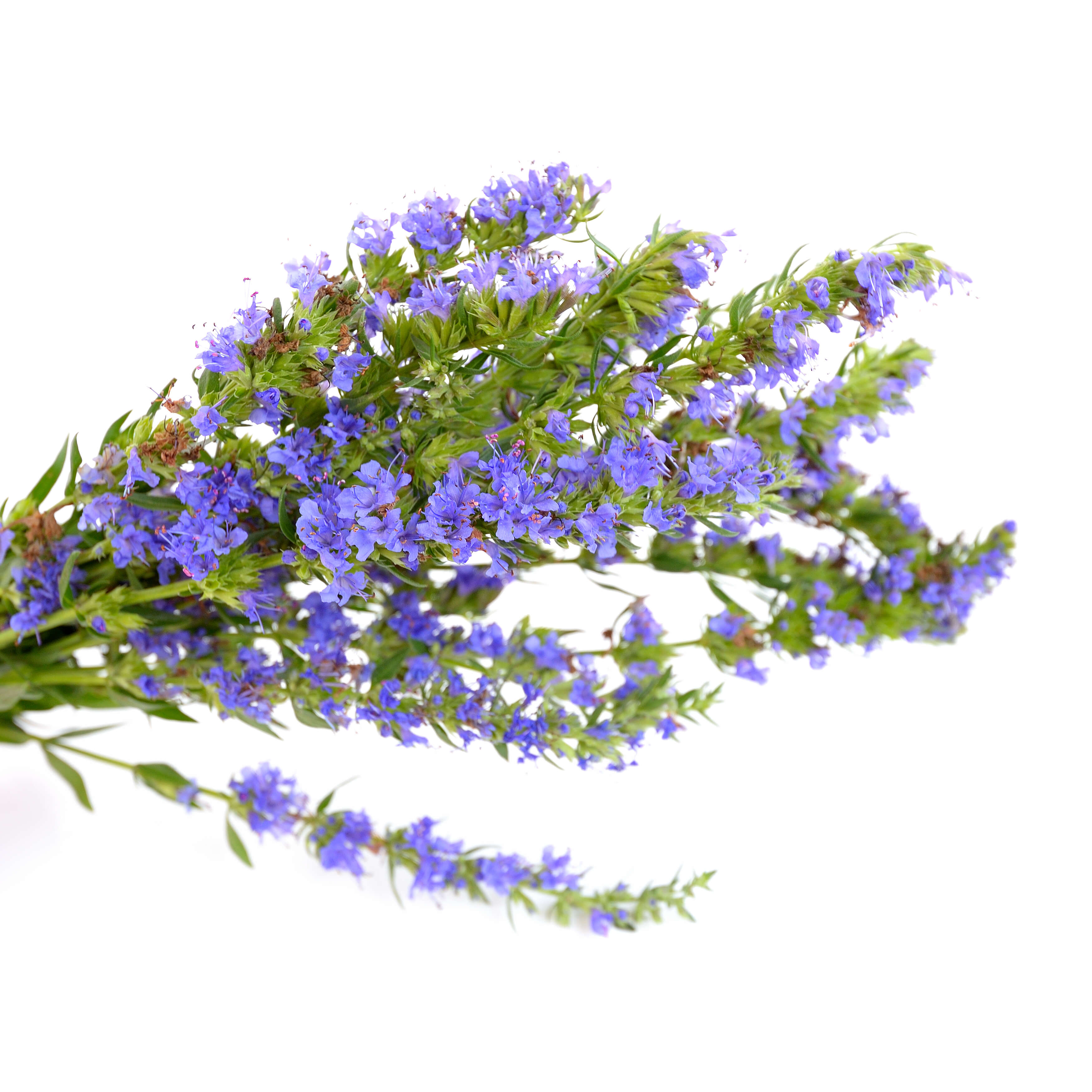
Hyssop is a perennial shrub belonging to the Lamiaceae family (as Patchouli EO or Spearmint EO for example), and of the genus Hyssopus L.
Chemotypes :
Hyssopus officinalis L. is the only species from the genus Hyssopus L. cultivated for its olfactory interest.
Nevertheless, it comprises three major varieties :
- Hyssopus officinalis subsp. officinalis, whose composition varies according to its country of origin - in ex-Yugoslavia, its composition is rich in Methyl Eugenol and D-Limonene; in Spain, it is rich in Eucalyptol; moreover, it is mainly composed of iso-pinocamphones.
- Hyssopus officinalis subsp. canescens, grown in the south of the Alps, rich in Eucalyptol and Linalool.
- Hyssopus officinalis subsp. aristatus, grown in Bulgaria and Spain, rich in Eucalyptol and iso-pinocamphones.
Extractions & Uses
Extraction process :
Hyssop grows in fairly dry, well-drained soil. Propagation of the plants is done by sowing seeds during spring, or by cutting old clumps, always during this season. Usually, the first plants appear in autumn, a few months after planting. It can be directly cultivated.
As the essential oil is mainly contained in the leaves, the stems are cut manually in the morning at their base when the flowers are open to three quarters of their potential. The plants are then left to dry before extraction.
Extraction is carried out in a distillation tank, under steam pressure. The essential oil is recovered by settling over the water in a Florentine vase, after cooling the vapours.
Yield for hyssop essential oil is of 0,15%. This can explain the price of this oil.
Uses in perfumery :
Used in lavender and lavandin accords, to give a natural effect, in small quantities. Also brings a hay and warm side to fougere-type perfumes.
Stability :
Terpenes found in this oil may polymerize under a strong oxydation.
Major Components :
- For Hyssopus officinalis ssp. officinalis : Iso-pinocamphone (25 - 45%)
- Pinocamphone (8 - 25%)
- Beta-pinene (7 - 20%)
- D-germacrene (1,2 - 4,5%)
- Sabinene (1 - 3,5%)
- Alloaromadendrene (1 - 3%)
- Beta-caryophyllene (1 - 3%)
- Myrtenyl methyl ether (0,9 - 3%)
- Beta-bourbonene (0,8 - 2,6%)
- D-Limonene (0,6 - 4%)
- Alpha-pinene (0,4 - 1,5%)
- Elemol (0,2 - 2,5%)
- Spathulenol (0,1 - 1,5%)

Photo credits: ScenTree SAS
Other comments :
The iso-pinocamphones in this essential oil are neurotoxic. This explains why hyssop essential oil is almost exclusively used in perfumery, in small quantities.
The iso-pinocamphones in this essential oil are neurotoxic. This explains why hyssop essential oil is almost exclusively used in perfumery, in small quantities.
Labelling
Allergens :
Signal word :
Danger
Hazard pictograms :

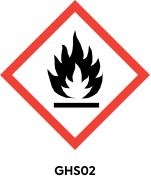

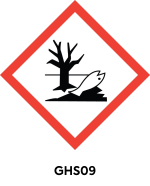
Precautionary statements :
| HAZARD | PRECAUTION |
|---|---|
| H226 Flammable liquid and vapour.
H302 Harmful if swallowed. H304 May be fatal if swallowed and enters airways. H317 May cause an allergic skin reaction. H411 Toxic to aquatic life with long lasting effects. |
IFRA
IFRA 51th :
This ingredient is restricted by the 51th amendment
Annexe I :
Some regulated synthetic ingredients are found in nature and in certain proportions in natural ingredients. This presence in nature has to be taken into account when calculating limits of use recommended by the IFRA. In case you do not know these concentrations, you can use the ones estimated by the IFRA. Here they are :
| List of regulated compounds contained in this ingredient | ||
|---|---|---|
| Regulated ingredient name | CAS N° | Estimated Concentration |
| Methyl eugenol | 93-15-2 | 0,2 |
| Hexen-2-al | 6728-26-3 | 0,2 |
| Estragole | 140-67-0 | 0,17 |
| alpha-Thujone | 546-80-5 | 0,2 |
Disclaimer :
ScenTree is solely responsible for the information provided here.
To learn more about IFRA's standards : https://ifrafragrance.org/safe-use/library