











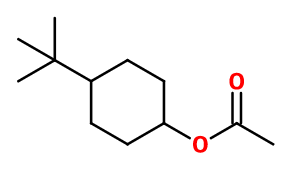
Photo credits: ScenTree SAS
Vertenex®
Woody > Ambery Woods > Green Fruits > Green
PTBCH acetate (ParaTertButylCycloHexanol) ; (4-tert-butylcyclohexyl) acetate ; Para-tert-butyl cyclohexyl acetate ; 4-tert-butyl cyclohexyl acetate ; 4-tert-butylcyclohexanol acetate ; Lorysia ; Oryclon ; 4-tert-pentylcyclohexanyl acetate ; Rodonex ; Woody acetate


Photo credits: ScenTree SAS
| Company | Ingredient Name | Learn more | Naturality | Certifications | MOQ | Purity |
|---|---|---|---|---|---|---|
|
PTBCHA
PT-1
|
Discover | - | 10 grs | 98.5 - 100 | |

|
LORYSIA®
956256
|
Discover | Molecules |

|
- | - |

|
Vertenex - 30 Gr | Discover | - | 30grs | - | |

|
Para Tertiary Butyl Cyclohexyl Acetate/PTBCHA/Vertenex | Discover | Synthetic Aroma Chemicals | - | - |
PT-1

956256

General Presentation
-
CAS N° :
32210-23-4 -
EINECS number :
250-954-9 -
FEMA number :
Donnée indisponible. -
FLAVIS number :
Donnée indisponible.
-
JECFA number :
Donnée indisponible. -
Volatility :
Heart -
Price Range :
€
Physico-chemical properties
-
Appearance :
Colorless liquid -
Density :
0,937 -
Refractive Index @20°C :
Donnée indisponible. -
Optical rotation :
Donnée indisponible. -
Vapor pressure :
Donnée indisponible. -
Flash Point :
100°C (212°F)
-
Molecular formula :
C12H22O2 -
Molecular Weight :
198,31 g/mol -
Log P :
4,23 -
Fusion Point :
Donnée indisponible. -
Boiling Point :
230°C (446°F) -
Detection Threshold :
Donnée indisponible.
Chemistry & Uses
Uses in perfumery :
Vertenex® is used in functional fragrance for its stability and substantivity. Used in fougere, marine, fruity notes. Making the link between a fruity or floral note with a woody note.
Year of discovery :
1948
Natural availability :
Vertenex® is not available in its natural state.
Isomerism :
The trans isomer of Vertenex® has a very woody smell, while the cis isomer has a more fruity and floral smell. One of the positional isomers of Vertenex® is Verdox®, with a less woody smell. Citronellyl acetate and Menthanyl acetate are constitutional isomers of Verdox®. Their smell is distinctly different. Although also fruity, they do not have a woody note.
Synthesis precursor :
Vertenex® is not a precursor to the synthesis of another compound of olfactory interest.
Synthesis route :
Vertenex® is synthesized by a first catalytic hydrogenation step of tertbutyl-phenol, at high temperature and pressure. Acetylation of the resulting compound is made by reaction with acetic anhydride and in the presence of an acid catalyst. For the hydrogenation phase, if nickel is used as a catalyst, the trans isomer is predominantly obtained. On the other hand, if the catalysis is made with rhodium, it is the cis isomer which is found in majority at the end of the reaction.
Stability :
Stable in perfumes and diverse functional bases
Other comments :
In comparision to Vertenex®, Verdox® has a more fruity note, reminiscent of apple, before also being woody.
Labelling
Allergens :
This ingredient does not contain any allergen.
Signal word :
Warning
Hazard pictograms :
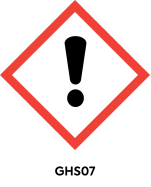
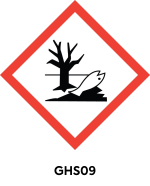
Precautionary statements :
| HAZARD | PRECAUTION |
|---|---|
| H317 May cause an allergic skin reaction.
H411 Toxic to aquatic life with long lasting effects. |
P261 Avoid breathing dust/fume/gas/mist/vapours/spray. P273 Avoid release to the environment. P280 Wear protective gloves/protective clothing/eye protection/face protection. P333 + P313 If skin irritation or rash occurs: Get medical advice/attention. P363 Wash contaminated clothing before reuse. P391 Collect spillage. |
IFRA
IFRA 51th :
This ingredient is not restricted for the 51th amendment