






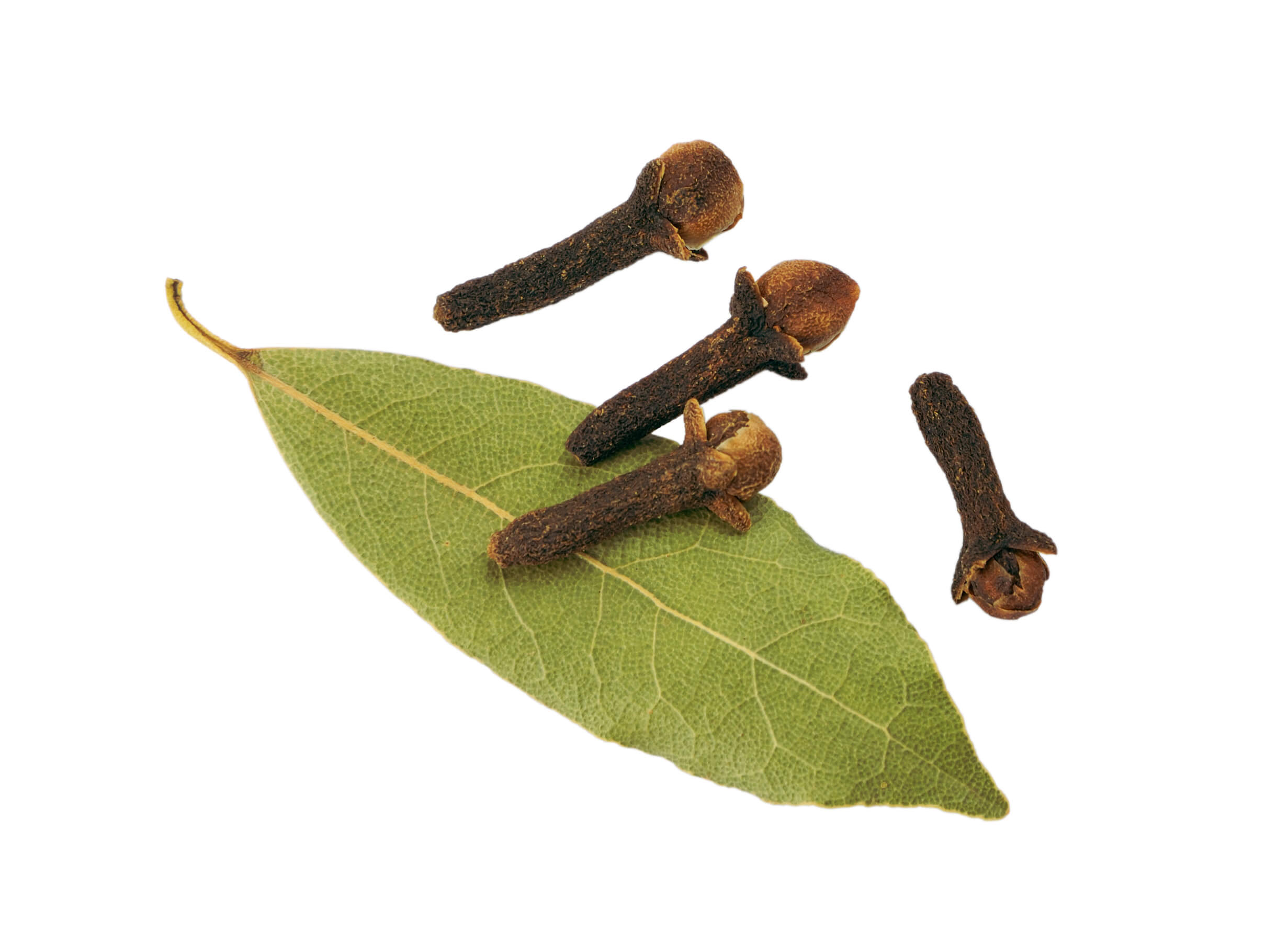
Clove leaf oil
Spicy > Warm Spices > Eugenol > Grassy
Syzygium aromaticum (L.) Merr. & Perry
Synonyms : Eugenia caryophyllata Thund. // Caryophyllus aromaticus L.


| Company | Ingredient Name | Learn more | Naturality | Certifications | MOQ | Latin name | Treated part | Origin |
|---|---|---|---|---|---|---|---|---|
|
Clove Leaf Oil Rectified 85%
CL-185
|
Discover | Natural |


|
800 Kgs | Eugenia caryophyllus | Leaves | Indonesia |
|
|
Clove Leaf Oil Crude 73%
CL-173
|
Discover | Natural |
|
800 Kgs | Eugenia caryophyllus | Leaves | Indonesia |
|
|
Clove Leaf Oil Rectified 80%
CL-180
|
Discover | Natural |
|
800 Kgs | Eugenia caryophyllus | Leaves | Indonesia |
|
|
Clove Leaf Oil Crude 82%
CL-182
|
Discover | Natural |
|
800 Kgs | Eugenia caryophyllus | Leaves | Indonesia |
|
|
Clove Leaf Oil Crude 78%
CL-178
|
Discover | Natural |
|
800 Kgs | Eugenia caryophyllus | Leaves | Indonesia |
|
|
Clove Leaf Oil Rectified 70%
CL-170
|
Discover | Natural |
|
800 Kgs | Eugenia caryophyllus | Leaves | Indonesia |
|
Rectified Clove Leaf Oil 80% | Discover | Natural |
|
- | Syzygium aromaticum | Leaves | Indonesia |
|
|
Rectified Clove Leaf Oil 85% | Discover | Natural |
|
- | Syzygium aromaticum | Leaves | Indonesia |
|
CLOVE LEAF EO
GFE-1
|
Discover | Naturel | 10 grs | - | - | - | |
|
Clove Leaf Oil | Discover | Essential Oil | - | Eugenia caryophyllata | - | - | |
|
Clove Leaf Oil Redistilled | Discover | Essential Oils | - | - | - | - |
CL-185

CL-173
CL-180
CL-182
CL-178
CL-170
GFE-1

General Presentation
-
CAS N° :
8000-34-8 -
EINECS number :
84961-50-2 -
FEMA number :
2325
-
Volatility :
Heart/Base -
Price Range :
€€
Physico-chemical properties
-
Appearance :
Colorless liquid -
Density :
1,039 - 1,049 @20°C -
Refractive Index @20°C :
1,528 - 1,535 @20°C -
Optical rotation :
-
Vapor pressure :
Donnée indisponible. -
Flash Point :
Donnée indisponible. -
Acid Value :
Botanical informations
Botanical name :
Syzygium aromaticum (L.) Merr. & Perry
Synonyms : Eugenia caryophyllata Thund. // Caryophyllus aromaticus L.
Botanical profile :
The clove tree is a member of the Myrtaceae family and the genus Syzygium Gaertn
The Myrtaceae family includes eucalyptus, myrtle, peppers, as well as cloves and tea tree.
Chemotypes :
The genus Syzygium Gaertn. regroups 1400 species. The clove tree is the most cultivated of all these species.
The greatest diversity of species for this botanical genus comes from Malaysia and South West Australia where many species are very little known and very little used.
Extractions & Uses
Extraction process :
The oval clove leaves end in a pointed shape. Their color is pink at first, then turns green when mature.
Clove cultivation in Indonesia covers more than 470,000 hectares (2010). The leaves are manually removed and placed in cloth bags, taken to the factory to crush and dry the leaves, after weighing the bags. After drying, the leaves are sent to the extractor, where their steam distillation allows to recover an essential oil with a yield of about 3.5%, after 8 hours of extraction. The essential oil of clove leaf is recovered at the end of the process in a decanter, separating from the distillation water.
Indonesia produces about 2500 tons of essential oil of clove leaf each year. This essential oil is mainly used to extract natural Eugenol.
In addition, it should be noted that cloves can also be extracted to obtain clove essential oil. It contains about the same level of Eugenol but is much more concentrated in Eugenyl Acetate at the expense of Caryophyllene.
Uses in perfumery :
Used in carnation, rose and white flowers accords. Very little used because of an old, heavy and voluminous effect it can bring.
Stability :
Aromatic compounds can be chromophoric and cause a coloration of the oil, especially in alkaline bases
The terpenes identified in this raw material can polymerize when they are oxidized
Major Components :
| Component | % min | % max |
|---|---|---|
| Eugenol | 80 | 92 |
| Beta-caryophyllene | 4 | 17 |
| Eugenyl acetate | 0.20 | 1 |
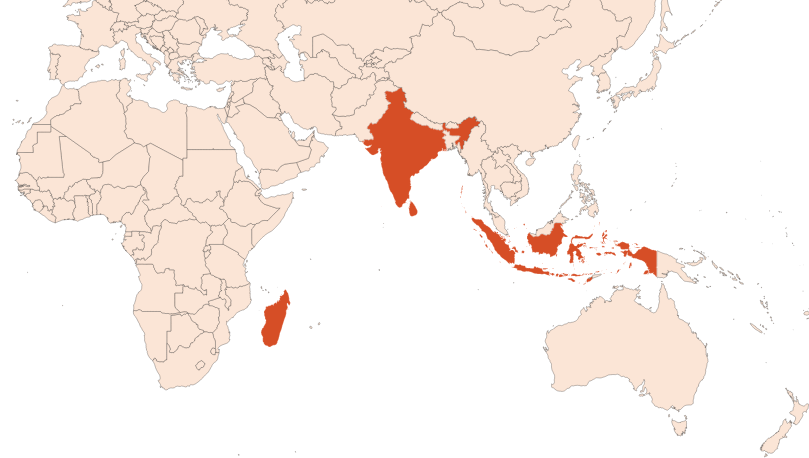
Photo credits: ScenTree SAS
Other comments :
Clove leaf essential oil is one of the largest sources of natural Eugenol, containing about 80% of it.
The composition of clove leaves essential oil allows a better profitability than the buds as for the isolation of Eugenol (carried out by adding soda).
Clove leaf essential oil must comply with standards guided by the ASTA (American Spice Trade Association) and FDA (Food and Drug Administration). These standards concern the physico-chemical properties of the essential oil.
An adulteration of the essential oil of clove leaf is possible with synthetic Eugenol, without the oil having its physico-chemical standards changed too much.
Clove leaf essential oil is one of the largest sources of natural Eugenol, containing about 80% of it.
The composition of clove leaves essential oil allows a better profitability than the buds as for the isolation of Eugenol (carried out by adding soda).
Clove leaf essential oil must comply with standards guided by the ASTA (American Spice Trade Association) and FDA (Food and Drug Administration). These standards concern the physico-chemical properties of the essential oil.
An adulteration of the essential oil of clove leaf is possible with synthetic Eugenol, without the oil having its physico-chemical standards changed too much.
Labelling
Allergens :
This ingredient is classified as an allergen under European Regulation 2023/1545, dated August 26, 2023.
Its presence must therefore be declared on product labels when it exceeds 0.001% in leave-on products and 0.01% in rinse-off products.
Signal word :
Danger
Hazard pictograms :
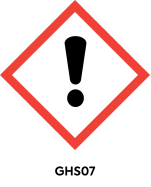
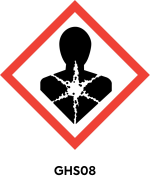
Precautionary statements :
| HAZARD | PRECAUTION |
|---|---|
| H302 Harmful if swallowed.
H304 May be fatal if swallowed and enters airways. H317 May cause an allergic skin reaction. H319 Causes serious eye irritation. |
P261 Avoid breathing dust/fume/gas/mist/vapours/spray. P264 Wash ... thoroughly after handling. P270 Do no eat, drink or smoke when using this product. P301 + P310 IF SWALLOWED: Immediately call a POISON CENTER/doctor/… P405 Store locked up. P501 Dispose of contents/container to… |
IFRA
IFRA 51th :
This ingredient is not restricted for the 51th amendment