














Photo credits: ScenTree SAS
Canthoxal®
Herbal > Anisic > Ozonic > Almondy
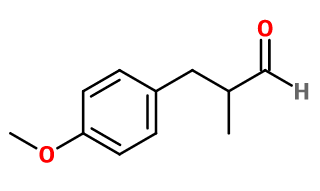
Anisyl Propanal ; 3-(4-methoxyphenyl)-2-methylpropanal ; Foliaver® ; Fennaldehyde ; Cantonal ; Canthorg ; Floral anise ; 2-methoxy-3-(para-methoxyphenyl) propanal ; 4-methoxy-alpha-methyl benzene propanal ; Para-methoxy-alpha-methyl hydrocinnamaldehyde ; Methoxyhydratropaldehyde ; Methoxyphenal ; 3-(para- methoxyphenyl)-2-methyl propionaldehyde ; 3-(4- methoxyphenyl)-2-methylpropanal ; Alpha- methyl-4-methoxybenzene propanal


Photo credits: ScenTree SAS


General Presentation
-
CAS N° :
5462-06-6 -
EINECS number :
226-749-5 -
FEMA number :
Donnée indisponible. -
FLAVIS number :
Donnée indisponible.
-
JECFA number :
Donnée indisponible. -
Volatility :
Heart -
Price Range :
€€
Physico-chemical properties
-
Appearance :
Colorless liquid -
Density :
1,043 -
Refractive Index @20°C :
1,517 - 1,522 -
Optical rotation :
Donnée indisponible. -
Vapor pressure :
0,0023 mmHg @23°C 0,0097 mmHg @25°C -
Flash Point :
94°C (201,2°F)
-
Molecular formula :
C11H14O2 -
Molecular Weight :
178,23 g/mol -
Log P :
2,5 -
Fusion Point :
Donnée indisponible. -
Boiling Point :
108°C (226,4°F) -
Detection Threshold :
Donnée indisponible.
Chemistry & Uses
Uses in perfumery :
Canthoxal® is used to create juicy fruits accords (melon, pear...) and floral notes (mimosa, brooms, lilies...). Can be used both as a booster for a cologne head or as a fresh note for oriental perfumes.
Year of discovery :
1951
Natural availability :
Canthoxal® is not available in its natural state.
Isomerism :
Canthoxal® has an asymmetrical carbon that gives rise to two enantiomers. However, it is the racemic mixture of these two isomers that is used in perfumery. Methyl Eugenol is a constitutional isomer of Canthoxal®. Its smell is however much more spicy and earthy.
Synthesis precursor :
Canthoxal® forms a Schiff base by reaction with Methyl Anthranilate or Indole for example.
Synthesis route :
Canthoxal® is synthesized by a condensation reaction of Anisic Aldehyde with propanal, followed by a hydrogenation of the intermediate product.
Stability :
Aldehydes may form diethylacetals in alcoholic perfumes, with no real impact on their smell.
Most of the time, the occurrence of a benzenic cycle in a molecule causes a coloration of this molecule through time
Other comments :
Canthoxal® is one of the only molecules mixing an anisic and ozonic note.
Labelling
Allergens :
This ingredient does not contain any allergen.
Signal word :
Warning
Hazard pictograms :
Precautionary statements :
| HAZARD | PRECAUTION |
|---|---|
| H317 May cause an allergic skin reaction.
H412 Harmful to aquatic life with long lasting effects. |
P261 Avoid breathing dust/fume/gas/mist/vapours/spray. P273 Avoid release to the environment. P280 Wear protective gloves/protective clothing/eye protection/face protection. P333 + P313 If skin irritation or rash occurs: Get medical advice/attention. P363 Wash contaminated clothing before reuse. P501 Dispose of contents/container to… |
IFRA
IFRA 51th :
This ingredient is restricted by the 51th amendment
-
Restriction type :
RESTRICTION -
Cause of restriction :
DERMAL SENSITIZATION AND SYSTEMIC TOXICITY -
Amendment :
51
Quantitative limit on the use :
| Cat.1 | Cat.2 | Cat.3 | Cat.4 |
Cat.5
A
B
C
D
|
Cat.6 | |||
|---|---|---|---|---|---|---|---|---|
| 0,11 % | 0,14 % | 0,75 % | 2,5 % |
0,64 %
0,64 %
0,64 %
0,21 %
|
||||
|
Cat.5
A
B
C
D
|
Cat.6 | |||||||
|
0,64 %
0,64 %
0,64 %
0,21 %
|
0,11 % | |||||||
|
Cat.7
A
B
|
Cat.8 | Cat.9 |
Cat.10
A
B
|
Cat.11
A
B
|
Cat.12 | |||
|
0,86 %
0,86 %
|
0,21 % | 2,7 % |
0,75 %
4,1 %
|
0,21 %
0,21 %
|
||||
|
Cat.10
A
B
|
Cat.11
A
B
|
Cat.12 | ||||||
|
0,75 %
4,1 %
|
0,21 %
0,21 %
|
No restriction | ||||||
Disclaimer :
ScenTree is solely responsible for the information provided here.
To learn more about IFRA's standards : https://ifrafragrance.org/safe-use/library