












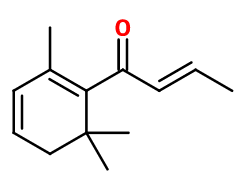
Photo credits: ScenTree SAS
Do you sell any of the raw materials? Would you like to let our users know?
Send an email to fournisseurs@scentree.coto learn about our advertising opportunities.
Do you sell any of the raw materials? Would you like to let our users know?
Send an email to fournisseurs@scentree.coto learn about our advertising opportunities.

General Presentation
-
CAS N° :
23726-93-4 -
EINECS number :
245-833-2 -
FEMA number :
3420 -
FLAVIS number :
07.108
-
JECFA number :
387 -
Volatility :
Heart/Base -
Price Range :
€€€€
Physico-chemical properties
-
Appearance :
Colorless to pale yellow liquid -
Density :
0,946 -
Refractive Index @20°C :
1.508 - 1.514 -
Optical rotation :
Data not available. -
Vapor pressure :
0.0064 mmHg @20°C 0.0052 mmHg @25°C -
Flash Point :
>100°C (>212°F)
-
Molecular formula :
C13H18O -
Molecular Weight :
190,29 g/mol -
Log P :
3,4 -
Fusion Point :
2°C (35,6°F) -
Boiling Point :
199°C (390,2°F) -
Detection Threshold :
0,0007 to 0,009 ppb
Chemistry & Uses
Uses in perfumery :
Damascenone-Beta® brings a fruity nuance for rosy notes. Gives a ''baked apple '' effect.
Year of discovery :
First rose ketones were discovered in 1965, by chemists P. Ruzicka and Dr. Demole, by analyzing Damask Rose Absolute. This opened the way to synthesize a major molecule category of the perfume industry.
Natural availability :
Damascenone-Beta® is present in small quantities in Damask Rose Absolute and Damask Rose EO (and other roses), from which it can be extracted. It is also present in Clary Sage Absolute and salvia officinale among others, always in very small proportions.
Isomerism :
There is an isomer of Damascenone-Beta® called Damascenone-Alpha®. Its smell is similar but the location of the double bonds in the ring is not the same (1,3 positions for beta and 2,4 positions for alpha). Cyclamen Aldehyde is a constitutional isomer of Damascenone-Beta, although its smell is completely different, as it is very marine, floral and aldehydic.
Synthesis precursor :
Damascenone-Beta® is not a precursor to the synthesis of another compound of olfactory interest.
Synthesis route :
Damascenone-Beta® is part of the ''rose ketones '' family, present in a small amount in Damask Rose Absolute, while playing an important role in their smell. Rose ketones are synthesized from the appropriate derivative of cyclogeranic acid (ester, halide, ...). A reaction of this derivative with an allyl magnesium halide followed by a pyrolysis, allows to obtain the desired compound by rearranging the double bond of the branched chain.
Stability :
Stable in perfumes and diverse functional bases
Other comments :
Data not available.
IFRA
IFRA 51th :
This ingredient is restricted by the 51th amendment
-
Restriction type :
RESTRICTION -
Cause of restriction :
DERMAL SENSITIZATION -
Amendment :
49
- Quantitative limit on the use :
-
Cat.1 Cat.2 Cat.3 Cat.4 Cat.5A B C DCat.6 0,0077 % 0,0023 % 0,046 % 0,043 % 0,011 % 0,011 % 0,011 % 0,011 %0,025 % Cat.5A B C DCat.6 0,011 % 0,011 % 0,011 % 0,011 %0,025 % Cat.7A BCat.8 Cat.9 Cat.10A BCat.11A BCat.12 0,088 % 0,088 %0,0045 % 0,084 % 0,3 % 0,3 %0,17 % 0,17 %No Restriction Cat.10A BCat.11A BCat.12 0,3 % 0,3 %0,17 % 0,17 %No Restriction
-
Restricted ingredients: notes
The above limits apply to Rose Ketones used individually or in combination. The sum of concentrations of Rose ketones isomers should not exceed the maximum concentration levels established by this Standard.