



Photo credits: ScenTree SAS
Silvial®
Floral > Light Flowers > Aldehydes > Aquatic
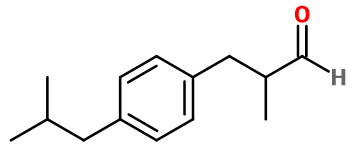
Alpha-methyl-4-(2-methylpropyl) benzenepropanal ; Para-isobutyl-alpha-methyl hydrocinnamaldehyde ; Aldéhyde para-isobutyl-alpha-methyl hydrocinnamique ; 3-(4-isobutylphenyl)-2-methylpropanal ; 3-(para-cumenyl)-2-methyl propionaldehyde ; Cyclamen homoaldehyde ; Homoaldehyde cyclamen ; 2-methyl-3-(4-(2-methyl propyl)phenyl) propanal ; Rhodial ; Suzaral


Photo credits: ScenTree SAS
| Company | Ingredient Name | Learn more | Naturality | Certifications | MOQ | Purity |
|---|---|---|---|---|---|---|
|
Silvial® - 30gr | Discover | - | 30grs | - |


General Presentation
-
CAS N° :
6658-48-6 -
EINECS number :
229-695-0 -
FEMA number :
Donnée indisponible. -
FLAVIS number :
Donnée indisponible.
-
JECFA number :
Donnée indisponible. -
Volatility :
Heart -
Price Range :
€€
Physico-chemical properties
-
Appearance :
Colorless liquid -
Density :
0,94 -
Refractive Index @20°C :
Donnée indisponible. -
Optical rotation :
Donnée indisponible. -
Vapor pressure :
Donnée indisponible. -
Flash Point :
120°C (248°F)
-
Molecular formula :
C14H20O -
Molecular Weight :
204,31 g/mol -
Log P :
4,7 -
Fusion Point :
Donnée indisponible. -
Boiling Point :
245°C (473°F) -
Detection Threshold :
0,7 ng/l air
Chemistry & Uses
Uses in perfumery :
Silvial® is usually used to replace regulated aldehydes as Lilial® or Lyral® in lily of the valley accords for example. It brings a powerful and fresh note, with a floral identity.
Year of discovery :
Patent N°1.430.164 (FR) published on Nov.13, 1964 by Rhône-Poulenc company
Natural availability :
Sylvial® is not found in nature. Thus, it is not extracted from any plant.
Isomerism :
Silvial® has one asymmetric carbon. Nevertheless, a mixture of these two molecules is used in perfumes. Also, ortho and meta isomers of Silvial® are not used in perfumery. Eventually, Lilial® is a positional isomer of Silvial®. Its smell is fresher and fruitier, and less aqueous.
Synthesis precursor :
Reacting with Methyl Anthranilate, Silvial® can help synthesizing its Schiff base, although it is very poorly used.
Synthesis route :
As it has a structure close to Lilial® and Cyclamen Aldehyde®, the synthesis of Silvial® can be made in two different ways. The first one consists in a condensation of two aldehydes : 4-isobutylbenzaldehyde and Acetaldehyde, using an excess of the first reagent, and adding the second one slowly, to prevent autocondensation of Acetaldehyde. Then, a catalytic hydrogenation of the obtained product leads to Silvial®. The second synthetic route is a Friedel and Craft reaction involving isobutylbenzene and Methacrolein diacetate, followed by subsequent acidic hydrolysis of the intermediary product.
Stability :
Very unstable in stong acidic (detergents) and alkaline (liquid bleach) bases. Stable in other types of bases.
Other comments :
Sylvial® has a structure close to Lilial®, Cyclamen Aldehyde®, Bourgeonal™ and Florhydral®. Each of these molecules have a light flower smell, with a more marine nuance for Cyclamen Aldehyde®, greener for Bourgeonal™ and fruitier for Florhydral® for example.
Labelling
Allergens :
This ingredient does not contain any allergen.
Signal word :
Warning
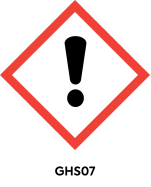
Hazard pictograms :
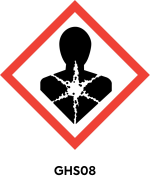
Precautionary statements :
| HAZARD | PRECAUTION |
|---|---|
| H317 May cause an allergic skin reaction.
H361 Suspected of damaging fertility or the unborn child. |
P201 Obtain special instructions before use. P261 Avoid breathing dust/fume/gas/mist/vapours/spray. P280 Wear protective gloves/protective clothing/eye protection/face protection. P281 Use personal protective equipment as required. P308 + P313 IF exposed or concerned: Get medical advice/attention. P333 + P313 If skin irritation or rash occurs: Get medical advice/attention. |
IFRA
IFRA 51th :
This ingredient is restricted by the 51th amendment
-
Restriction type :
RESTRICTION -
Cause of restriction :
DERMAL SENSITIZATION AND SYSTEMIC TOXICITY -
Amendment :
49
Quantitative limit on the use :
| Cat.1 | Cat.2 | Cat.3 | Cat.4 |
Cat.5
A
B
C
D
|
Cat.6 | |||
|---|---|---|---|---|---|---|---|---|
| 0,08 % | 0,053 % | 0,8 % | 0,99 % |
0,25 %
0,25 %
0,25 %
0,083 %
|
||||
|
Cat.5
A
B
C
D
|
Cat.6 | |||||||
|
0,25 %
0,25 %
0,25 %
0,083 %
|
0,08 % | |||||||
|
Cat.7
A
B
|
Cat.8 | Cat.9 |
Cat.10
A
B
|
Cat.11
A
B
|
Cat.12 | |||
|
0,72 %
0,72 %
|
0,083 % | 1,9 % |
1,9 %
5,4 %
|
0,083 %
0,083 %
|
||||
|
Cat.10
A
B
|
Cat.11
A
B
|
Cat.12 | ||||||
|
1,9 %
5,4 %
|
0,083 %
0,083 %
|
No Restriction | ||||||
Disclaimer :
ScenTree is solely responsible for the information provided here.
To learn more about IFRA's standards : https://ifrafragrance.org/safe-use/library