
















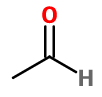
Photo credits: ScenTree SAS
Acetaldehyde
Fruity > Yellow Fruits > Boozy > Earthy > Green
Acetic aldehyde ; Ethanal ; Ethanaldehyde ; Ethyl aldehyde ; Octowy aldehyde


Photo credits: ScenTree SAS
| Company | Ingredient Name | Learn more | Naturality | Certifications | MOQ | Purity |
|---|---|---|---|---|---|---|

|
Acetaldehyde natural | Discover | Natural Aroma Chemicals | - | - |


General Presentation
-
CAS N° :
75-07-0 -
EINECS number :
200-836-8 -
FEMA number :
2003 -
FLAVIS number :
5,001
-
JECFA number :
80 -
Volatility :
Head -
Price Range :
€
Physico-chemical properties
-
Appearance :
Colorless liquid -
Density :
0,785 -
Refractive Index @20°C :
Donnée indisponible. -
Optical rotation :
Donnée indisponible. -
Vapor pressure :
Donnée indisponible. -
Flash Point :
-40°C (-40°F)
-
Molecular formula :
C2H4O -
Molecular Weight :
44,05 g/mol -
Log P :
0,5 -
Fusion Point :
-125°C (-193°F) -
Boiling Point :
21°C (69,8°F) -
Detection Threshold :
0,7 et 200 ppb
Chemistry & Uses
Uses in perfumery :
Acetaldehyde is used in perfumery to bring a juicy note to fruity accords, more often for exotic fruits.
Year of discovery :
Data not available.
Natural availability :
Acetaldehyde is present in the odorous principle of many fruits, many liquors, and can be extracted from certain essential oils such as Litsea Cubeba EO, Magnolia Flower EO, Rosemary EO and many others, in which it is present in very small quantities.
Isomerism :
Acetaldehyde does not have any isomer used in perfumery.
Synthesis precursor :
Acetaldehyde is used in the manufacture of several synthetic compounds such as Damascone-Alpha® or Bourgeonal™, where it is used for aldol condensation. It is also used in acetalization reactions, such as for the synthesis of Hyacinth Body®. It can also be used for the synthesis of Cinnamic Aldehyde, by condensation with Benzaldehyde. It is used in many other syntheses.
Synthesis route :
Acetaldehyde can be synthesized in several ways: the first one is by oxidation of Ethanol with potassium dichromate, in the presence of concentrated sulphuric acid as a catalyst. The second method is by adding water to acetylene. A final synthesis route is hemisynthetic, by fermentation of a plant, then recovery by fractional distillation, and purification by amination, followed by the addition of diluted sulfuric acid.
Stability :
Acetaldehyde is very unstable in various functional bases, bu is used is low quantity. Also able to react with molecules containing nitrogen as Methyl Anthranilate or Indol to form Schiff bases.
Other comments :
Data not available.
Labelling
Allergens :
This ingredient does not contain any allergen.
Signal word :
Danger
Hazard pictograms :



Precautionary statements :
| HAZARD | PRECAUTION |
|---|---|
| H224 Extremely flammable liquid and vapour.
H319 Causes serious eye irritation. H335 May cause respiratory irritation. H351 Suspected of causing cancer. |
P210 Keep away from heat, hot surfaces, sparks, open flames and other ignition sources. No smoking P280 Wear protective gloves/protective clothing/eye protection/face protection. P305 + P351 + P338 IF IN EYES: Rinse cautiously with water for several minutes. Remove contact lenses, if present and easy to do. Continue rinsing. P370 + P378 In case of fire: Use… to extinguish. P403 + P235 Store in a well-ventilated place. Keep cool. |
IFRA
IFRA 51th :
This ingredient is not restricted for the 51th amendment