















Photo credits: ScenTree SAS
Sandalore®
Woody > Sandalwood > Milky > Grapefruit > Leather
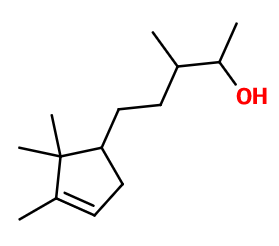
3-methyl-5-(2,2,3-trimethyl-1-cyclopent-3-enyl)pentan-2-ol ; Dersantol ; Landasweet ; Pentamethyl cyclopent-3-ene butanol ; Alpha,beta,2,2,3-pentamethyl cyclopent-3-ene-1-butanol ; Sandal pentanol ; Sandal touch ; Sandalorex ; Sandasweet


Photo credits: ScenTree SAS


General Presentation
-
CAS N° :
65113-99-7 -
EINECS number :
265-453-0 -
FEMA number :
Donnée indisponible. -
FLAVIS number :
Donnée indisponible.
-
JECFA number :
Donnée indisponible. -
Volatility :
Base -
Price Range :
€€
Physico-chemical properties
-
Appearance :
Colorless viscous liquid -
Density :
0,898 -
Refractive Index @20°C :
Donnée indisponible. -
Optical rotation :
Donnée indisponible. -
Vapor pressure :
Donnée indisponible. -
Flash Point :
95°C (203°F)
-
Molecular formula :
C14H26O -
Molecular Weight :
210,36 g/mol -
Log P :
4,7 -
Fusion Point :
< -50°C (< -58°F) -
Boiling Point :
275°C (527°F) -
Detection Threshold :
Donnée indisponible.
Chemistry & Uses
Uses in perfumery :
Sandalore® is used in sandalwood reproductions, woody notes for bringing volume and trail. Used for a milky and creamy effect in sandalwood notes. To be combined with other sandalwood notes such as Sandela®, Bacdanol® or Polysantol®. Not to be put in candle base. Tends to flatten accords.
Year of discovery :
1976
Natural availability :
Sandalore® is not available in its natural state.
Isomerism :
The isomer of Sandalore® formed during the synthesis has a ramified alcohol function, while Sandalore® has it on its main carbon chain. Sandalore® has two asymmetric carbons. It is therefore a mixture of isomers that is used even when Sandalore® is isolated. Adoxal® is a constitutional isomer of Sandalore®. Its smell is however radically different, as it is marine and aldehydic.
Synthesis precursor :
Sandalore® is not a precursor to the synthesis of another compound of olfactory interest.
Synthesis route :
Sandalore® is synthesized by a condensation of Campholenal with Methyl Ethyl Ketone. Then, two compounds are obtained and catalytically hydrogenated to ensure a selectivity of this hydrogenation (the alcene function of the ring must not be hydrogenated). A mixture of two hydrogenated molecules is obtained. These two isomers can be separated by a fractional distillation, or used together, as their smell is similar. The term Sandalore® refers to only one of these two molecules.
Stability :
Unstable in acid cleaners and in very alkaline products.
Labelling
Allergens :
This ingredient does not contain any allergen.
Signal word :
Warning
Hazard pictograms :
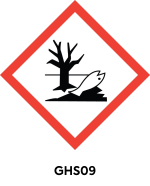
Precautionary statements :
| HAZARD | PRECAUTION |
|---|---|
| H411 Toxic to aquatic life with long lasting effects. | P273 Avoid release to the environment.
P391 Collect spillage. P501 Dispose of contents/container to… |
IFRA
IFRA 51th :
This ingredient is restricted by the 51th amendment
-
Restriction type :
RESTRICTION -
Cause of restriction :
DERMAL SENSITIZATION -
Amendment :
49
Quantitative limit on the use :
| Cat.1 | Cat.2 | Cat.3 | Cat.4 |
Cat.5
A
B
C
D
|
Cat.6 | |||
|---|---|---|---|---|---|---|---|---|
| 0,21 % | 0,062 % | 1,2 % | 1,2 % |
0,29 %
0,29 %
0,29 %
0,29 %
|
||||
|
Cat.5
A
B
C
D
|
Cat.6 | |||||||
|
0,29 %
0,29 %
0,29 %
0,29 %
|
0,68 % | |||||||
|
Cat.7
A
B
|
Cat.8 | Cat.9 |
Cat.10
A
B
|
Cat.11
A
B
|
Cat.12 | |||
|
2,4 %
2,4 %
|
0,12 % | 2,3 % |
8,1 %
8,1 %
|
4,5 %
4,5 %
|
||||
|
Cat.10
A
B
|
Cat.11
A
B
|
Cat.12 | ||||||
|
8,1 %
8,1 %
|
4,5 %
4,5 %
|
No Restriction | ||||||
Disclaimer :
ScenTree is solely responsible for the information provided here.
To learn more about IFRA's standards : https://ifrafragrance.org/safe-use/library