

















Photo credits: ScenTree SAS
Sandela®
Woody > Sandalwood > Milky
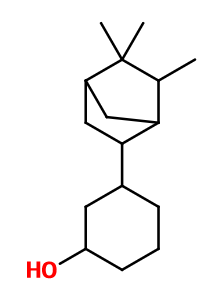
Sandiff® ; 3-[5,5,6-trimethylbicyclo[2.2.1]hept-2-yl]cyclohexan-1-ol ; IBCH (IsoBornylCycloHexanol) ; RhodiantalTM IBCH ; Sandenol extra ; 3-(5,5,6-trimethyl-2-norbornyl)cyclohexanol


Photo credits: ScenTree SAS


General Presentation
-
CAS N° :
3407-42-9 -
EINECS number :
222-294-1 -
FEMA number :
Donnée indisponible. -
FLAVIS number :
Donnée indisponible.
-
JECFA number :
Donnée indisponible. -
Volatility :
Base -
Price Range :
€€
Physico-chemical properties
-
Appearance :
Colorless viscous liquid -
Density :
0,972 -
Refractive Index @20°C :
Donnée indisponible. -
Optical rotation :
Donnée indisponible. -
Vapor pressure :
Donnée indisponible. -
Flash Point :
152°C (305,6°F)
-
Molecular formula :
C16H28O -
Molecular Weight :
236,4 g/mol -
Log P :
5,27 -
Fusion Point :
Donnée indisponible. -
Boiling Point :
160°C (320°F) -
Detection Threshold :
Donnée indisponible.
Chemistry & Uses
Uses in perfumery :
Sandela® is used in woody notes and sandalwood reproductions. To be combined with Sandalore for more facets. This material is often 85% solubilized in Isopropyl Myristate before dilution in alcohol.
Year of discovery :
1942
Natural availability :
Sandela® is not available in its natural state.
Isomerism :
Sandela® is the only one of the isomers resulting from the synthesis described above to be odorous and to present a real interest for perfumery. Ambroxan®, Cedramber® and Muscenone® are constitutional isomers of Sandela®. Their smell can also be woody, or even musky. It is very different anyway.
Synthesis precursor :
Sandela® is not a precursor to the synthesis of another compound of olfactory interest.
Synthesis route :
Sandela® is part of a mixture of isomers synthesized by reaction between Camphene and Guaiacol, in the presence of a Lewis acid such as boron trifluoride. During this first stage, the Camphene undergoes a rearrangement in three forms: Isocamphyl, Isofenchyl and Isobornyl, which gives rise to the mixture of isomers. A high temperature catalytic hydrogenation of these derivatives allows to obtain a new mixture with more isomers. Indeed, the terpenic half of the final molecule may be in axial or equatorial position with respect to the other half of the molecule. 3-trans-Isocamphylcyclohexanol, corresponding to Sandela®, is one of the isomers of the mixture. It is isolated by a fractional distillation. Another method of synthesis starts from Cathecol rather than Guaiacol, and allows to obtain a greater proportion of Sandela® in the final mixture (especially if the hydrogenation step is made under high pressure and catalysed with cobalt).
Stability :
Stable in perfumes and diverse functional bases
Other comments :
Sandela® is less powerful than Bacdanol® and milkier than Sandalore®.
Labelling
Allergens :
This ingredient does not contain any allergen.
Signal word :
Warning
Hazard pictograms :

Precautionary statements :
| HAZARD | PRECAUTION |
|---|---|
| H315 Causes skin irritation.
H319 Causes serious eye irritation. |
P264 Wash ... thoroughly after handling. P280 Wear protective gloves/protective clothing/eye protection/face protection. P302 + P352 IF ON SKIN: Wash with plenty of water/… P305 + P351 + P338 IF IN EYES: Rinse cautiously with water for several minutes. Remove contact lenses, if present and easy to do. Continue rinsing. P321 Specific treatment (see ... on this label). P332 + P313 If skin irritation occurs: Get medical advice/attention. |
IFRA
IFRA 51th :
This ingredient is not restricted for the 51th amendment