















Photo credits: ScenTree SAS
Polysantol®
Woody > Sandalwood > Milky > Buttery
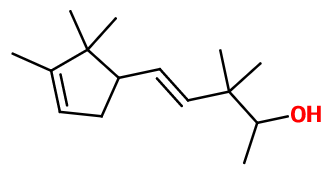
Mysantol® ; (E)-3,3-dimethyl-5-(2,2,3-trimethyl-3-cyclopenten-1-yl)-4-penten-2-ol ; Aquisantol ; Lansantol ; Megasantol ; Nirvanol ; Santol pentenol ; Supersantol ; Trimethyl cyclopentenyl dimethyl isopentenol


Photo credits: ScenTree SAS


General Presentation
-
CAS N° :
107898-54-4 -
EINECS number :
411-580-3 -
FEMA number :
Donnée indisponible. -
FLAVIS number :
Donnée indisponible.
-
JECFA number :
Donnée indisponible. -
Volatility :
Base -
Price Range :
€€
Physico-chemical properties
-
Appearance :
Colorless liquid -
Density :
0,902 -
Refractive Index @20°C :
Donnée indisponible. -
Optical rotation :
Donnée indisponible. -
Vapor pressure :
0,00285 mmHg @23°C -
Flash Point :
>100°C (>212°F)
-
Molecular formula :
C15H26O -
Molecular Weight :
222,37 g/mol -
Log P :
4,7 -
Fusion Point :
Donnée indisponible. -
Boiling Point :
-
Detection Threshold :
Donnée indisponible.
Chemistry & Uses
Uses in perfumery :
Polysantol® is used in woody accords, linked with musky notes, in milk accords and in sandalwood notes in woody perfumes. Brings a cosmetic note.
Year of discovery :
1984 'Polysantol®' trademark has been published and protected by Firmenich SA since 22/10/1985 (brand N°497404)
Natural availability :
Polysantol® is not available in its natural state.
Isomerism :
Polysantol® has a double bond and two asymmetric carbons that give rise to several isomers of this molecule. It is nevertheless its mixture of isomers that is used in perfumery. In addition, Polysantol® is a constitutional isomer of Javanol®. These two compounds have a similar structure, and are used for similar reasons in perfumery. Javanol® has a less milky note than Polysantol®, but is more powerful.
Synthesis precursor :
Polysantol® is not used to synthesize other compounds of organoleptic interest.
Synthesis route :
Polysantol® is synthesized from campholenaldehyde, condensed with butan-2-one in an acid medium to give 3-methyl-5-(2,2,3-trimethyl-3-cyclopenten-1-yl)-3-penten-2-one as an intermediate product. A methylation step under phase transfer conditions provides a new product, which can be reduced by sodium borohydride to get Polysantol®.
Stability :
Stable in perfumes and diverse functional bases
Other comments :
Several sandalwood compounds have similar structures. This is the case of Ebanol, Bacdanol®, Javanol® and Polysantol®. Their structure is composed of a branched cyclopentenic body, and a long carbon chain attached to this cycle. It is on this chain that the differences between the compounds are made.
Labelling
Allergens :
This ingredient does not contain any allergen.
Signal word :
Warning
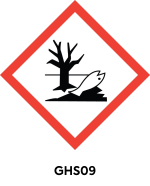
Hazard pictograms :

Precautionary statements :
| HAZARD | PRECAUTION |
|---|---|
| H315 Causes skin irritation.
H410 Very toxic to aquatic life with long lasting effects. |
P264 Wash ... thoroughly after handling. P273 Avoid release to the environment. P280 Wear protective gloves/protective clothing/eye protection/face protection. P302 + P352 IF ON SKIN: Wash with plenty of water/… P332 + P313 If skin irritation occurs: Get medical advice/attention. P391 Collect spillage. |
IFRA
IFRA 51th :
This ingredient is restricted by the 51th amendment
-
Restriction type :
RESTRICTION -
Cause of restriction :
DERMAL SENSITIZATION AND SYSTEMIC TOXICITY -
Amendment :
49
Quantitative limit on the use :
| Cat.1 | Cat.2 | Cat.3 | Cat.4 |
Cat.5
A
B
C
D
|
Cat.6 | |||
|---|---|---|---|---|---|---|---|---|
| 0,031 % | 0,057 % | 0,25 % | 1,1 % |
0,27 %
0,27 %
0,27 %
0,091 %
|
||||
|
Cat.5
A
B
C
D
|
Cat.6 | |||||||
|
0,27 %
0,27 %
0,27 %
0,091 %
|
0,031 % | |||||||
|
Cat.7
A
B
|
Cat.8 | Cat.9 |
Cat.10
A
B
|
Cat.11
A
B
|
Cat.12 | |||
|
0,63 %
0,63 %
|
0,091 % | 1,7 % |
1,7 %
4 %
|
0,091 %
0,091 %
|
||||
|
Cat.10
A
B
|
Cat.11
A
B
|
Cat.12 | ||||||
|
1,7 %
4 %
|
0,091 %
0,091 %
|
No Restriction | ||||||
Disclaimer :
ScenTree is solely responsible for the information provided here.
To learn more about IFRA's standards : https://ifrafragrance.org/safe-use/library