









Photo credits: ScenTree SAS
Rosalva®
Floral > Rosy > Metallic > Mushroom
Trepanol® ; Dec-9-en-1-ol ; 9-decenol ; Decylenic alcohol ; 9-decenyl alcohol ; Omega-decenol


Photo credits: ScenTree SAS
| Company | Ingredient Name | Learn more | Naturality | Certifications | MOQ | Purity |
|---|---|---|---|---|---|---|
|
ROSALVA
ROSA-1
|
Discover | - | 10 grs | - |
ROSA-1


General Presentation
-
CAS N° :
13019-22-2 -
EINECS number :
235-878-6 -
FEMA number :
Donnée indisponible. -
FLAVIS number :
2,138
-
JECFA number :
Donnée indisponible. -
Volatility :
Head/Heart -
Price Range :
€€
Physico-chemical properties
-
Appearance :
Colorless liquid -
Density :
0,845 -
Refractive Index @20°C :
Donnée indisponible. -
Optical rotation :
Donnée indisponible. -
Vapor pressure :
0,0060 mmHg @23°C -
Flash Point :
99°C (210,2°F)
-
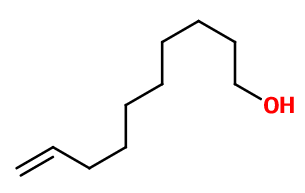
Molecular formula :
C10H20O -
Molecular Weight :
156,27 g/mol -
Log P :
3,7 -
Fusion Point :
Donnée indisponible. -
Boiling Point :
236°C (456,8°F) -
Detection Threshold :
1,6 ng/l air
Chemistry & Uses
Uses in perfumery :
Rosalva® is used in marine, violet flower, aldehydic, green and aromatic notes. Used more generally in floral notes.
Year of discovery :
Data not available.
Natural availability :
Rosalva® is found in Cardamom EO and in trace amounts in cognac, but it is not extracted naturally. Only the synthetic compound is used in perfumery.
Isomerism :
One of the isomers of Rosalva® is used in perfumery: 2-decenol (the alcene function is placed on carbon 2 rather than 9), which smell is more waxy and ozonic. Therefore, two positional isomers can have a very different smell. Rosalva® is a constitutional isomer of Patchone, L-Menthol, Dihydromyrcenol and Citronellol, although it has a much more rosy and honeyed smell.
Synthesis precursor :
Rosalva® is not a precursor to the synthesis of another compound of olfactory interest.
Synthesis route :
Rosalva® is an aliphatic alcohol synthesized by a partial dehydration of 1,10-decandiol.
Stability :
Stable in perfumes and diverse functional bases
Other comments :
Comparing it to Rosyrane Super®, Rosalva® has a distinctive mushroom note.
Labelling
Allergens :
This ingredient does not contain any allergen.
Signal word :
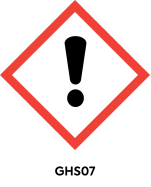
Warning
Hazard pictograms :
Precautionary statements :
| HAZARD | PRECAUTION |
|---|---|
| H315 Causes skin irritation.
H319 Causes serious eye irritation. |
P264 Wash ... thoroughly after handling. P280 Wear protective gloves/protective clothing/eye protection/face protection. P302 + P352 IF ON SKIN: Wash with plenty of water/… P332 + P313 If skin irritation occurs: Get medical advice/attention. P337 + P313 If eye irritation persists: Get medical advice/attention. P362 Take off contaminated clothing. |
IFRA
IFRA 51th :
This ingredient is not restricted for the 51th amendment