










Opoponax oil
Green > Mushroom > Balsamic > Leather > Earthy


| Company | Ingredient Name | Learn more | Naturality | Certifications | MOQ | Latin name | Treated part | Origin |
|---|---|---|---|---|---|---|---|---|

|
OPOPONAX
F1828
|
Discover | Huile essentielle |


|
- | Commiphora erythraea(Ehrenb.) Engl. | Exsudat | Somalie |
|
OPOPONAX EO
OPOHE-1
|
Discover | Naturel | 10 grs | - | - | - | |

|
OPOPONAX EO
968188
|
Discover | Naturals | - | COMMIPHORA ERYTHRAEA | - | - | |

|
Huile essentielle d'Opoponax - 30 gr | Discover | - | 30grs | - | - | - | |

|
OPOPONAX Essential Oil
M_0020100
|
Discover | Naturel | - | - | - | - | |
|
|
OPOPONAX Rectified Essential Oil
M_0052405
|
Discover | Naturel | - | - | - | - |
F1828

OPOHE-1
968188
M_0020100
M_0052405

General Presentation
-
CAS N° :
8021-36-1 -
EINECS number :
639-660-5 -
FEMA number :
Donnée indisponible.
-
Volatility :
Heart -
Price Range :
€€€€€
Physico-chemical properties
-
Appearance :
Yellow to dark yellow liquid -
Density :
0,880 - 0,912 @20°C -
Refractive Index @20°C :
Donnée indisponible. -
Optical rotation :
-
Vapor pressure :
Donnée indisponible. -
Flash Point :
94°C (201,2°F) -
Acid Value :
Botanical informations
Botanical name :
Botanical profile :
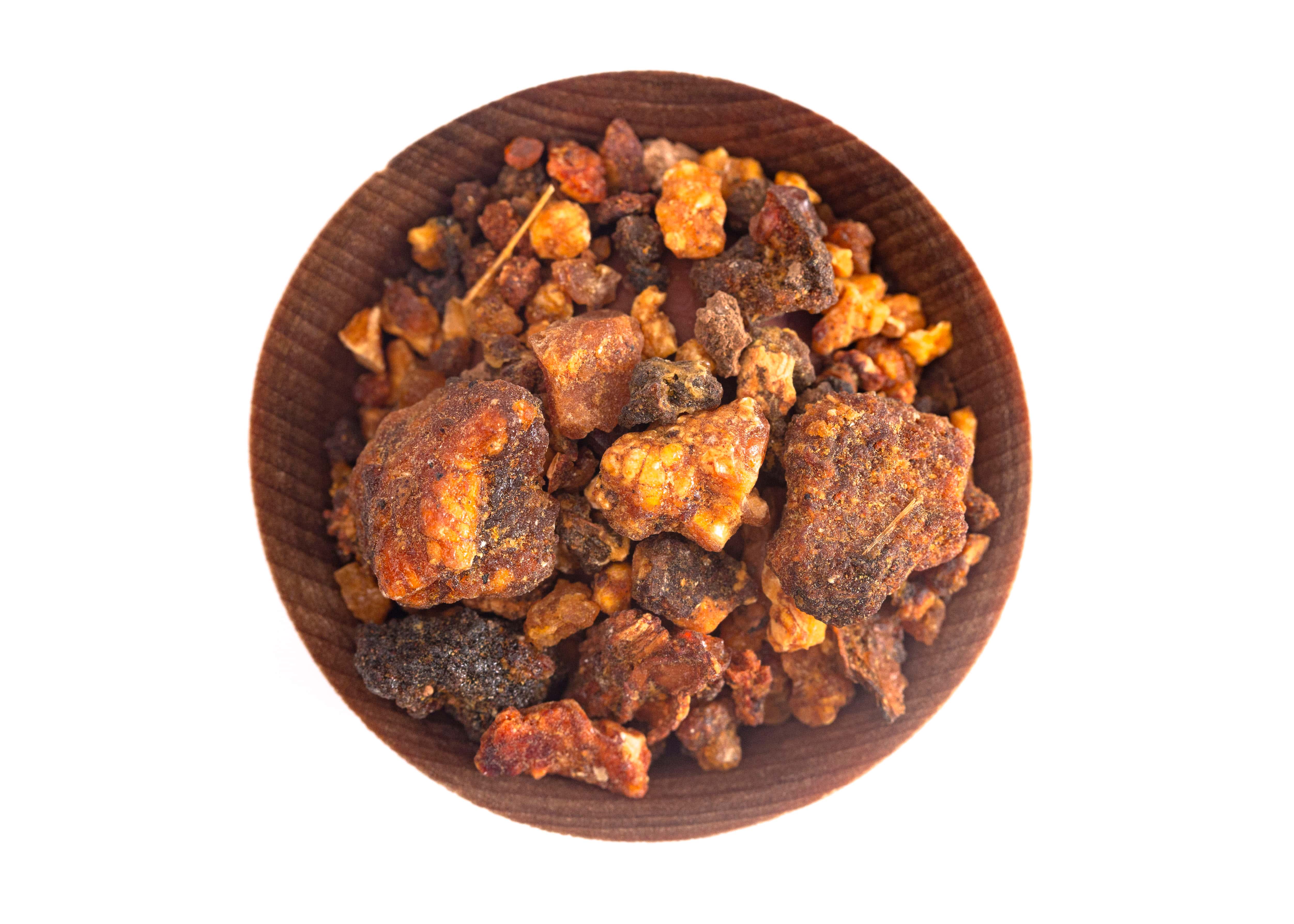
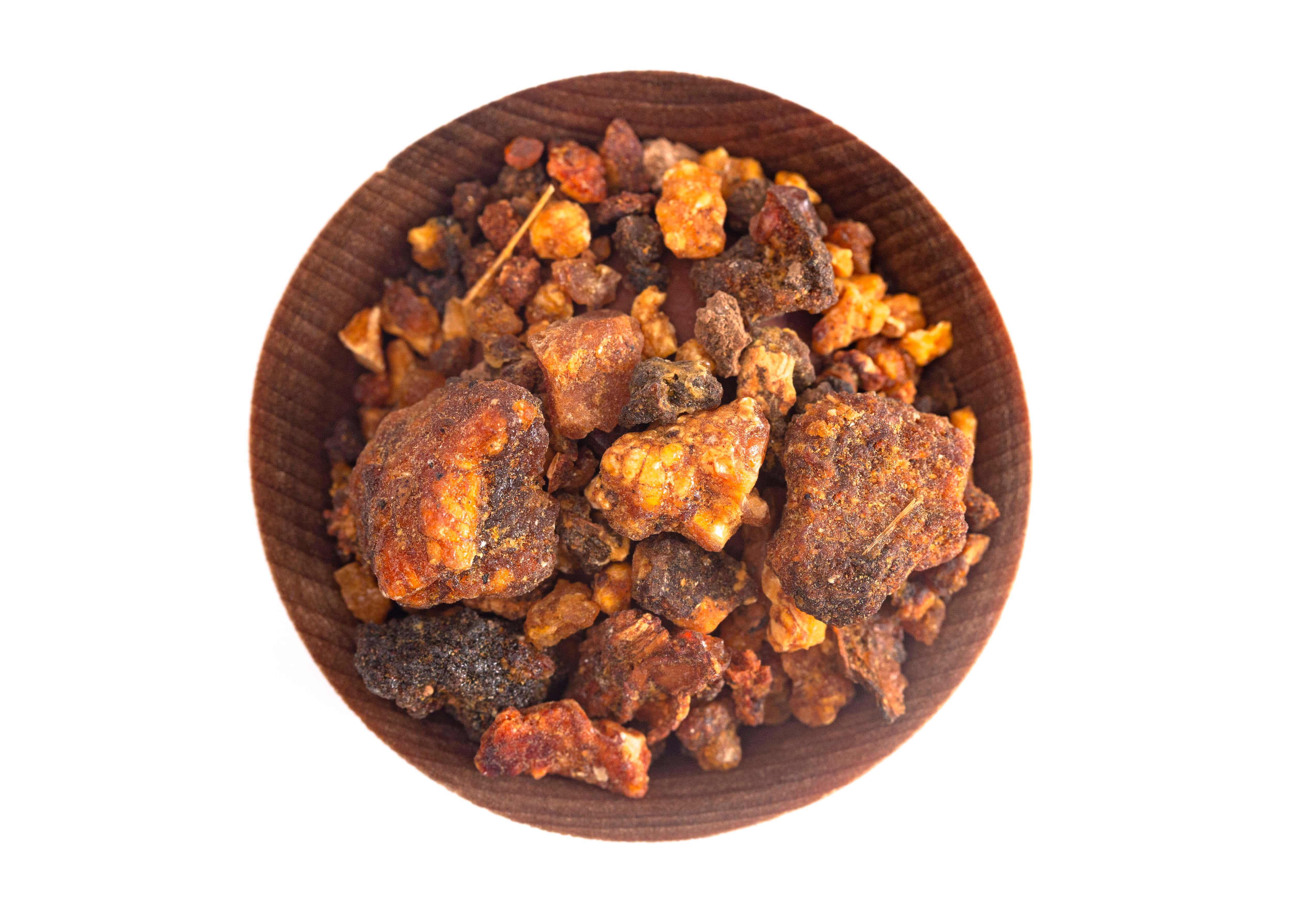
Opoponax is the resin of a tree of the same name, belonging to the Burseraceae family (which also includes frankincense, elemi, and myrrh) and the genus Commiphora Jacq.
Chemotypes :
Commiphora Jacq. groups nearly 200 species.
In perfumery, we use two of them :
- Commiphora myrrha (Nees) Engl. : Myrrh resinoid / Myrrh oil / Myrrh SFE / Myrrh absolute, mainly cultivated in the East-North of Africa
- Commiphora kataf (Forssk.) Engl. : Opoponax oil / Opoponax resinoid / Opoponax SFE / Opoponax absolute / Opoponax extract
Extractions & Uses
Extraction process :
As for myrrh, the resin secretion of the opoponax tree is provoked to let the resin tears flow down the bark of the tree. Once dry, these tears are collected with a blade and freed from their impurities by filtration. After that, they are exported to Europe to be extracted.
An essential oil and a resinoid can be obtained. The essential oil is obtained by steam distillation of the resin, under high pressure. Aromatic compounds are brought to a condensor, to settle the essential oil in a florentine flask, over water.
Opoponax Resinoid is obtained by diluting the tree resin in cold alcohol and after filtration and evaporation of the solvent. It is also possible to obtain a supercritical CO2 extract of myrrh with a superior olfactory quality.
The resinoid may be bleached by distillation.
From the same botanical variety
Uses in perfumery :
Used over all in woody, spicy and incense notes and in oriental perfumes to bring a spicy-woody and natural effect.
Stability :
The terpenes identified in this raw material can polymerize when they are oxidized
Major Components :
| Component | % min | % max |
|---|---|---|
| Elemène | ||
| Capène | ||
| Sesquiterpenes and furanic sesquiterpenones | ||
| Sesquiterpènes et sesquiterpénones furaniques |
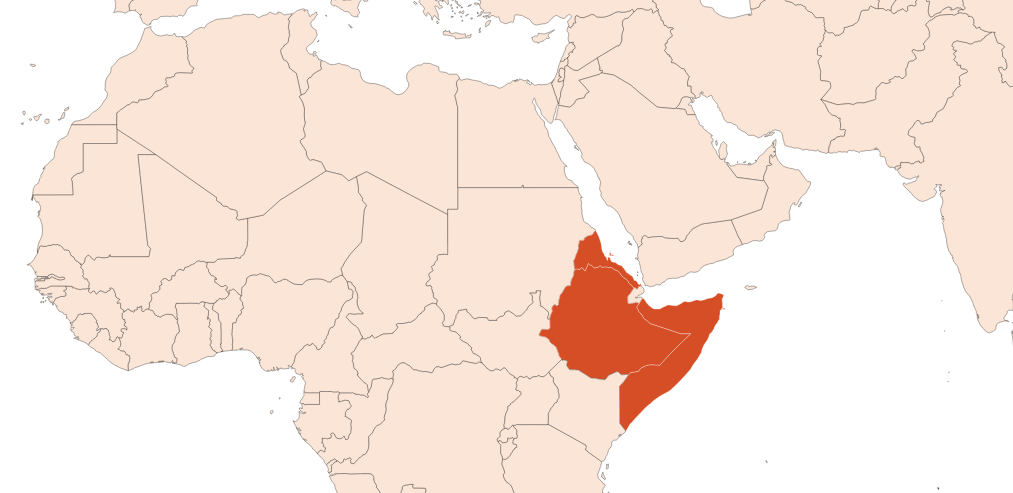
Photo credits: ScenTree SAS
Other comments :
Originally, opoponax was one of the resins that were burned for the gods because the fumigations are smellious and considered as an offering in this regard.
Originally, opoponax was one of the resins that were burned for the gods because the fumigations are smellious and considered as an offering in this regard.
Labelling
Allergens :
Cinnamates
Signal word :
Danger
Hazard pictograms :
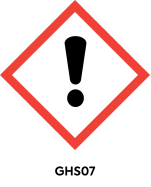
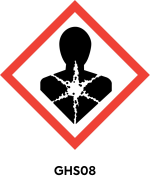
Precautionary statements :
| HAZARD | PRECAUTION |
|---|---|
| H304 May be fatal if swallowed and enters airways.
H315 Causes skin irritation. H317 May cause an allergic skin reaction. |
P261 Avoid breathing dust/fume/gas/mist/vapours/spray. P264 Wash ... thoroughly after handling. P272 Contaminated work clothing should not be allowed out of the workplace. P280 Wear protective gloves/protective clothing/eye protection/face protection. P301 + P310 IF SWALLOWED: Immediately call a POISON CENTER/doctor/… P302 + P352 IF ON SKIN: Wash with plenty of water/… |
IFRA
IFRA 51th :
This ingredient is restricted by the 51th amendment

-
Restriction type :
RESTRICTION_SPECIFICATION -
Cause of restriction :
DERMAL SENSITIZATION -
Amendment :
49
Quantitative limit on the use :
| Cat.1 | Cat.2 | Cat.3 | Cat.4 |
Cat.5
A
B
C
D
|
Cat.6 | |||
|---|---|---|---|---|---|---|---|---|
| 0,077 % | 0,023 % | 0,46 % | 0,43 % |
0,11 %
0,11 %
0,11 %
0,11 %
|
||||
|
Cat.5
A
B
C
D
|
Cat.6 | |||||||
|
0,11 %
0,11 %
0,11 %
0,11 %
|
0,25 % | |||||||
|
Cat.7
A
B
|
Cat.8 | Cat.9 |
Cat.10
A
B
|
Cat.11
A
B
|
Cat.12 | |||
|
0,88 %
0,88 %
|
0,045 % | 0,84 % |
3 %
3 %
|
1,7 %
1,7 %
|
||||
|
Cat.10
A
B
|
Cat.11
A
B
|
Cat.12 | ||||||
|
3 %
3 %
|
1,7 %
1,7 %
|
No Restriction | ||||||
Specified ingredients: notes
Opoponax oil can be obtained from solvent extraction or pyrolysis.
Opoponax oil obtained through pyrolysis shall be rectified according to Good Manufacturing Practices (GMP) and the content of Polycyclic Aromatic Hydrocarbons (PAH) resulting from their use shall respect the following requirement:
Benzopyrene and 1,2-Benzanthracene are to be used as markers for PAH. If used alone or in combination with rectified Cade oil, rectified Birch tar oils or rectified Styrax oil, the total concentration of both of the markers should not exceed 1 ppb in the final product.
Disclaimer :
ScenTree is solely responsible for the information provided here.
To learn more about IFRA's standards : https://ifrafragrance.org/safe-use/library