











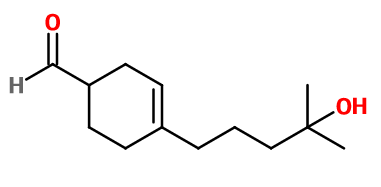
Photo credits: ScenTree SAS
Lyral®
Floral > Light Flowers > Aldehydes > Fresh Flowers > Aquatic
Kovanol® ; Leerall® ; 4-(4-hydroxy-4-methylpentyl)cyclohex-3-ene-1-carbaldehyde ; Cyclohexal ; 4-(4-hydroxy-4-methylpentyl)-3-cyclohexene-1-carboxaldehyde ; Kovyral ; Landolal ; Lanyral ; Lydoucal ; Lysinal ; Mugonal


Photo credits: ScenTree SAS


General Presentation
-
CAS N° :
31906-04-4 -
EINECS number :
250-863-4 -
FEMA number :
Donnée indisponible. -
FLAVIS number :
Donnée indisponible.
-
JECFA number :
Donnée indisponible. -
Volatility :
Heart -
Price Range :
€€
Physico-chemical properties
-
Appearance :
Colorless liquid that crystallizes at room temperature -
Density :
0,995 -
Refractive Index @20°C :
1,486 - 1,492 -
Optical rotation :
Donnée indisponible. -
Vapor pressure :
0,0075 mmHg @20°C -
Flash Point :
105°C (221°F)
-
Molecular formula :
C13H22O2 -
Molecular Weight :
210,32 g/mol -
Log P :
2,08 -
Fusion Point :
-20°C (-4°F) -
Boiling Point :
121°C (249,8°F) -
Detection Threshold :
0,1 ng/l air
Chemistry & Uses
Uses in perfumery :
Lyral® is used in floral notes such as white flowers, lily of the valley, lilac or lily.
Year of discovery :
Discovered in 1958. Patent N°868,850 published on May 8, 1958 by IFF
Natural availability :
Lyral® is not available in its natural state.
Isomerism :
The positional isomer that is formed during the synthesis of Lyral® has no great olfactory difference with Lyral® used in perfumery. Geranyl Propionate is a constitutional isomer of Lyral®. Their smell is very different as Geranyl Propionate is much rosier.
Synthesis precursor :
Lyral® forms Schiff bases in the presence of amino compounds such as Methyl Anthranilate or Indole.
Synthesis route :
Lyral® is synthesized by a Diels-Alder reaction between Myrcenol and Acrolein (or Propenal) in the presence of a Lewis catalyst such as zinc chloride. When this reaction is performed without a catalyst and at a high temperature, it results in the formation of a mixture of two positional isomers of Lyral®, although Lyral® is still predominant (70%).
Stability :
Aldehydes may form diethylacetals in alcoholic perfumes, with no real impact on their smell.
Other comments :
Lyral® was subject to a recall procedure in 2019, and its use will be banned in 2021.
It is one of the 26 allergens in perfumery.
Labelling
Allergens :
This ingredient does not contain any allergen.
Signal word :
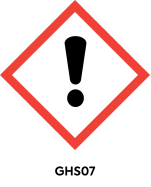
Warning
Hazard pictograms :
Precautionary statements :
| HAZARD | PRECAUTION |
|---|---|
| H317 May cause an allergic skin reaction.
H412 Harmful to aquatic life with long lasting effects. |
P261 Avoid breathing dust/fume/gas/mist/vapours/spray. P273 Avoid release to the environment. P280 Wear protective gloves/protective clothing/eye protection/face protection. P333 + P313 If skin irritation or rash occurs: Get medical advice/attention. P363 Wash contaminated clothing before reuse. P501 Dispose of contents/container to… |
IFRA
IFRA 51th :
This ingredient is restricted by the 51th amendment
-
Restriction type :
RESTRICTION -
Cause of restriction :
DERMAL SENSITIZATION AND SYSTEMIC TOXICITY -
Amendment :
49
Quantitative limit on the use :
| Cat.1 | Cat.2 | Cat.3 | Cat.4 |
Cat.5
A
B
C
D
|
Cat.6 | |||
|---|---|---|---|---|---|---|---|---|
| 0,02 % | 0,02 % | 0,1 % | 0,2 % |
0,2 %
0,2 %
0,2 %
0,067 %
|
||||
|
Cat.5
A
B
C
D
|
Cat.6 | |||||||
|
0,2 %
0,2 %
0,2 %
0,067 %
|
0,2 % | |||||||
|
Cat.7
A
B
|
Cat.8 | Cat.9 |
Cat.10
A
B
|
Cat.11
A
B
|
Cat.12 | |||
|
0,02 %
0,02 %
|
0,067 % | 0,2 % |
0,2 %
0,2 %
|
0,067 %
0,067 %
|
||||
|
Cat.10
A
B
|
Cat.11
A
B
|
Cat.12 | ||||||
|
0,2 %
0,2 %
|
0,067 %
0,067 %
|
91 % | ||||||
Restricted ingredients: notes
The restrictions as given for the individual categories are not based on the Quantitative Risk Assessment (QRA) methodology but solely represent a pragmatic approach to address the specific situation for 3 and 4-(4-Hydroxy-4-methylpentyl)-3-cyclohexene-1-carboxaldehyde (HMPCC).
Disclaimer :
ScenTree is solely responsible for the information provided here.
To learn more about IFRA's standards : https://ifrafragrance.org/safe-use/library