












Photo credits: ScenTree SAS
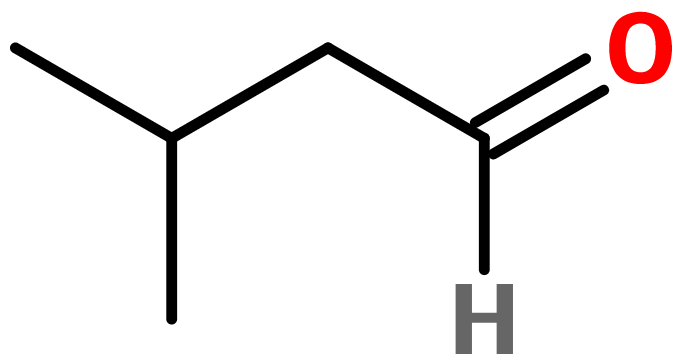
Isovaleraldehyde
Fruity > Berries > Etheric Solvent > Green Fruits > Gourmand
Isoamyl aldehyde ; 3-methylbutanal ; 3-methyl butanal ; 3-methylbutan-1-al ; 3-methyl butan-1-al ; 3-methyl butyraldehyde ; 3-methyl-1-butanal ; Isopentaldehyde ; Isovaleral ; Isovaleric aldehyde


Photo credits: ScenTree SAS
| Company | Ingredient Name | Learn more | Naturality | Certifications | MOQ | Purity |
|---|---|---|---|---|---|---|

|
ISOVALERIC ALDEHYDE
IVAL-1
|
Discover | - | 10 grs | 97.0 - 100.0 | |

|
Iso Valeraldehyde | Discover | Synthetic Aroma Chemicals | - | - | |
|
|
Iso Valeraldehyde natural | Discover | Natural Aroma Chemicals | - | - |
IVAL-1


General Presentation
-
CAS N° :
590-86-3 -
EINECS number :
209-691-5 -
FEMA number :
2692 -
FLAVIS number :
5,006
-
JECFA number :
258 -
Volatility :
Head -
Price Range :
Data not available.
Physico-chemical properties
-
Appearance :
Colorless liquid -
Density :
0,803 -
Refractive Index @20°C :
1,382 -
Optical rotation :
Donnée indisponible. -
Vapor pressure :
Donnée indisponible. -
Flash Point :
- 5°C (23°F)
-
Molecular formula :
C5H10O -
Molecular Weight :
86,13 g/mol -
Log P :
1,5 -
Fusion Point :
-51°C (-59,8°F) -
Boiling Point :
90°C (194°F) -
Detection Threshold :
Donnée indisponible.
Chemistry & Uses
Uses in perfumery :
Isovaleraldehyde is used in cherry and chocolate notes, to bring a liquorous head note.
Year of discovery :
Data not available.
Natural availability :
Isovaleraldehyde is found in the odorous principle of many fruits and food we consume every day : apple, ginger, beef, lovage…
Isomerism :
Isovaleraldehyde does not have any isomer used in perfumery.
Synthesis precursor :
Isovaleraldehyde can be used to synthesize Schiff bases, reacting with Methyl Anthranilate or Indole for example.
Synthesis route :
Isovaleraldehyde is synthesized by oxydation of Isoamyl Alcohol.
Stability :
This molecule may form Schiff bases by reacting with Methyl Anthranilate or Indole for example, forming another colored and differently smelling compound.
Other comments :
Isovaleraldehyde can be compared to Furfural, standing out thanks to its more pyrogenic and bitter almond gourmand note. Isovaleraldehyde is more etheric and fruity-cherry and pear.
Labelling
Allergens :
This ingredient does not contain any allergen.
Signal word :
Danger
Hazard pictograms :

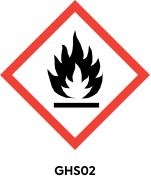
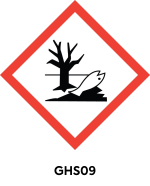
Precautionary statements :
| HAZARD | PRECAUTION |
|---|---|
| H225 Highly flammable liquid and vapour.
H317 May cause an allergic skin reaction. H319 Causes serious eye irritation. H335 May cause respiratory irritation. H411 Toxic to aquatic life with long lasting effects. |
IFRA
IFRA 51th :
This ingredient is not restricted for the 51th amendment