












Photo credits: ScenTree SAS
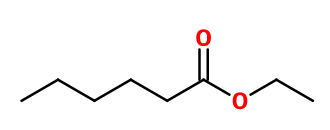
Ethyl caproate
Fruity > Tropical Fruits > Butyric
Ethyl Hexanoate ; Hexanoic acid ethyl ester ; Ethyl hexoate


Photo credits: ScenTree SAS
| Company | Ingredient Name | Learn more | Naturality | Certifications | MOQ | Purity |
|---|---|---|---|---|---|---|

|
ETHYL HEXANOATE
ETHEX-1
|
Discover | - | 10 grs | 99 - 100 | |

|
ETHYL CAPROATE
M_0050625
|
Discover | Naturel | - | - | |

|
Ethyl Caproate (Hexanoate) | Discover | Synthetic Aroma Chemicals | - | - | |
|
|
Ethyl Caproate natural | Discover | Natural Aroma Chemicals | - | - |
ETHEX-1

M_0050625

General Presentation
-
CAS N° :
123-66-0 -
EINECS number :
204-640-3 -
FEMA number :
2439 -
FLAVIS number :
9,06
-
JECFA number :
31 -
Volatility :
Head -
Price Range :
€
Physico-chemical properties
-
Appearance :
Colorless liquid -
Density :
0,869 -
Refractive Index @20°C :
1,406 - 1,409 -
Optical rotation :
Donnée indisponible. -
Vapor pressure :
1,6576 mmHg @25°C -
Flash Point :
53°C (127,4°F)
-
Molecular formula :
C8H16O2 -
Molecular Weight :
144,21 g/mol -
Log P :
2,8 -
Fusion Point :
Donnée indisponible. -
Boiling Point :
168°C (334,4°F) -
Detection Threshold :
0,3 à 5 ppb (0,0000005%)
Chemistry & Uses
Uses in perfumery :
Ethyl Caproate is used in exotic, fruity, tropical fruits and yellow fruits notes to ripen fruits. Also used in cheese notes, fruity and floral accords. Can accompany aldehydes in a rose accord.
Year of discovery :
Data not available.
Natural availability :
Ethyl Caproate is present in many fruits such as apple, guava or banana and in some cheeses, among others. There is also an Ethyl Caproate of natural origin.
| Ingredient | % min | % max |
|---|---|---|
| Wine lees oil (white) |
Isomerism :
Ethyl Caproate does not have any isomer used in perfumery.
Synthesis precursor :
Ethyl Caproate is not a precursor to the synthesis of another compound of olfactory interest.
Synthesis route :
Ethyl Caproate is synthesized by an esterification reaction between Hexanoic Acid and ethanol, using acid catalysis.
Stability :
May form caproic acid through time
Other comments :
Data not available.
Labelling
Allergens :
This ingredient does not contain any allergen.
Signal word :
Warning
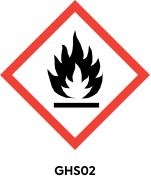
Hazard pictograms :
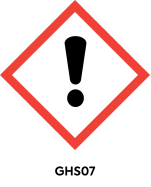
Precautionary statements :
| HAZARD | PRECAUTION |
|---|---|
| H226 Flammable liquid and vapour.
H315 Causes skin irritation. H319 Causes serious eye irritation. H335 May cause respiratory irritation. |
P261 Avoid breathing dust/fume/gas/mist/vapours/spray. P305 + P351 + P338 IF IN EYES: Rinse cautiously with water for several minutes. Remove contact lenses, if present and easy to do. Continue rinsing. |
IFRA
IFRA 51th :
This ingredient is not restricted for the 51th amendment