








Photo credits: ScenTree SAS
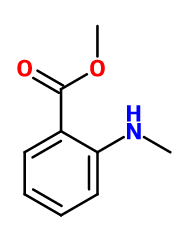
Dimethyl anthranilate
Floral > Orange Blossom > Anthranilic > Earthy
Methyl 2-methylaminobenzoate ; Methyl 2-(methyl amino) benzoate ; Methyl 2-(methylamino) benzoate ; Methyl 2-amino-3-methylbenzoate ; Methyl 2-amino-3-methylbenzenecarboxylate ; Methyl 2-methylaminobenzoate ;Mmethyl 3-methylanthranilate ; Methyl methyl anthranilate ; Methyl methanthranilate ; Methyl anthranilate methyl ; Methyl N-methyl anthranilate ; Methyl N-methyl-2-aminobenzoate ; Methyl 2-methylaminobenzoate


Photo credits: ScenTree SAS
| Company | Ingredient Name | Learn more | Naturality | Certifications | MOQ | Purity |
|---|---|---|---|---|---|---|
|
DIMETHYL ANTHRANILATE
DIMAN-2
|
Discover | - | 10 grs | - | |
|
Anthranilate de dimethyle - 30Gr | Discover | - | 30grs | - | |

|
METHYL METHYL ANTHRANILATE
M_0050657
|
Discover | Naturel | - | - | |

|
Dimethyl Anthranilate natural | Discover | Natural Aroma Chemicals | - | - |
DIMAN-2

M_0050657

General Presentation
-
CAS N° :
85-91-6 -
EINECS number :
201-642-6 -
FEMA number :
2718 -
FLAVIS number :
9,781
-
JECFA number :
480 -
Volatility :
Heart -
Price Range :
€€
Physico-chemical properties
-
Appearance :
Orange liquid -
Density :
1,138 -
Refractive Index @20°C :
1,578 – 1,581 -
Optical rotation :
Donnée indisponible. -
Vapor pressure :
0,0099 mmHg @20°C 0,0195 mmHg @25°C -
Flash Point :
91°C (195,8°F)
-
Molecular formula :
C9H11NO2 -
Molecular Weight :
165,19 g/mol -
Log P :
2,69 -
Fusion Point :
18°C (64,4°F) -
Boiling Point :
256°C (492,8°F) -
Detection Threshold :
Donnée indisponible.
Chemistry & Uses
Uses in perfumery :
Dimethyl Anthranilate is used in floral and fruity notes. Very useful in tangerine accords. May be associated with warm woods, but less with fresher woods.
Year of discovery :
Data not available.
Natural availability :
Dimethyl Anthranilate is one of the major constituents of the Petitgrain Mandarin EO and is also present in Mandarin Yellow EO. It can be extracted from these oils in its natural state.
| Ingredient | % min | % max |
|---|---|---|
| Mandarin oil (yellow) | 0.50 | |
| Mandarin oil (red) | 0.50 | |
| Mandarin oil (green) | 0.50 | |
| Petitgrain mandarin oil | 40 | 55 |
Isomerism :
Dimethyl Anthranilate does not have any isomer used in perfumery.
Synthesis precursor :
Dimethyl Anthranilate easily produces Schiff bases by reaction with aldehydes.
Synthesis route :
Dimethyl Anthranilate is prepared from Methyl Anthranilate by a methylation reaction of the amine function of the molecule. This reaction is made in an acid medium.
Stability :
Can color through time. As Methyl Anthranilate, this compound is well known for synthesizing Schiff bases by reacting espacially with aldehydes. These compounds can have an olfactive interest but are still a source of coloration in perfume concentrates and perfumes besides others. This is why this raw material is used is small quantities.
Very unstable in acidic products, except fabric conditioners, and in very basic products
Other comments :
Methyl Anthranilate is more associated with Orange Blossom Absolute notes and fruity notes of wild strawberry than Dimethyl Anthranilate, closer to Mandarin Yellow EO.
Labelling
Allergens :
This ingredient does not contain any allergen.
Signal word :
Warning
Hazard pictograms :

Precautionary statements :
| HAZARD | PRECAUTION |
|---|---|
| H319 Causes serious eye irritation.
H412 Harmful to aquatic life with long lasting effects. |
IFRA
IFRA 51th :
This ingredient is restricted by the 51th amendment
-
Restriction type :
RESTRICTION_SPECIFICATION -
Cause of restriction :
PHOTOTOXICITY AND SYSTEMIC TOXICITY, POTENTIAL OF NITROSAMINE FORMATION -
Amendment :
51
Quantitative limit on the use :
| Cat.1 | Cat.2 | Cat.3 | Cat.4 |
Cat.5
A
B
C
D
|
Cat.6 | |||
|---|---|---|---|---|---|---|---|---|
| 0,10 % | 0,10 % | 0,10 % | 0,10 % |
0,10 %
0,10 %
0,10 %
0,10 %
|
||||
|
Cat.5
A
B
C
D
|
Cat.6 | |||||||
|
0,10 %
0,10 %
0,10 %
0,10 %
|
0,50 % | |||||||
|
Cat.7
A
B
|
Cat.8 | Cat.9 |
Cat.10
A
B
|
Cat.11
A
B
|
Cat.12 | |||
|
0,50 %
0,10 %
|
0,10 % | 0,50 % |
0,50 %
0,10 %
|
No restriction
0,10 %
|
||||
|
Cat.10
A
B
|
Cat.11
A
B
|
Cat.12 | ||||||
|
0,50 %
0,10 %
|
No restriction
0,10 %
|
No restriction | ||||||
Annexe I :
Some regulated synthetic ingredients are found in nature and in certain proportions in natural ingredients. This presence in nature has to be taken into account when calculating limits of use recommended by the IFRA. In case you do not know these concentrations, you can use the ones estimated by the IFRA. Here they are :
| List of regulated compounds contained in this ingredient | |||
|---|---|---|---|
| Ingredient Name | Botanical Name | CAS N° | Estimated Concentration |
| Mandarin oil | Citrus reticulata Blanco | 8008-31-9 | 0,4 |
| Petitgrain mandarin oil | Citrus reticulata Blanco | 8014-17-3 | 50,13 |
| Petitgrain oil, Paraguay | Citrus aurantium L. spp. Amara Link | 8014-17-3 | 0,06 |
| Clementine oil | Citrus clementina Hort. Ex Tan | 93686-22-7 | 0,03 |
| Genet absolute | Spartium junceum L. | 90131-21-8 | 0,34 |
Restricted ingredients due to phototoxicity considerations: notes
This Standard is set due to the phototoxic effects of Methyl N-methylanthranilate. For more detailed information on the application of this Standard, please refer to the note on phototoxic ingredients in chapter 1 of the Guidance for the use of IFRA Standards.
Specified ingredients: notes
This material has been identified for having the potential of forming nitrosamines in nitrosating systems. Downstream users therefore have to be notified of the presence of the material and its potential, to be able to consider adequate protective measures.
Disclaimer :
ScenTree is solely responsible for the information provided here.
To learn more about IFRA's standards : https://ifrafragrance.org/safe-use/library