






Photo credits: ScenTree SAS
| Company | Ingredient Name | ID | Comments | Naturality | Certifications | MOQ | Purity |
|---|---|---|---|---|---|---|---|
|
CINNAMIC ALCOHOL | ACS-1 |
Visit website

|
- |


|
10 grs | 99 - 100 |
|
Cinnamic Alcohol | - |
Visit website
|
Synthetic Aroma Chemicals | - | - | |
|
Alcool Cinnamique - 30 Gr | - |
Visit website
|
- | - | - |


General Presentation
-
CAS N° :
104-54-1 -
EINECS number :
203-212-3 -
FEMA number :
2294 -
FLAVIS number :
02.017
-
JECFA number :
647 -
Volatility :
Heart/Base -
Price Range :
€€
Physico-chemical properties
-
Appearance :
Colorless liquid that crystallizes at room temperature -
Density :
1,044 -
Refractive Index @20°C :
1,582 -
Optical rotation :
Donnée indisponible. -
Vapor pressure :
0,012 mmHg @25°C -
Flash Point :
126°C (258,8°F)
-
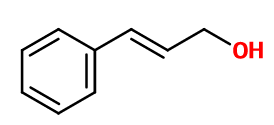
Molecular formula :
C9H10O -
Molecular Weight :
134,17 g/mol -
Log P :
1,64 -
Fusion Point :
32°C (89,6°F) -
Boiling Point :
250°C (482°F) -
Detection Threshold :
Le seuil de détection de cette molécule n'est pas le même pour sa forme cis (81 ppb) et sa forme trans (2,8 ppm)
Chemistry & Uses
Uses in perfumery :
Cinnamyl Alcohol is suitable for ambery and solar flowers notes. Brings a cinnamon facet that is both warm and spicy. Very good fixator.
Year of discovery :
1881
Natural availability :
Cinnamyl Alcohol is naturally present in Ceylon Cinnamon EO (and other origins), Peru Balsam Resinoid and Tolu Balsam Resinoid, from which it can be extracted by fractional distillation.
Isomerism :
Cinnamyl Alcohol exists as two diastereomers naturally present in nature: the (E) trans form is the most abundant in nature and can be extracted from many plants such as Styrax EO. Cis form is much more powerful (see Other Comments). Ethyl Vanillin is a constitutional isomer of Cinnamyl Alcohol, although their smell is different as Cinnamyl Alcohol is much spicier and less sweet.
Synthesis precursor :
Cinnamyl Alcohol is a precursor to the synthesis of cinnamyl esters, such as Cinnamyl acetate or Cinnamyl Benzoate, which are used in perfumery.
Synthesis route :
Cinnamyl Alcohol is synthesized by a reduction of Cinnamaldehyde, the major component of cinnamon essential oil. This can be done in three ways. The Meerwein-Ponndorf reduction (85% yield) reduces the aldehyde in the presence of Benzyl or Isopropyl Alcohol and their aluminum alkoxide. A second reduction is made with a yield of 95%, in the presence of osmium tetroxide. Finally, a last reduction can be made from Cinnamaldehyde in the presence of sodium tetrahydruroborate.
Stability :
Most of the time, the occurrence of a benzenic cycle in a molecule causes a coloration of this molecule through time
Other comments :
Cinnamyl Alcohol is less powerful, heady and warm than Cinnamaldehyde. Cinnamyl Alcohol is one of the 26 allergens in perfumery.
Labelling
Allergens :
This ingredient does not contain any allergen.
IFRA
IFRA 51th :
This ingredient is restricted by the 51th amendment
-
Restriction type :
RESTRICTION -
Cause of restriction :
DERMAL SENSITIZATION AND SYSTEMIC TOXICITY -
Amendment :
49
- Quantitative limit on the use :
-
Cat.1 Cat.2 Cat.3 Cat.4 Cat.5A B C DCat.6 0,22 % 0,067 % 0,25 % 1,2 % 0,32 % 0,25 % 0,25 % 0,085 %Cat.5A B C DCat.6 0,32 % 0,25 % 0,25 % 0,085 %0,13 % Cat.7A BCat.8 Cat.9 Cat.10A BCat.11A BCat.12 0,25 % 0,25 %0,085 % 0,76 % 0,76 % 2 %0,085 % 0,085 %Cat.10A BCat.11A BCat.12 0,76 % 2 %0,085 % 0,085 %51 %
Annexe I :
Some regulated synthetic ingredients are found in nature and in certain proportions in natural ingredients. This presence in nature has to be taken into account when calculating limits of use recommended by the IFRA. In case you do not know these concentrations, you can use the ones estimated by the IFRA. Here they are :
| List of regulated compounds contained in this ingredient | |||
|---|---|---|---|
| Ingredient Name | Botanical Name | CAS N° | Estimated Concentration |
| Benzoin infusion, Sumatra | Styrax paralleloneurum Perkins | 0,006 | |
| Cinnamon bark oil, Laos | Cinnamomum loureiroi Nees | 97659-68-2 | 0,5 |
| Cinnamon bark CO2 extract | Cinnamomum verum J. Presl syn. C. zeylanicum Blume | 8015-91-6 | 1,1 |
| Cinnamon bark oil | Cinnamomum zeylanicum Blume | 8015-91-6 | 0,3 |
| Cassia bark oil | Cinnamomum cassia [L.] J. Presl syn. C. aromaticum Nees | 8007-80-5 | 0,3 |
| Cassia bark oleoresin | Cinnamomum cassia [L.] J. Presl syn. C. aromaticum Nees | 8007-80-5 | 0,37 |
| Cassia oil | Cinnamomum cassia [L.] J. Presl syn. C. aromaticum Nees | 8007-80-5 | 0,2 |
| Champaca absolute | Michelia champaca L. | 8006-76-6 | 0,02 |
| Cistus absolute | Cistus ladaniferus L. | 8016-26-0 | 0,03 |
| Styrax absolute | Liquidambar styraciflua L. | 8046-19-3 | 0,82 |
| Styrax essence pyrogenated | Liquidambar Styraciflua | 8046-19-3 | 0,25 |
| Styrax extract | Liquidambar spp. | 8046-19-3 | 0,8 |
| Styrax oil | Liquidambar styraciflua L. | 8046-19-3 | 1,85 |
| Styrax oil, Honduras | Liquidambar styraciflua L. | 8046-19-3 | 1,5 |
| Styrax resinoid | Liquidambar styraciflua L. | 8046-19-3 | 1,4 |
| Styrax oil, pyrogenated | Liquidambar orientalis Mill. | 8024-01-9 | 0,3 |
| Ylang ylang oil I | Cananga odorata (Lam.) Hook. f. &Thomson oil (forma genuine Steenis) | 8006-81-3 | 0,01 |
| Ylang ylang oil II | Cananga odorata (Lam.) Hook.f.&Thomson forma genuina | 8006-81-3 | 0,02 |
| Ylang ylang oil III | Cananga odorata (Lam.) Hook. f. &Thomson oil (forma genuine Steenis) | 8006-81-3 | 0,02 |
| Hyacinth absolute | Hyacinthus orientalis L. | 8023-94-7 | 11,2 |
| Jasmine sambac absolute | Jasminum sambac (L.) Aiton | 103798-23-6 | 0,15 |
| Jasmine sambac CO2 extract | Jasminum sambac | 103798-23-6 | 0,15 |
| Benzoin resinoid, Siam | Styrax tonkinensis (Pierre) Craib ex Hartwick | 0,36 | |
| Benzoin resinoid, Sumatra | Styrax benzoin Dryand. | 0,01 | |