






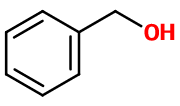
Photo credits: ScenTree SAS
Benzyl alcohol
Floral > White Flowers > Benzyl > Plastic
Alpha-hydroxytoluène ; Benzencarbinol ; Benzene carbinol ; Benzene methanol ; Benzoyl alcohol ; Benzylicum ; (hydroxymethyl)benzene ; Phenyl methanol ; Phenyl carbinol ; Phenyl carbinolum ; Alpha-toluenol ; Ulfesia


Photo credits: ScenTree SAS
| Company | Ingredient Name | Learn more | Naturality | Certifications | MOQ | Purity |
|---|---|---|---|---|---|---|
|
BENZYL ALCOHOL FR
BAL-2
|
Discover | Naturel | 10 grs | 98.5 - 100.0 | |
|
Alcool Benzylique - 30gr | Discover | - | 30grs | - | |

|
Benzyl Alcohol | Discover | Synthetic Aroma Chemicals | - | - | |
|
|
Benzyl Alcohol natural | Discover | Natural Aroma Chemicals | - | - |
BAL-2


General Presentation
-
CAS N° :
100-51-6 -
EINECS number :
202-859-9 -
FEMA number :
2137 -
FLAVIS number :
2,01
-
JECFA number :
25 -
Volatility :
Heart/Base -
Price Range :
€
Physico-chemical properties
-
Appearance :
Colorless liquid -
Density :
1,04 -
Refractive Index @20°C :
1,5384 @25°C -
Optical rotation :
Donnée indisponible. -
Vapor pressure :
0,099 mmHg @20°C -
Flash Point :
93°C (199,4°F)
-
Molecular formula :
C7H8O -
Molecular Weight :
108,14 g/mol -
Log P :
1,1 -
Fusion Point :
-15°C (5°F) -
Boiling Point :
205°C (401°F) -
Detection Threshold :
1,2 et 1000 ppb (0,0001%)
Chemistry & Uses
Uses in perfumery :
Benzyl Alcohol is used in majority as a solvent for some ingredients, even if it is rarely the case. It can also be used is some white flowers accords, to bring volatility.
Year of discovery :
Data not available.
Natural availability :
Benzyl Alcohol is found in low quantity in many natural ingredients. It is found for example in Clove Leaf EO, Damask Rose Absolute and Narcissus Absolute.
Isomerism :
Benzyl Alcohol is an isomer of para-Cresol. These two molecules, although close structurally speaking, do not have the same smell at all, much more animalic on para-Cresol part.
Synthesis precursor :
Benzyl Alcohol can be used to synthesize Benzaldehyde, by adding nitric acid to oxydize it. This oxydation can also be carried out with copper-magnesium oxide pumice. Numerous esterifications can be carried out using Benzyl Alcohol, to obtain compounds as Benzyl acetate, Benzyl Salicylate... Eventually, heating this molecule with strong acids or bases may form Dibenzyl Oxide.
Synthesis route :
Two synthetic routes can be used to obtain Benzyl Alcohol. The first one is a hydrolysis of benzyl chloride, by heating this molecule with alkaline and earthy-alkaline hydroxydes and carbonates. Up to 10% Dibenzyl Ether is also resulting from this reaction. A second route is an oxydation of toluene into benzyl hydroperoxyde. Subsequent hydrolysis synthesizes Benzyl Alcohol and Benzaldehyde. A purification can then isolate Benzyl Alcohol.
Stability :
Aromatic compounds are chromophorous. This means that they may colour through time or in an alkaline medium.
Other comments :
In perfumery, using a benzylic molecule brings a fruity white flower note as jasmine. A long homologous molecule of Benzyl Alcohol is Phenyl Ethyl Alcohol, bringing a rosy note. By lengthening even more the chain, a dihydrocinnamic body brings more heavy floral balsamic note.
Benzyl Alcohol is part of the 26 allergens used in perfumery.
Labelling
Allergens :
This ingredient is classified as an allergen under European Regulation 2023/1545, dated August 26, 2023.
Its presence must therefore be declared on product labels when it exceeds 0.001% in leave-on products and 0.01% in rinse-off products.
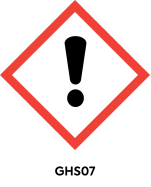
Signal word :
Warning
Hazard pictograms :
Precautionary statements :
| HAZARD | PRECAUTION |
|---|---|
| H302 Harmful if swallowed.
H319 Causes serious eye irritation. H332 Harmful if inhaled. |
P261 Avoid breathing dust/fume/gas/mist/vapours/spray. P264 Wash ... thoroughly after handling. P271 Use only outdoors or in a well-ventilated area. P280 Wear protective gloves/protective clothing/eye protection/face protection. P305 + P351 + P338 IF IN EYES: Rinse cautiously with water for several minutes. Remove contact lenses, if present and easy to do. Continue rinsing. P337 + P313 If eye irritation persists: Get medical advice/attention. |
IFRA
IFRA 51th :
This ingredient is restricted by the 51th amendment
-
Restriction type :
RESTRICTION -
Cause of restriction :
DERMAL SENSITIZATION AND SYSTEMIC TOXICITY -
Amendment :
49
Quantitative limit on the use :
| Cat.1 | Cat.2 | Cat.3 | Cat.4 |
Cat.5
A
B
C
D
|
Cat.6 | |||
|---|---|---|---|---|---|---|---|---|
| 0,45 % | 0,14 % | 0,34 % | 2,5 % |
0,64 %
0,17 %
0,34 %
0,057 %
|
||||
|
Cat.5
A
B
C
D
|
Cat.6 | |||||||
|
0,64 %
0,17 %
0,34 %
0,057 %
|
1,5 % | |||||||
|
Cat.7
A
B
|
Cat.8 | Cat.9 |
Cat.10
A
B
|
Cat.11
A
B
|
Cat.12 | |||
|
0,68 %
0,68 %
|
0,057 % | 2,2 % |
2,2 %
8,5 %
|
0,057 %
0,057 %
|
||||
|
Cat.10
A
B
|
Cat.11
A
B
|
Cat.12 | ||||||
|
2,2 %
8,5 %
|
0,057 %
0,057 %
|
No Restriction | ||||||
Annexe I :
Some regulated synthetic ingredients are found in nature and in certain proportions in natural ingredients. This presence in nature has to be taken into account when calculating limits of use recommended by the IFRA. In case you do not know these concentrations, you can use the ones estimated by the IFRA. Here they are :
| List of regulated compounds contained in this ingredient | |||
|---|---|---|---|
| Ingredient Name | Botanical Name | CAS N° | Estimated Concentration |
| Balsam absolute, Peru | Myroxylon balsamum (L.) Harms var. pereirae (Royle) Harms | 8007-00-9 | 0,43 |
| Balsam oil, Peru | Myroxylon balsamum (L.) Harms var. pereirae (Royle) Harms | 8007-00-9 | 1,57 |
| Balsam resinoid, Peru | Myroxylon balsamum (L.) Harms var. pereirae (Royle) Harms | 8007-00-9 | 0,17 |
| Cinnamon leaf oil | Cinnamomum zeylanicum Blume | 8015-91-6 | 0,1 |
| Cassie absolute | Vachellia farnesiana (L.) Willd. | 8023-82-3 | 2,7 |
| Champaca absolute | Michelia champaca L. | 8006-76-6 | 0,64 |
| Clove bud oil terpenes | Syzygium aromaticum (L.) Merr. & L.M.Perry | 8000-34-8 | 0,01 |
| Jasmine absolute | Jasmium grandifloum L. | 8022-96-6 | 1,08 |
| Jasmine concrete | Jasminum grandiflorum L. | 8022-96-6 | 1,08 |
| Mimosa absolute | Acacia decurrens (Wendl.f.) Willd. | 8031-03-6 | 0,19 |
| Narcissus poeticus absolute | Narcissus poeticus L. | 68917-12-4 | 2,8 |
| Carnation absolute | Dianthus caryophyllus L. | 8021-43-0 | 0,2 |
| Rose oil | Rosa x damascena Mill. | 8007-01-0 | 0,02 |
| Rose absolute | Rosa x damascena Mill. | 90106-38-0 | 0,54 |
| Styrax absolute | Liquidambar styraciflua L. | 8046-19-3 | 2,5 |
| Styrax essence pyrogenated | Liquidambar Styraciflua | 8046-19-3 | 0,15 |
| Styrax oil | Liquidambar styraciflua L. | 8046-19-3 | 0,07 |
| Thyme absolute | Thymus vulgaris L. | 8007-46-3 | 0,3 |
| Tuberose absolute | Poliantes tuberosa L. | 8024-05-3 | 0,5 |
| Tuberose concrete | Poliantes tuberosa L. | 8024-05-3 | 0,5 |
| Violet leaf absolute | Viola odorata L. | 8024-08-6 | 0,1 |
| Ylang ylang oil I | Cananga odorata (Lam.) Hook. f. &Thomson oil (forma genuine Steenis) | 8006-81-3 | 0,09 |
| Ylang ylang oil II | Cananga odorata (Lam.) Hook. f. &Thomson oil (forma genuine Steenis) | 8006-81-3 | 0,09 |
| Ylang ylang oil III | Cananga odorata (Lam.) Hook. f. &Thomson oil (forma genuine Steenis) | 8006-81-3 | 0,04 |
| Ylang, Ylang oil complete | Cananga odorata (Lam.) Hook. f. &Thomson oil (forma genuine Steenis) | 8006-81-3 | 0,25 |
| Ylang, Ylang oil extra | Cananga odorata (Lam.) Hook. f. &Thomson oil (forma genuine Steenis) | 8006-81-3 | 0,24 |
| Hyacinth absolute | Hyacinthus orientalis L. | 8023-94-7 | 40 |
| Jasmine officinale absolute | Jasminum officinale L. | 8024-43-9 | 3 |
| Jasmine sambac absolute | Jasminum sambac (L.) Aiton | 103798-23-6 | 4,2 |
| Jasmine sambac CO2 extract | Jasminum sambac | 103798-23-6 | 4,2 |
| Lavandin grosso absolute | Lavandula angustifolia Mill. x Lavandula latifolia Medik. | 617-009-6 | 0,02 |
| Mimosa concrete | Acacia decurrens Willd. var.dealbata | 98903-76-5 | 0,04 |
| Ylang-ylang absolute | Cananga odorata (Lam.) Hook.f.&Thomson forma genuina | 0,5 | |
Disclaimer :
ScenTree is solely responsible for the information provided here.
To learn more about IFRA's standards : https://ifrafragrance.org/safe-use/library