














Photo credits: ScenTree SAS
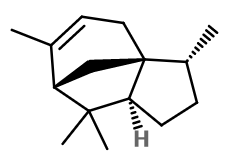
Alpha-cedrene
Woody > Cedar > Smoky Woods > Leather
(3R-(3a,3ab,7b,8aa))-2,3,4,7,8,8a-hexahydro-3,6,8,8-tetramethyl-1H-3a,7-methanoazulene ; (1S,2R,5S)-2,6,6,8- tetramethyl tricyclo(5.3.1.01.5)undec-8-ene


Photo credits: ScenTree SAS
| Company | Ingredient Name | Learn more | Naturality | Certifications | MOQ | Purity |
|---|---|---|---|---|---|---|
|
CEDRENE
CDNE-1
|
Discover | Naturel | 10 grs | - |
CDNE-1


General Presentation
-
CAS N° :
469-61-4 -
EINECS number :
207-418-4 -
FEMA number :
Donnée indisponible. -
FLAVIS number :
1,022
-
JECFA number :
Donnée indisponible. -
Volatility :
Base -
Price Range :
€€
Physico-chemical properties
-
Appearance :
Colorless liquid -
Density :
0,93 -
Refractive Index @20°C :
1,495 - 1,510 -
Optical rotation :
Donnée indisponible. -
Vapor pressure :
Donnée indisponible. -
Flash Point :
104°C (219,2°F)
-
Molecular formula :
C15H24 -
Molecular Weight :
204,35 g/mol -
Log P :
Donnée indisponible. -
Fusion Point :
Donnée indisponible. -
Boiling Point :
262°C (503,6°F) -
Detection Threshold :
Donnée indisponible.
Chemistry & Uses
Uses in perfumery :
Alpha-Cedrene is generally used for leather notes or as a substitute for Cedarwood Virginia EO, for its substantially equivalent note.
Year of discovery :
Isolated by scientist Walter in 1841 (ex. Juniperus virginiana). In 1953, Stork and Breslow were the first to synthesize dl-cedrol and dl-Alpha-Cedrene. Two years later, they acheived in synthesizing completely cedrol and Alpha-Cedrene.
Natural availability :
Alpha-Cedrene is one of the major components of Cedarwood Virginia EO, Cedarwood Texas EO, Cedarwood Chinese EO, among others, and is present in trace amounts especially in Verbena EO.
Isomerism :
Alpha-Cedrene has several isomers, by delocalization of its double bond. We distinguish beta-Cedrene, which has a smell relatively similar to Alpha-Cedrene. Moreover, this molecule is a constitutional isomer of beta-Caryophyllene and Valencene, but has a smell much less spicy or green than these two isomers.
Synthesis precursor :
Alpha-Cedrene is not a precursor to the synthesis of another compound of olfactory interest.
Synthesis route :
There are several routes of synthesis for Alpha-Cedrene depending on the starting reagent. Only one of them is detailed below: One of the syntheses with the least steps is a Corey synthesis from 2-methylhept-2-enen lithiated in its carbon 6, reacting with 3-methoxycyclopent-2-enone. The obtained intermediate product undergoes a reduction with sodium borohydride, then a treatment with diiodomethane, catalysed by brass, and a pyrogenation in the presence of chromium trioxide and dichloromethane. An acetylation of the ketone function that is still present, allows to form a carbocation which, by rearrangement, forms epi-Alpha-Cedrene and Alpha-Cedrene.
Stability :
Terpenes tend to polymerize by oxydation
Other comments :
Alpha-Cedrene is a sesquiterpene. This means that it has 15 carbon atoms, linked to 24 hydrogen atoms. In the case of Alpha-Cedrene, the molecule has a tricyclic structure.
Labelling
Allergens :
This ingredient does not contain any allergen.
Signal word :
Danger
Hazard pictograms :
Precautionary statements :
| HAZARD | PRECAUTION |
|---|---|
| H304 May be fatal if swallowed and enters airways.
H410 Very toxic to aquatic life with long lasting effects. |
IFRA
IFRA 51th :
This ingredient is restricted by the 51th amendment
-
Restriction type :
RESTRICTION -
Cause of restriction :
DERMAL SENSITIZATION -
Amendment :
49
Quantitative limit on the use :
| Cat.1 | Cat.2 | Cat.3 | Cat.4 |
Cat.5
A
B
C
D
|
Cat.6 | |||
|---|---|---|---|---|---|---|---|---|
| 0,27 % | 0,08 % | 1,6 % | 1,5 % |
0,38 %
0,38 %
0,38 %
0,38 %
|
||||
|
Cat.5
A
B
C
D
|
Cat.6 | |||||||
|
0,38 %
0,38 %
0,38 %
0,38 %
|
0,88 % | |||||||
|
Cat.7
A
B
|
Cat.8 | Cat.9 |
Cat.10
A
B
|
Cat.11
A
B
|
Cat.12 | |||
|
3,1 %
3,1 %
|
0,16 % | 2,9 % |
11 %
11 %
|
5,8 %
5,8 %
|
||||
|
Cat.10
A
B
|
Cat.11
A
B
|
Cat.12 | ||||||
|
11 %
11 %
|
5,8 %
5,8 %
|
No Restriction | ||||||
Annexe I :
Some regulated synthetic ingredients are found in nature and in certain proportions in natural ingredients. This presence in nature has to be taken into account when calculating limits of use recommended by the IFRA. In case you do not know these concentrations, you can use the ones estimated by the IFRA. Here they are :
| List of regulated compounds contained in this ingredient | |||
|---|---|---|---|
| Ingredient Name | Botanical Name | CAS N° | Estimated Concentration |
| Juniper berry oil | Juniperus communis L. | 8002-68-4 | 0,4 |
| Cananga oil | Cananga odorata (Lam.) Hook. f. & Thomson (forma macrophylla Steenis) | 68606-83-7 | 0,4 |
| Cedarwood oil, Atlas | Cedrus atlantica (Endl.) Manetti ex Carriere | 8023-85-6 | 1,5 |
| Cedarwood oil, Chinese | Cupressus funebris Endl. | 1159574-01-2 | 19,1 |
| Cedarwood oil, Texas | Juniperus mexicana Schiede | 68990-83-0 | 12 |
| Cedarwood oil, Virginian | Juniperus virginiana L. | 8000-27-9 | 24,3 |
| Cypress oil | Cupresssus sempervirens L. | 8013-86-3 | 0,36 |
| Helichrysum absolute | Helichrysum angustifolium DC. | 8023-95-8 | 0,08 |
| Pine needle, dwarf, oil | Pinus pumila (Pall.) Regel | 8000-26-8 | 0,25 |
| Verbena absolute | Lippia citriodora (L.) Kunth | 8024-12-2 | 0,5 |
| Vetiver oil (all origins) | Chrysopogon zizanioides (L.) Roberty | 8016-96-4 | 0,2 |
Contributions from other sources
The natural contribution of Cedrene is determined by the sum of the natural contributions of each of its isomers.
Disclaimer :
ScenTree is solely responsible for the information provided here.
To learn more about IFRA's standards : https://ifrafragrance.org/safe-use/library