












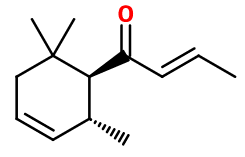
Photo credits: ScenTree SAS
(E/Z)-Delta-damascone®
Fruity > Berries > Rosy > Minty > Dry Woods
1-(2,6,6-trimethyl-3-cyclohexen-1-yl)-2-buten-1-one ; 8-damascone ; Delta-damascone ; Dihydro floriffone TD ; Delta-rose ketone ; 1-(2,6,6-trimethyl-1-cyclohex-3-enyl)but-2-en-1-one


Photo credits: ScenTree SAS
| Company | Ingredient Name | Learn more | Naturality | Certifications | MOQ | Purity |
|---|---|---|---|---|---|---|
|
DAMASCONE DELTA
DD-1
|
Discover | - | 10 grs | > 85% |
DD-1


General Presentation
-
CAS N° :
57378-68-4 -
EINECS number :
260-709-8 -
FEMA number :
3622 -
FLAVIS number :
7,13
-
JECFA number :
386 -
Volatility :
Heart/Base -
Price Range :
€€€
Physico-chemical properties
-
Appearance :
Colorless to pale yellow liquid -
Density :
0,93 -
Refractive Index @20°C :
Donnée indisponible. -
Optical rotation :
Donnée indisponible. -
Vapor pressure :
Donnée indisponible. -
Flash Point :
103°C (217,4°F)
-
Molecular formula :
C13H20O -
Molecular Weight :
192,3 g/mol -
Log P :
4,13 -
Fusion Point :
Donnée indisponible. -
Boiling Point :
264°C (507,2°F) -
Detection Threshold :
0,007 ng/l air
Chemistry & Uses
Uses in perfumery :
Delta-Damascone® is used for its cooked fruits and jammy sides. It is used most of the time in association with other Damascones to give various effects. It also is frequently used because it is less costly.
Year of discovery :
First damascones were discovered in 1965 by chemists P. Ruzicka and Dr. Demole, by anayzing an extract as Damask Rose Absolute. This discovery showed the way to a new rosy and fruity molecule family.
Natural availability :
Delta-Damascone® is not found on a natural state. Thus, it is impossible to extract it in any way.
Isomerism :
"Rose ketone" family contains a few different molecules, almost all evoking cooked apple, blackcurrant and Damask Rose Absolute. Delta-Damascone® smell is close to Alpha-Damascone®, which is a little more woody. Beta-Damascone® and Gamma-Damascone® have respectively more rosy and coniferous smells. Alpha-Ionone and Beta-Ionone are both positional isomers of Damascone® molecules, because their ketone function is located on another carbon, and as they have a relocated methyl function. Nevertheless, their smell is very different, as Ionones are reminiscent of violet flower.
Synthesis precursor :
Delta-Damascone® is not a precursor for the synthesis of another olfactive compound.
Synthesis route :
Delta-Damascone® synthesis uses a Diels-Alder reaction (reacting a diene and a dienophile) between 1,3-pentadiene and mesityl oxide, giving birth to acetyl trimethyl cyclohexene. This intermediary product can then handle an aldol condensation with Acetaldehyde, to obtain the final product : Delta-Damascone®.
Stability :
very stable in perfumes and in various alkaline bases.
Other comments :
The particuarity of Delta-Damascone® is its long-lasting and stability. This ables to use it in Fabric Care products (for clothes).
Labelling
Allergens :
This ingredient is classified as an allergen under European Regulation 2023/1545, dated August 26, 2023.
Its presence must therefore be declared on product labels when it exceeds 0.001% in leave-on products and 0.01% in rinse-off products.
Oral care products may contain up to 0.02% of damascone before labelling becomes mandatory.
Signal word :
Warning
Hazard pictograms :

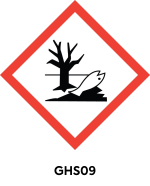
Precautionary statements :
| HAZARD | PRECAUTION |
|---|---|
| H302 Harmful if swallowed.
H315 Causes skin irritation. H317 May cause an allergic skin reaction. H319 Causes serious eye irritation. H400 Very toxic to aquatic life. H410 Very toxic to aquatic life with long lasting effects. |
IFRA
IFRA 51th :
This ingredient is restricted by the 51th amendment
-
Restriction type :
RESTRICTION -
Cause of restriction :
DERMAL SENSITIZATION -
Amendment :
49
Quantitative limit on the use :
| Cat.1 | Cat.2 | Cat.3 | Cat.4 |
Cat.5
A
B
C
D
|
Cat.6 | |||
|---|---|---|---|---|---|---|---|---|
| 0,0077 % | 0,0023 % | 0,046 % | 0,043 % |
0,011 %
0,011 %
0,011 %
0,011 %
|
||||
|
Cat.5
A
B
C
D
|
Cat.6 | |||||||
|
0,011 %
0,011 %
0,011 %
0,011 %
|
0,025 % | |||||||
|
Cat.7
A
B
|
Cat.8 | Cat.9 |
Cat.10
A
B
|
Cat.11
A
B
|
Cat.12 | |||
|
0,088 %
0,088 %
|
0,0045 % | 0,084 % |
0,3 %
0,3 %
|
0,17 %
0,17 %
|
||||
|
Cat.10
A
B
|
Cat.11
A
B
|
Cat.12 | ||||||
|
0,3 %
0,3 %
|
0,17 %
0,17 %
|
No Restriction | ||||||
Restricted ingredients: notes
The above limits apply to Rose Ketones used individually or in combination. The sum of concentrations of Rose ketones isomers should not exceed the maximum concentration levels established by this Standard.
Disclaimer :
ScenTree is solely responsible for the information provided here.
To learn more about IFRA's standards : https://ifrafragrance.org/safe-use/library