

















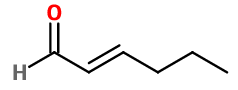
Photo credits: ScenTree SAS
(E)-2-Hexenal
Fruity > Green Fruits > Boozy
(E)-2-Hexenal ; Leaf aldehyde ; Trans-2-hexenyl aldehyde ; Trans-2-hexenal supra ; (E)-2-hexenyl aldehyde


Photo credits: ScenTree SAS


General Presentation
-
CAS N° :
6728-26-3 -
EINECS number :
229-778-1 -
FEMA number :
2560 -
FLAVIS number :
5,073
-
JECFA number :
1353 -
Volatility :
Head -
Price Range :
€€
Physico-chemical properties
-
Appearance :
Colorless liquid -
Density :
0,846 -
Refractive Index @20°C :
Donnée indisponible. -
Optical rotation :
Donnée indisponible. -
Vapor pressure :
Donnée indisponible. -
Flash Point :
43°C (109,4°F)
-
Molecular formula :
C6H10O -
Molecular Weight :
98,14 g/mol -
Log P :
1,58 -
Fusion Point :
Donnée indisponible. -
Boiling Point :
146°C (294,8°F) -
Detection Threshold :
Donnée indisponible.
Chemistry & Uses
Uses in perfumery :
Trans-2-Hexenal is most often used in green notes and apple reconstitutions, to bring crunch to the fruit and this characteristic green note.
Year of discovery :
Data not available.
Natural availability :
Trans-2-Hexenal is present in several plant extracts, including the leaves of some trees and shrubs. These extracts include Geranium EO, Verbena EO or Petitgrain Grapefruit EO. It is also present in the fragrant principle of many fruits, always in small quantities. It is its synthetic version that remains the most widely used in perfumery.
Isomerism :
Trans-2-Hexenal is a diastereoisomer of cis-2-Hexenal, much less used in perfumery, but also with a very green and fruity note.
Synthesis precursor :
Trans-2-Hexenal, like all aldehydes, can be used to synthesize Schiff bases, by reaction with Methyl Anthranilate or Indole for example. These reactions often lead to the formation of a very powerful and coloured product.
Synthesis route :
The synthesis of trans-2-Hexenal can be achieved by reaction between two molar equivalents of butanal and one equivalent of ethyl vinyl ether, in the catalytic presence of boron trifluoride. This first synthesis step is followed by an acid hydrolysis of the obtained product, in the presence of concentrated sulphuric acid for example. Biosynthetic ways of obtaining this molecule are being developed, improving its yield and reducing the rejections in the environment.
Stability :
Aldehyde can form their diethylacetal in alcoholic stability, bringing not so much olfactive change, but less efficiency of the ingredient.
Other comments :
Trans-2-Hexenal is very powerful and must be used diluted in compositions. It does not have the same smell, whether it is pure or diluted. It is its dilution that gives it its green and fruity facet, reminiscent of apple.
This molecule is to be distinguished from trans-2-Hexenol, its corresponding alcohol. Aldehyde is much more powerful, although both have a green, apple-like smell.
Labelling
Allergens :
This ingredient does not contain any allergen.
Signal word :
Danger
Hazard pictograms :

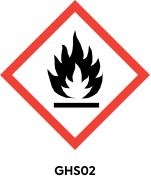
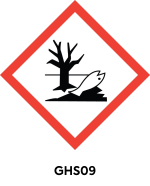
Precautionary statements :
| HAZARD | PRECAUTION |
|---|---|
| H226 Flammable liquid and vapour.
H302 Harmful if swallowed. H311 Toxic in contact with skin. H317 May cause an allergic skin reaction. H411 Toxic to aquatic life with long lasting effects. |
P210 Keep away from heat, hot surfaces, sparks, open flames and other ignition sources. No smoking. P233 Keep container tightly closed. P240 Ground and bond container and receiving equipment. P241 Use explosion-proof [electrical/ventilating/lighting/…] equipment. P261 Avoid breathing dust/fume/gas/mist/vapours/spray. P264 Wash ... thoroughly after handling. P270 Do no eat, drink or smoke when using this product. P272 Contaminated work clothing should not be allowed out of the workplace. P273 Avoid release to the environment. P280 Wear protective gloves/protective clothing/eye protection/face protection. P301 + P312 IF SWALLOWED: Call a POISON CENTER/doctor/… if you feel unwell. P302 + P352 IF ON SKIN: Wash with plenty of water/… P303 + P361 + P353 IF ON SKIN (or hair): Take off immediately all contaminated clothing. Rinse skin with water [or shower]. P330 Rinse mouth. P333 + P313 If skin irritation or rash occurs: Get medical advice/attention. P391 Collect spillage. P403 + P235 Store in a well-ventilated place. Keep cool. P501 Dispose of contents/container to… |
IFRA
IFRA 51th :
This ingredient is restricted by the 51th amendment

-
Restriction type :
RESTRICTION -
Cause of restriction :
DERMAL SENSITIZATION AND SYSTEMIC TOXICITY -
Amendment :
51
Quantitative limit on the use :
| Cat.1 | Cat.2 | Cat.3 | Cat.4 |
Cat.5
A
B
C
D
|
Cat.6 | |||
|---|---|---|---|---|---|---|---|---|
| 0,0014 % | 0,00041 % | 0,0083 % | 0,0077 % |
0,0020 %
0,0020 %
0,0020 %
0,00067 %
|
||||
|
Cat.5
A
B
C
D
|
Cat.6 | |||||||
|
0,0020 %
0,0020 %
0,0020 %
0,00067 %
|
0,0045 % | |||||||
|
Cat.7
A
B
|
Cat.8 | Cat.9 |
Cat.10
A
B
|
Cat.11
A
B
|
Cat.12 | |||
|
0,016 %
0,016 %
|
0,00067 % | 0,015 % |
0,054 %
0,054 %
|
0,00067 %
0,00067 %
|
||||
|
Cat.10
A
B
|
Cat.11
A
B
|
Cat.12 | ||||||
|
0,054 %
0,054 %
|
0,00067 %
0,00067 %
|
No restriction | ||||||
Annexe I :
Some regulated synthetic ingredients are found in nature and in certain proportions in natural ingredients. This presence in nature has to be taken into account when calculating limits of use recommended by the IFRA. In case you do not know these concentrations, you can use the ones estimated by the IFRA. Here they are :
| List of regulated compounds contained in this ingredient | |||
|---|---|---|---|
| Ingredient Name | Botanical Name | CAS N° | Estimated Concentration |
| Hyssop oil | Hyssopus officinalis L. | 8006-83-5 | 0,2 |
| Spearmint oil | Mentha spicata L. | 8008-79-5 | 0,02 |
| Erospicata oil, Mentha spicata 'Erospicata' | Mentha spicata Erospicata | 917-841-2 | 0,07 |
| Spearmint oil terpenes | Mentha spicata L. syn Mentha viridis L. var. crispa Benth. | 0,25 | |
Disclaimer :
ScenTree is solely responsible for the information provided here.
To learn more about IFRA's standards : https://ifrafragrance.org/safe-use/library