










Photo credits: ScenTree SAS
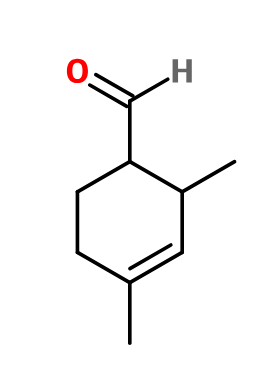
Triplal®
Green > Cut Grass > Metallic
Cyclal C® ; Vertocitral® ; Ligustral® ; 2,4-dimethylcyclohex-3-ene-1-carbaldehyde ; Acroval ; Citrulan ; Cyclogreenal ; 2,4-dimethyl-3-cyclohexene-1-carbaldehyde ; 4-formyl-1,3-dimethylcyclohex-1-ene ; Hivertal ; 2,4-ivy carbaldehyde ; Lantral ; Tricyclal ; Trigustral ; Trivertal ; Zestover


Photo credits: ScenTree SAS
| Company | Ingredient Name | Learn more | Naturality | Certifications | MOQ | Purity |
|---|---|---|---|---|---|---|

|
TRITAL
TR-1
|
Discover | - | 10 grs | - | |

|
TRIVERTAL
993135
|
Discover | Molecules |

|
- | - |

|
Triplal - 30 Gr | Discover | - | 30grs | - | |

|
SCHIFF LIGUSTRAL
85530
|
Discover | Molecule | - | - | |

|
Ligustral/Triplal | Discover | Synthetic Aroma Chemicals | - | - |
TR-1

993135
85530

General Presentation
-
CAS N° :
68039-49-6 -
EINECS number :
268-264-1 -
FEMA number :
4505 -
FLAVIS number :
Donnée indisponible.
-
JECFA number :
Donnée indisponible. -
Volatility :
Head/Heart -
Price Range :
€
Physico-chemical properties
-
Appearance :
Colorless liquid -
Density :
0,937 -
Refractive Index @20°C :
Donnée indisponible. -
Optical rotation :
Donnée indisponible. -
Vapor pressure :
0,723 mmHg @23°C -
Flash Point :
70°C (158°F)
-
Molecular formula :
C9H14O -
Molecular Weight :
138,21 g/mol -
Log P :
2,34 -
Fusion Point :
Donnée indisponible. -
Boiling Point :
-
Detection Threshold :
Donnée indisponible.
Chemistry & Uses
Uses in perfumery :
Triplal® is used in jasmine, colognes and fougere notes, to bring a different green and fruity note and freshness. Brings a spring facet to floral notes.
Year of discovery :
1920
Natural availability :
Triplal® is not available in its natural state.
Isomerism :
Triplal® used in perfumery is a mixture of two enantiomers with very similar smells. This is why they are not separated by fractional distillation. Trans-2-cis-6-Nonadienal is a constitutional isomer of Triplal® but has a very different cucumber smell.
Synthesis precursor :
Triplal® forms a Schiff base with Methyl Anthranilate, with a still very green smell but fruity and more artificial.
Synthesis route :
Triplal® is synthesized by a Diels-Alder reaction between 2-methyl-1,3-pentadiene and acrolein. A mixture of two enantiomers is obtained.
Stability :
Aldehydes may form diethylacetals in alcoholic perfumes, with no real impact on their smell.
Very unstable in acid cleaners, antiperspirants and very alkaline products.
Other comments :
In comparision to other cut grass notes, Triplal® has a metallic note that distinguishes it from cis-3-Hexenol for example.
Labelling
Allergens :
This ingredient does not contain any allergen.
Signal word :
Warning
Hazard pictograms :

Precautionary statements :
| HAZARD | PRECAUTION |
|---|---|
| H317 May cause an allergic skin reaction. |
IFRA
IFRA 51th :
This ingredient is restricted by the 51th amendment
-
Restriction type :
RESTRICTION -
Cause of restriction :
DERMAL SENSITIZATION -
Amendment :
49
Quantitative limit on the use :
| Cat.1 | Cat.2 | Cat.3 | Cat.4 |
Cat.5
A
B
C
D
|
Cat.6 | |||
|---|---|---|---|---|---|---|---|---|
| 0,45 % | 0,14 % | 2,7 % | 2,5 % |
0,64 %
0,64 %
0,64 %
0,64 %
|
||||
|
Cat.5
A
B
C
D
|
Cat.6 | |||||||
|
0,64 %
0,64 %
0,64 %
0,64 %
|
1,5 % | |||||||
|
Cat.7
A
B
|
Cat.8 | Cat.9 |
Cat.10
A
B
|
Cat.11
A
B
|
Cat.12 | |||
|
5,2 %
5,2 %
|
0,27 % | 4,9 % |
18 %
18 %
|
9,8 %
9,8 %
|
||||
|
Cat.10
A
B
|
Cat.11
A
B
|
Cat.12 | ||||||
|
18 %
18 %
|
9,8 %
9,8 %
|
No Restriction | ||||||
Restricted ingredients: notes
The above limits apply to Dimethylcyclohexen-3-ene-1-carbaldehyde (mixed isomers) used individually or in combination. The sum of concentrations of Dimethylcyclohexen-3-ene-1-carbaldehyde isomers should not exceed the maximum concentration levels established by this Standard.
Disclaimer :
ScenTree is solely responsible for the information provided here.
To learn more about IFRA's standards : https://ifrafragrance.org/safe-use/library