















| Company | Ingredient Name | ID | Comments | Naturality | Certifications | MOQ | Latin name | Treated part | Geographical origin |
|---|---|---|---|---|---|---|---|---|---|
|
SANDAL SPICATUM AUSTRALIA EO | SANAU-1 |
Visit website

|
Naturel | 10 grs | - | - | - |


General Presentation
-
CAS N° :
8024-35-9 -
EINECS number :
296-618-5 -
FEMA number :
3005
-
Volatility :
Base -
Price Range :
€€€€€
Physico-chemical properties
-
Appearance :
Yellow to brown liquid -
Density :
0,945 - 0,980 @20°C -
Refractive Index @20°C :
1,500 - 1,517 @20°C -
Optical rotation :
-16° // +4° -
Vapor pressure :
Donnée indisponible. -
Flash Point :
Donnée indisponible. -
Acid Value :
£ 5
Botanical informations
Botanical name :
Artemisia absinthium L.
Synonyms : Artemisia absinthium var. absinthium // Absinthium officinale Brot.
Botanical profile :
Woormwood is a plant of the Asteraceae family and the genus Artemisia L.
Asteraceae family is one of the most important family in the fragrance world, it includes for example all the Artemisia (Wormwood, Armoise, Tarragon, Davana) and all the Tansy, the Everlasting and the tagetes.
Chemotypes :
Wormwood has numerous chemotypes, classified according to their oil constitution.
This variety is due to two possible botanical synthesis routes : isoprenic (containing Alpha-Terpineol, Eucalyptol, Thuyones, Borneol, Camphor...) and phenylpropanic (containing Estragole, Chavicol, Anethole...).
Thus, different chemotype can be distinguished :
Davanone-containing artemisia:
- Artemisia herba-alba L. : Artemisia herba-alba oil
- Artemisia pallens L. : Davana oil.
Thuyone-containing artemisia:
- Artemisia absinthium L. : Wormwood oil / Wormwood oil terpenless
- Artemisia arborescens L. (Arborescent Wormwood)
Camphor-containing artemisia:
- Artemisia douglasiana L. : Tarragon oil / Tarragon absolute / Tarragon oil (low methyleugenol)
- Artemisia vulgaris L. : Artemisia vulgaris oil
Extractions & Uses
Extraction process :
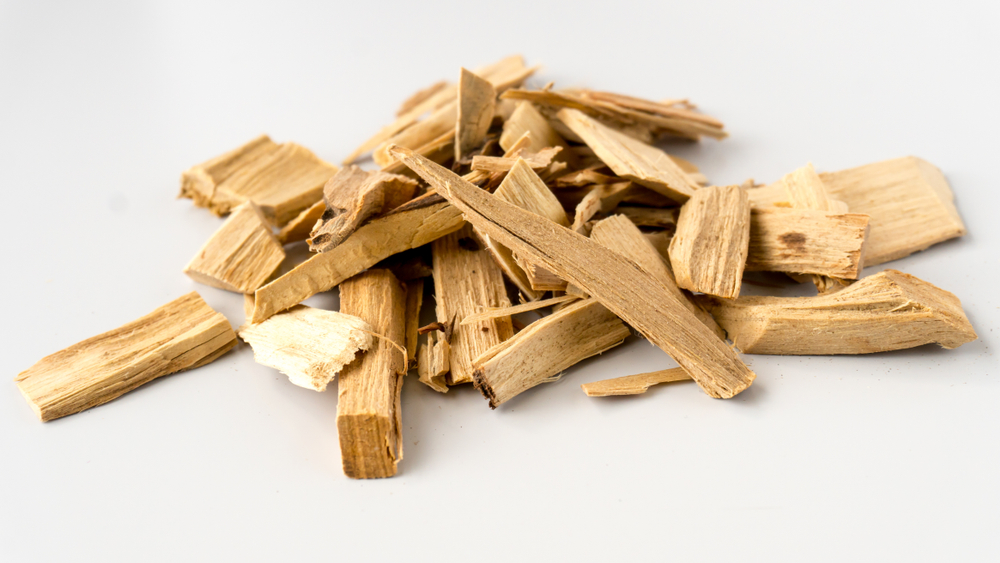
The sandalwood tree can grow up to 15 meters tall and live a century. Sandalwood is produced at low altitude, cultivated in a temperate climate and requires little drainage.
Sandalwood cultivation should be preferably done with trees of a certain age. From the age of seven, trees are cut at any time of the year. They are totally removed, instead of cutting them into their base. The next step is to lop the branches off and remove the leaves to conserve the trunk and the thick branches solely. Then the trees are sorted according to the content of their trunk: the heart of the trunk is of red-brown colour. The essential oil quality depends on the diameter of the trunk, the thicker the better. The third step is to strip off the bark from the trunk, using a debarking drum. Afterwards, the trunk can be crushed into chips for extraction.
The steam distillation of the chips takes place for 48 to 72 hours at atmospheric pressure. At the end of the process, the essential oil is collected in an essencier, at the refrigerant outlet? by decantation of the water.
The extraction yield of sandalwood ranges from 5 to 6%.
Uses in perfumery :
Data not available.
Stability :
The terpenes identified in this raw material can polymerize when they are oxidized
Major Components :
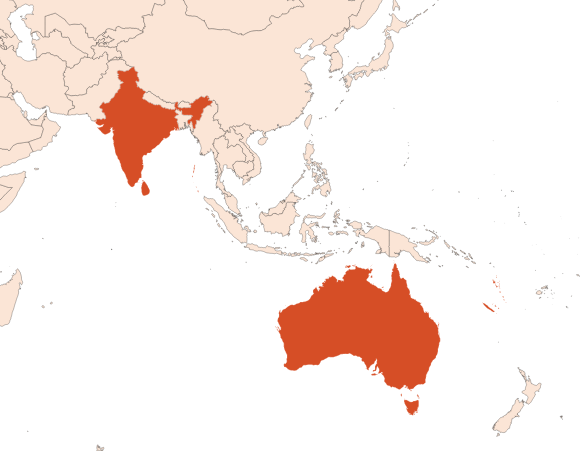
Photo credits: ScenTree SAS
Other comments :
It is one of the essential oils with thujone (it contains about 40%) which explain its high toxicity. Other essential oils contain thujones: Cedar Leaf EO, Camphorated Wormwood EO, tansy, thuja or Dalmatian Sage EO.
Another name for absinthe is "wormwood".
Absinthe is known worldwide for the beverage made with its essential oil which has been banned in many countries because of its excessive alcohol content, but also because of thujone. However, in France, since 2011, the consumption of this drink has been authorized again, provided that the rate of thujone is very limited. The excessive consumption of absinthe has also given its name to a disease: absinthism. Thujones have long given a very bad press to the plant.
In the past, Indian trees were cut only when they were dead. In order to meet the increasing demand in the 20th century, the Indian government had to allow premature cutting. This decision has had a considerable impact on the sustainability of the production. Several other constraints to cultivation can occur, such as forest fires and the long maturation period of the tree before cultivation. It has therefore been essential for India to considerably control its production and in particular its shipment. The Indian sandalwood is now registered in the red list of the IUCN ( International Union for Conservation of Nature) as it is so threatened with extinction.
The α and β-Santalol are present in large majority in the essential oil, which makes sandalwood the main precursor of these molecules in there natural state, today these molecules are mainly produced in laboratory. Research into the creation and production of molecules to work a sandalwood scent was intensified in the 1950s. Today there are a large number of attractive molecules.
In order to grow, sandalwood parasitizes the roots of nearby plants so that they contribute to its development. One such plant is Davana EO, which often grows at the foot of sandalwood trees in India.
In India, sandalwood is a symbol of protection and wish fulfilment... There is no ceremony in India without sandalwood where it symbolizes a myriad of gods. It is one of the four sacred woods (acacia- sassafras and teak).
Labelling
Allergens :
This ingredient does not contain any allergen.
IFRA
IFRA 51th :
This ingredient is not restricted for the 51th amendment