















Photo credits: ScenTree SAS
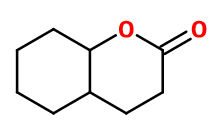
Octahydrocoumarin
Balsamic Ambery > Coumarinic > Tropical Fruits
Bicyclononalactone ; 3,4,4a,5,6,7,8,8a-octahydrochromen-2-one ; Octahydro-2H-1-benzopyran-2-one ; Cyclohexyl lactone ; Octahydro-1-benzopyran-2-one ; Octahydrochromen-2-one


Photo credits: ScenTree SAS
| Company | Ingredient Name | Learn more | Naturality | Certifications | MOQ | Purity |
|---|---|---|---|---|---|---|
|
OCTAHYDROCOUMARIN
OC-1
|
Discover | - | 10 grs | 90 - 100 |
OC-1


General Presentation
-
CAS N° :
4430-31-3 -
EINECS number :
224-623-4 -
FEMA number :
3791 -
FLAVIS number :
13,161
-
JECFA number :
1166 -
Volatility :
Base -
Price Range :
€€€
Physico-chemical properties
-
Appearance :
Colorless liquid -
Density :
1,09 -
Refractive Index @20°C :
Donnée indisponible. -
Optical rotation :
Donnée indisponible. -
Vapor pressure :
0,001558 mmHg @23°C -
Flash Point :
113°C (235,4°F)
-
Molecular formula :
C9H14O2 -
Molecular Weight :
154,21 g/mol -
Log P :
2,52 -
Fusion Point :
Donnée indisponible. -
Boiling Point :
-
Detection Threshold :
Donnée indisponible.
Chemistry & Uses
Uses in perfumery :
Octahydrocoumarin is used in fine fragrance in fougere fragrances. Allows to work on fig, coconut, white and heady flowers, vanillic, ambery and spicy-cinnamon notes.
Year of discovery :
Data not available.
Natural availability :
Octahydrocoumarin is not available in its natural state.
Isomerism :
Folione® is a constitutional isomer of Octahydrocoumarin, even if these two ingredient do not have the same smell at all.
Synthesis precursor :
Octahydrocoumarin is not a precursor to the synthesis of another compound of olfactory interest.
Synthesis route :
Octahydrocoumarin is synthesized from Coumarin by a catalytic hydrogenation reaction carried at a high temperature which must reach 392 to 482°F to synthesize this compound. Another synthetic route is an intramolecular esterification of 3-(2-hydroxycyclohexyl)propanoic acid.
Stability :
Stable in perfumes and diverse functional bases
Other comments :
Octahydrocoumarin has a much more fruity and lactonic smell than other coumarin derivatives.
Labelling
Allergens :
This ingredient does not contain any allergen.
Signal word :
Danger
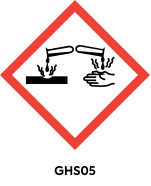
Hazard pictograms :
Precautionary statements :
| HAZARD | PRECAUTION |
|---|---|
| H318 Causes serious eye damage. | P280 Wear protective gloves/protective clothing/eye protection/face protection. P305 + P351 + P338 IF IN EYES: Rinse cautiously with water for several minutes. Remove contact lenses, if present and easy to do. Continue rinsing. P310 Immediately call a POISON CENTER/doctor/… |
IFRA
IFRA 51th :
This ingredient is not restricted for the 51th amendment