







Photo credits: ScenTree SAS
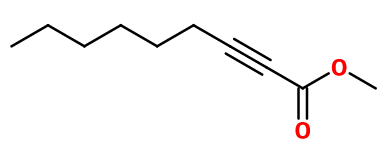
Methyl octine carbonate
Green > Fatty > Mushroom > Juicy Fruits
MOC ; Methyl non-2-ynoate ; Methyl 2-nonynoate ; Methyl octyne carbonate ; 2-nonynoic acid methyl ester


Photo credits: ScenTree SAS
| Company | Ingredient Name | Learn more | Naturality | Certifications | MOQ | Purity |
|---|---|---|---|---|---|---|
|
METHYL OCTINE CARBONATE
OCM-1
|
Discover | - | 10 grs | - |
OCM-1


General Presentation
-
CAS N° :
111-80-8 -
EINECS number :
203-909-2 -
FEMA number :
2726 -
FLAVIS number :
9,156
-
JECFA number :
1356 -
Volatility :
Heart -
Price Range :
€€€
Physico-chemical properties
-
Appearance :
Colorless liquid -
Density :
0,921 -
Refractive Index @20°C :
Donnée indisponible. -
Optical rotation :
Donnée indisponible. -
Vapor pressure :
Donnée indisponible. -
Flash Point :
101°C (213,8°F)
-
Molecular formula :
C10H16O2 -
Molecular Weight :
168,24 g/mol -
Log P :
4 -
Fusion Point :
Donnée indisponible. -
Boiling Point :
122°C (251,6°F) -
Detection Threshold :
Donnée indisponible.
Chemistry & Uses
Uses in perfumery :
Methyl Octine Carbonate is used in notes of violet flower, tuberose, linden and mimosa. A green facet with fruity notes. Used in combination with green notes and ionones.
Year of discovery :
1903
Natural availability :
Methyl Octine Carbonate is not available in its natural state.
Isomerism :
Jasmolactone is a constitutional isomer of Methyl Octine Carbonate. Its smell is however very different, as it is reminiscent of peach and jasmine.
Synthesis precursor :
Methyl Octine Carbonate is not a precursor to the synthesis of another compound of olfactory interest.
Synthesis route :
Methyl Octine Carbonate is synthesized by an esterification reaction between non-2-ynoic acid and methanol. This reaction is catalysed by the presence of a strong concentrated acid such as sulfuric acid.
Stability :
May form octine carbonic acid through time, under the effect of heat.
Unstable in acidic products, except antiperspirants, and very alkaline products
Other comments :
In comparision to other green notes of Violet Leaf Absolute as Folione® or Violiff®, Methyl Octine Carbonate has a clear mushroom note.
Labelling
Allergens :
This ingredient does not contain any allergen.
Signal word :
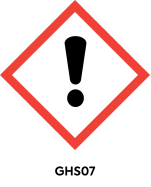
Warning
Hazard pictograms :
Precautionary statements :
| HAZARD | PRECAUTION |
|---|---|
| H302 Harmful if swallowed.
H317 May cause an allergic skin reaction. |
P261 Avoid breathing dust/fume/gas/mist/vapours/spray. P270 Do no eat, drink or smoke when using this product. P272 Contaminated work clothing should not be allowed out of the workplace. P280 Wear protective gloves/protective clothing/eye protection/face protection. P301 + P312 IF SWALLOWED: Call a POISON CENTER/doctor/… if you feel unwell. P302 + P352 IF ON SKIN: Wash with plenty of water/… |
IFRA
IFRA 51th :
This ingredient is restricted by the 51th amendment
-
Restriction type :
RESTRICTION -
Cause of restriction :
DERMAL SENSITIZATION -
Amendment :
49
Quantitative limit on the use :
| Cat.1 | Cat.2 | Cat.3 | Cat.4 |
Cat.5
A
B
C
D
|
Cat.6 | |||
|---|---|---|---|---|---|---|---|---|
| 0,0018 % | 0,00055 % | 0,011 % | 0,01 % |
0,0026 %
0,0026 %
0,0026 %
0,0026 %
|
||||
|
Cat.5
A
B
C
D
|
Cat.6 | |||||||
|
0,0026 %
0,0026 %
0,0026 %
0,0026 %
|
0,0061 % | |||||||
|
Cat.7
A
B
|
Cat.8 | Cat.9 |
Cat.10
A
B
|
Cat.11
A
B
|
Cat.12 | |||
|
0,021 %
0,021 %
|
0,0011 % | 0,02 % |
0,072 %
0,072 %
|
0,04 %
0,04 %
|
||||
|
Cat.10
A
B
|
Cat.11
A
B
|
Cat.12 | ||||||
|
0,072 %
0,072 %
|
0,04 %
0,04 %
|
No Restriction | ||||||
Restricted ingredients: notes
When used in the same fragrance compound within a specific QRA category, the sum total of and Methyl heptine carbonate (MHC, CAS number 111-12-6) and Methyl octine carbonate (MOC, CAS number 111-80-8) contributions must not exceed the maximum permitted level for MHC. At the same time, the contribution from MOC should always respect the maximum levels permitted as listed in the table above.
Disclaimer :
ScenTree is solely responsible for the information provided here.
To learn more about IFRA's standards : https://ifrafragrance.org/safe-use/library