

















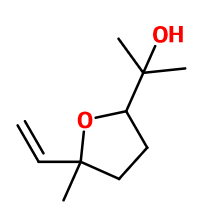
Photo credits: ScenTree SAS
Linalool oxide
Herbal > Camphoric > Fresh Flowers > Zesty
2-(5-methyl-5-vinyltetrahydro-2-furanyl)-2-propanol ; Linalool 3,7-oxide ; Linalool dihydroepoxide ; (Z,E)-2-methyl-2-vinyl-5-(2-hydroxy-2-propyl) tetrahydrofuran ; Alpha-methyl-alpha-(4-methyl-3-penten-1-yl)-2-oxiranemethanol ; (Z,E)-2-vinyl-2-methyl-5-(1-hydroxy-1-methylethyl)tetrahydrofuran


Photo credits: ScenTree SAS


General Presentation
-
CAS N° :
1365-19-1 -
EINECS number :
215-723-9 -
FEMA number :
3746 -
FLAVIS number :
13,14
-
JECFA number :
1454 -
Volatility :
Head/Heart -
Price Range :
€€€
Physico-chemical properties
-
Appearance :
Colorless liquid -
Density :
0,941 -
Refractive Index @20°C :
Donnée indisponible. -
Optical rotation :
Donnée indisponible. -
Vapor pressure :
Donnée indisponible. -
Flash Point :
63°C (145,4°F)
-
Molecular formula :
C10H18O2 -
Molecular Weight :
170,25 g/mol -
Log P :
1,7 -
Fusion Point :
Donnée indisponible. -
Boiling Point :
188°C (370,4°F) -
Detection Threshold :
320 ppb (0,000032%)
Chemistry & Uses
Uses in perfumery :
Linalool Oxide brings a fresh and acidic fruit facet to an apple. Allows to enhance floral and fruity notes, rising them.
Year of discovery :
Data not available.
Natural availability :
Linalool Oxide is present in several plants and especially in Eucalyptus EO. It can therefore be extracted in its natural state. Nevertheless, synthetic Linalool Oxide is much more produced and used in perfumery.
| Ingredient | % min | % max |
|---|---|---|
| Ho wood oil | 2 | |
| Mentha citrata oil | 2 | |
| Osmanthus absolute | 8 |
Isomerism :
Linalool Oxide is a mixture of two cis and trans isomers. Both have a similar smell but are rarely used separately. A dehydrated derivative of Linalool Oxide exists and is present in its natural state. Its smell is also minty and close to Eucalyptus EO. Gamma-Decalactone and Neofolione® are constitutional isomers of Linalool Oxide, but they have a very different fruity-peach smell.
Synthesis precursor :
Linalool Oxide is not a precursor to the synthesis of another compound of olfactory interest.
Synthesis route :
Linalool Oxide is synthesized from Linalool, reacting with a peracid. This reaction forms the desired five-atom ring, but also another product with a six-atom ring.
Stability :
Unstable in acidic products, except antiperspirants, and in very alkaline products.
Other comments :
Data not available.
Labelling
Allergens :
This ingredient does not contain any allergen.
Signal word :
Warning
Hazard pictograms :

Precautionary statements :
| HAZARD | PRECAUTION |
|---|---|
| H302 Harmful if swallowed.
H319 Causes serious eye irritation. |
IFRA
IFRA 51th :
This ingredient is not restricted for the 51th amendment