













Photo credits: ScenTree SAS
Hexyl acetate
Fruity > Green Fruits > White Flowers
Acetic acid hexyl ester ; acetate C6 ; Hexyl ethanoate


Photo credits: ScenTree SAS
| Company | Ingredient Name | Learn more | Naturality | Certifications | MOQ | Purity |
|---|---|---|---|---|---|---|
|
HEXYL ACETATE
AH-1
|
Discover | - | 10 grs | - | |

|
Acetate d'Hexyle - 30 Gr | Discover | - | 30grs | - | |

|
HEXYL ACETATE
M_0050641
|
Discover | Naturel | - | - | |

|
Hexyl Acetate | Discover | Synthetic Aroma Chemicals | - | - | |
|
|
Hexyl Acetate natural | Discover | Natural Aroma Chemicals | - | - |
AH-1

M_0050641

General Presentation
-
CAS N° :
142-92-7 -
EINECS number :
205-572-7 -
FEMA number :
2565 -
FLAVIS number :
9,006
-
JECFA number :
128 -
Volatility :
Head/Heart -
Price Range :
€
Physico-chemical properties
-
Appearance :
Colorless liquid -
Density :
0,873 -
Refractive Index @20°C :
1,406 - 1,411 -
Optical rotation :
Donnée indisponible. -
Vapor pressure :
0,9076 mmHg @20°C 0,911409 mmHg @23°C 1,388 mmHg @25°C -
Flash Point :
56°C (132,8°F)
-
Molecular formula :
C8H15O2 -
Molecular Weight :
144,21 g/mol -
Log P :
2,87 -
Fusion Point :
-80°C (-112°F) -
Boiling Point :
169°C (336,2°F) -
Detection Threshold :
2 et 480 ppb (0,000048%)
Chemistry & Uses
Uses in perfumery :
Hexyl acetate is used as a top note to green apple, pear and banana accords. Useful for faceting floral notes as jasmine accords.
Year of discovery :
Data not available.
Natural availability :
Hexyl acetate is one of the most common natural compounds present in fruits and it can be extracted from Lavender EO.
Isomerism :
Hexyl acetate does not have any isomer used in perfumery.
Synthesis precursor :
Hexyl acetate is not a precursor to the synthesis of another compound of olfactory interest.
Synthesis route :
Hexyl acetate is an ester obtained by an esterification of acetic acid or acetic anhydride with Hexanol in the presence of an acid catalyst.
Stability :
acetates may form acetic acid through time. Hexyl acetate is particularly unstable.
Other comments :
Hexyl acetate is more jasmine-like and less green than cis-3-Hexenyl acetate, and less rosy than Heptyl acetate.
Labelling
Allergens :
This ingredient does not contain any allergen.
Signal word :
Warning
Hazard pictograms :
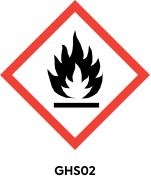
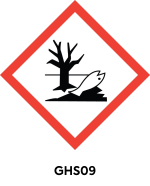
Precautionary statements :
| HAZARD | PRECAUTION |
|---|---|
| H226 Flammable liquid and vapour.
H411 Toxic to aquatic life with long lasting effects. |
P210 Keep away from heat, hot surfaces, sparks, open flames and other ignition sources. No smoking. P273 Avoid release to the environment. P303 + P361 + P353 IF ON SKIN (or hair): Take off immediately all contaminated clothing. Rinse skin with water [or shower]. P370 + P378 In case of fire: Use… to extinguish. P391 Collect spillage. P403 + P235 Store in a well-ventilated place. Keep cool. |
IFRA
IFRA 51th :
This ingredient is not restricted for the 51th amendment