















Photo credits: ScenTree SAS


Photo credits: ScenTree SAS
Do you sell any of the raw materials? Would you like to let our users know?
Send an email to fournisseurs@scentree.coto learn about our advertising opportunities.

General Presentation
-
CAS N° :
29548-30-9 -
EINECS number :
249-689-1 -
FEMA number :
4213 -
FLAVIS number :
9,818
-
JECFA number :
1831 -
Volatility :
Heart/Base -
Price Range :
€€€€
Physico-chemical properties
-
Appearance :
Colorless liquid -
Density :
0,91 -
Refractive Index @20°C :
1,474 -
Optical rotation :
Donnée indisponible. -
Vapor pressure :
Donnée indisponible. -
Flash Point :
110°C (230°F)
-
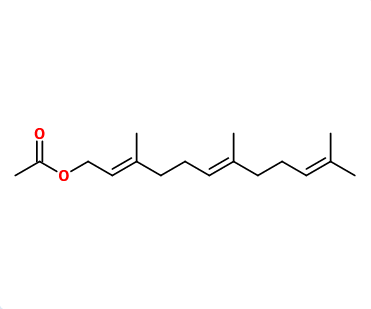
Molecular formula :
C17H28O3 -
Molecular Weight :
264,4 g/mol -
Log P :
6,77 -
Fusion Point :
Donnée indisponible. -
Boiling Point :
325°C (617°F) -
Detection Threshold :
Donnée indisponible.
Chemistry & Uses
Uses in perfumery :
Mainly used to add volume and freshness in white flowers accords.
Year of discovery :
Data not available.
Natural availability :
Found in Ambrette seed Oil (4%)
Isomerism :
Due to the presence of two double bonds in Farnesol, there are four pairs of diastereoisomers of Farnesyl acetate : (E,E), (Z,E), (E,Z), (Z,Z). In perfumery, we use a mix of all those isomers.
Synthesis precursor :
Farnesyl acetate is not a precursor to the synthesis of another compound of olfactory interest.
Synthesis route :
The synthesis of Farnesyl acetate is carried out by an esterification reaction between Acetic Acid and Farnesol. This reaction can be catalyzed by the presence of a small amount of a strong acid such as concentrated sulfuric acid. It can also be achieved by thanks to the use of acetic anhydride or chloroacetic acid instead of acetic acid.
Stability :
Esters may form their corresponding acid through time
Other comments :
Data not available.
Labelling
Allergens :
This ingredient does not contain any allergen.
Signal word :
-
Hazard pictograms :
Precautionary statements :
| HAZARD | PRECAUTION |
|---|---|
IFRA
IFRA 51th :
This ingredient is not restricted for the 51th amendment