











Caraway seed oil
Herbal > Minty > Anisic > Spicy > Fatty
Carum carvi L.
Synonyms : Apium carvi (L.) Crantz // Ligusticum carvi (L.) Roth


| Company | Ingredient Name | Learn more | Naturality | Certifications | MOQ | Latin name | Treated part | Origin |
|---|---|---|---|---|---|---|---|---|
|
CARAWAY EO
CARVI-1
|
Discover | Naturel | 10 grs | - | - | - | |

|
Huile essentielle de Carvi - 30 gr | Discover | - | 30grs | - | - | - | |

|
Caraway Oil F.C.C. | Discover | Essential Oils | - | - | - | - |
CARVI-1


General Presentation
-
CAS N° :
8000-42-8 -
EINECS number :
288-921-6 -
FEMA number :
2238
-
Volatility :
Head/Heart -
Price Range :
€€
Physico-chemical properties
-
Appearance :
Colorless to pale yellow liquid -
Density :
0,900 - 0,920 @20°C -
Refractive Index @20°C :
1,484 - 1,490 @20°C -
Optical rotation :
+67° // +80° -
Vapor pressure :
Donnée indisponible. -
Flash Point :
Donnée indisponible. -
Acid Value :
Max 1
Botanical informations
Botanical name :
Carum carvi L.
Synonyms : Apium carvi (L.) Crantz // Ligusticum carvi (L.) Roth
Botanical profile :
Caraway is a plant belonging to the Apiaceae family and the genus Carum L.
The Apiaceae family includes many spices, such as angelica, coriander, cumin, as well as dill and anise.
Chemotypes :
20 species belong to the genus Carum L.
Caraway is the most cultivated plant among all these species and has the greatest economic interest.
Carvi is often confused with black caraway (Carum bulbocastanum (L.) W.D.J.Koch) and nigella (Nigella sativa L.), which both have an olfactory interest but are less cultivated than caraway.
Extractions & Uses
Extraction process :
Each year around the world, 30 to 40 tons of caraway essential oil are produced on average, producing 15,000 tons of seeds each year.
The cultivation of caraway is done at low altitude for annual seeds, and at high altitude for biannual seeds. The fields need to be very sunny, with moderate temperatures.
The propagation of a crop is done by sowing caraway seeds from March to April (in temperate zone) and from October to November (in sub-tropical zone), with a space of a few tens of centimetres between each plant. For each hectare of cultivated land, 8 to 10 kg of seeds are needed. The cultivation is carried out 4 to 15 months after planting the seeds, and allows to cultivate 1 to 3 tons of seeds per hectare cultivated, depending on the type of seed (the yield is better for the biennial caraway).
After the cultivation, the seeds are rinsed and dried until a 10-12% moisture content and stored in bags away from moisture and light. Before the extraction, seeds are crushed to improve the yield of the essential oil. At the end of the process, the extraction is made by hydro distilling the dry seed to obtain the essential oil by decantation. The extraction yield is between 70 and 160 kg of essential oil per hectare of culture, meaning the seeds yield is of 30 to 60 ‰.
An extraction with volatile solvent is possible and provides a warm, aromatic and pleasant smell.
Another distillation allows to bleach the essential oil and to extract the natural D-Carvone.
Uses in perfumery :
Most often used in Home Care and Body Care products to provide a clean, fresh and minty effect. Brings a note that is both minty and zesty.
Stability :
Solubility issues in perfumes
The terpenes identified in this raw material can polymerize when they are oxidized
D-Limonene tends to convert into Carvone through time, and to give a minthy note to the oil
Major Components :
| Component | % min | % max |
|---|---|---|
| D-carvone | 50 | 63 |
| D-Limonene | 33 | 45 |
| Myrcene | 0.20 | 0.70 |
| (Z)-Carveol | 0.20 | 0.50 |
| (Z)-Dihydrocarvone | 0.10 | 1.50 |
| (E)-Carveol | 0.50 |
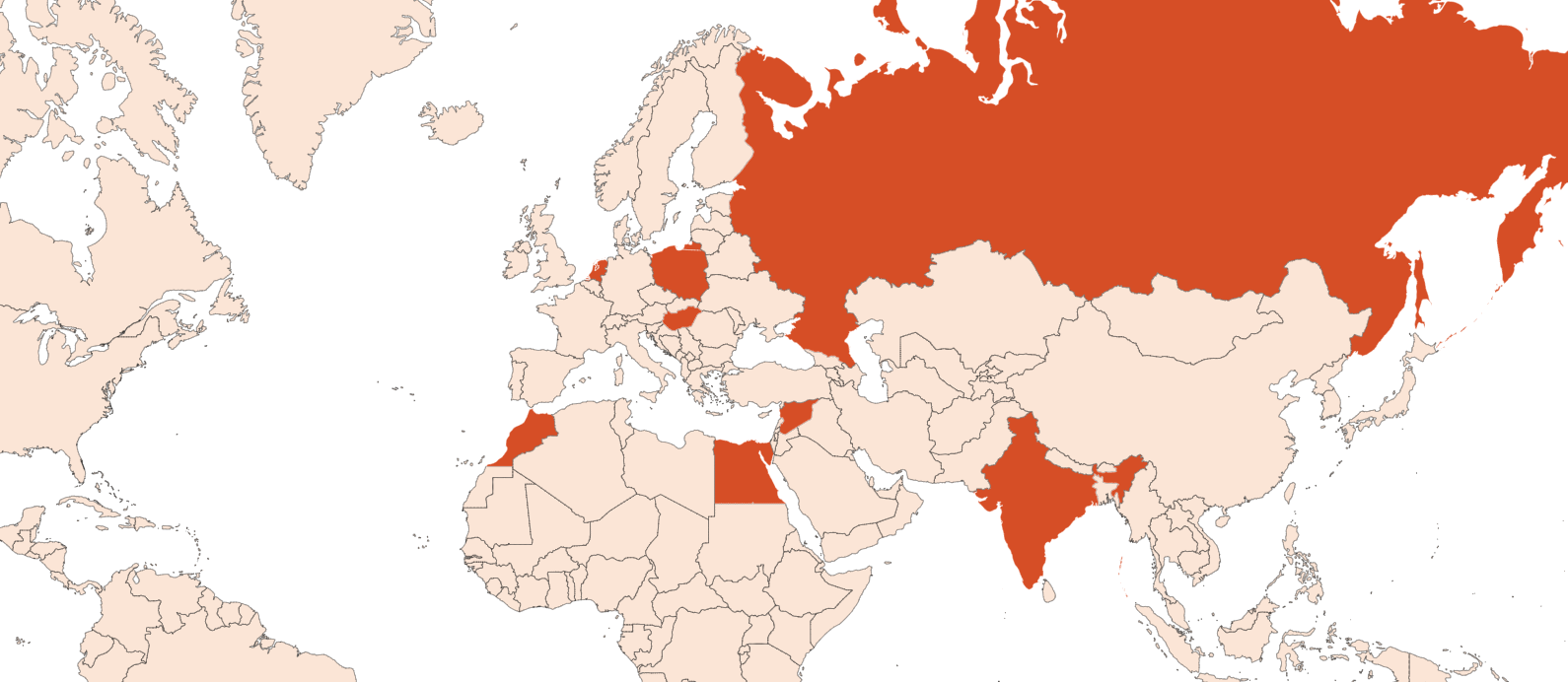
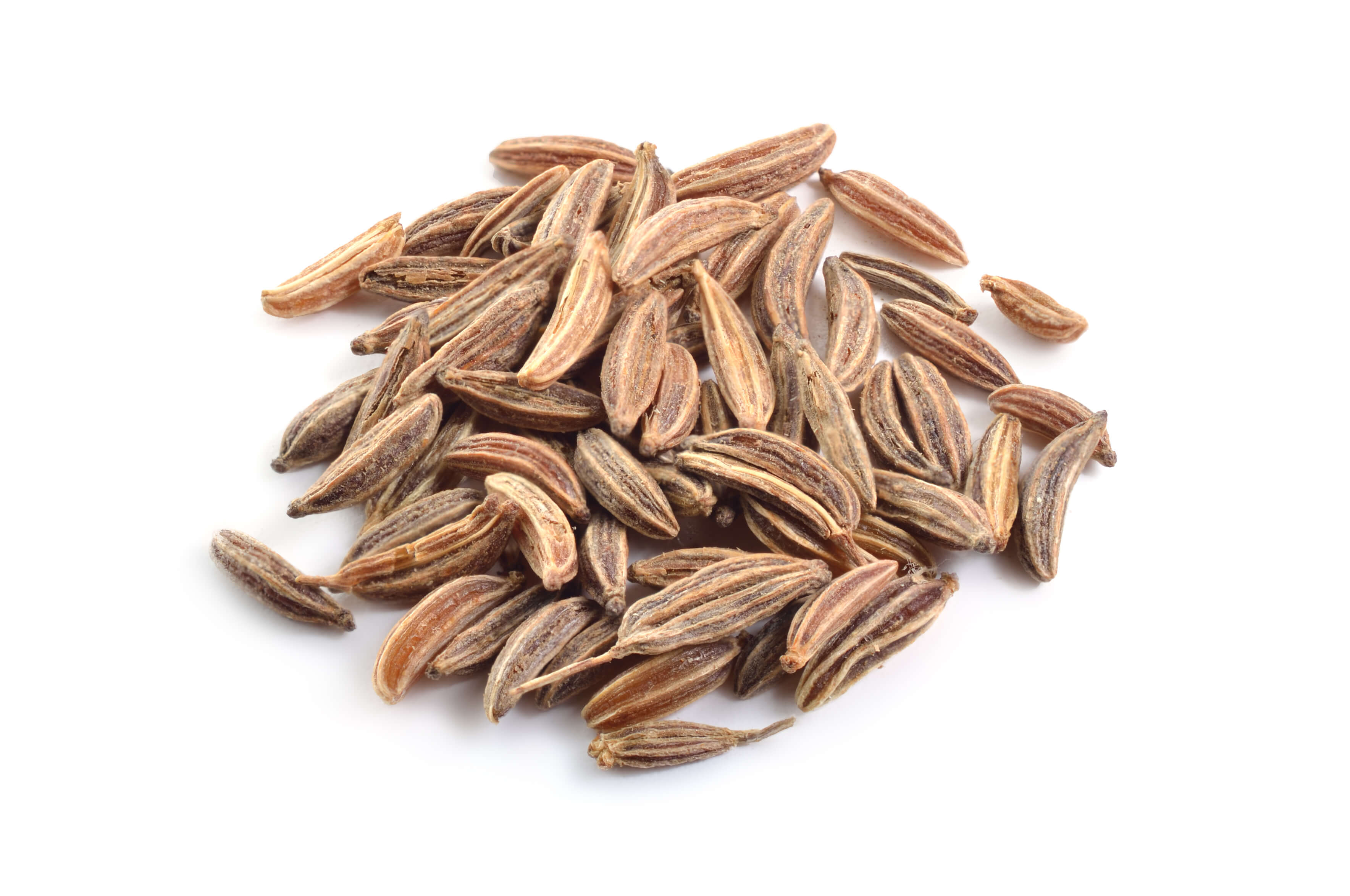
Photo credits: ScenTree SAS
Other comments :
The essential oil contained in the caraway seed depends on its culture frequency. The biannual caraway contains up to 5% essential oil, while the caraway grown only once a year contains up to 3.3%.
The quality of a caraway seed is judged on its maturity, colour, size, weight and the composition of its essential oil.
The essential oil must contain 47 to 81% of Carvone, 9 to 48% of Limonene-D, have little to no colour and must have certain physical characteristics. Those criterias compensate various adulterations by adding less expensive extracts in the essential oil (seeds of bad quality, plant stem, ryegrass ...).
The essential oil contained in the caraway seed depends on its culture frequency. The biannual caraway contains up to 5% essential oil, while the caraway grown only once a year contains up to 3.3%.
The quality of a caraway seed is judged on its maturity, colour, size, weight and the composition of its essential oil.
The essential oil must contain 47 to 81% of Carvone, 9 to 48% of Limonene-D, have little to no colour and must have certain physical characteristics. Those criterias compensate various adulterations by adding less expensive extracts in the essential oil (seeds of bad quality, plant stem, ryegrass ...).
Labelling
Allergens :
This ingredient does not contain any allergen.
Signal word :
Warning
Hazard pictograms :
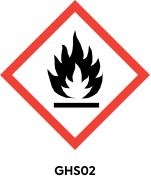
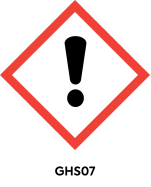
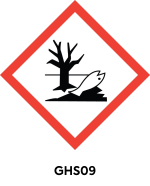
Precautionary statements :
| HAZARD | PRECAUTION |
|---|---|
| H226 Flammable liquid and vapour.
H312 Harmful in contact with skin. H315 Causes skin irritation. H317 May cause an allergic skin reaction. H410 Very toxic to aquatic life with long lasting effects. |
P233 Keep container tightly closed. P240 Ground and bond container and receiving equipment. P241 Use explosion-proof [electrical/ventilating/lighting/…] equipment. P242 Use non-sparking tools. P243 Take action to prevent static discharges. P261 Avoid breathing dust/fume/gas/mist/vapours/spray. P264 Wash ... thoroughly after handling. P270 Do no eat, drink or smoke when using this product. P272 Contaminated work clothing should not be allowed out of the workplace. P273 Avoid release to the environment. P280 Wear protective gloves/protective clothing/eye protection/face protection. P302 + P352 IF ON SKIN: Wash with plenty of water/… P303 + P361 + P353 IF ON SKIN (or hair): Take off immediately all contaminated clothing. Rinse skin with water [or shower]. P312 Call a POISON CENTER/doctor/… if you feel unwell. P321 Specific treatment (see ... on this label). P332 + P313 If skin irritation occurs: Get medical advice/attention. P333 + P313 If skin irritation or rash occurs: Get medical advice/attention. P362 Take off contaminated clothing. P363 Wash contaminated clothing before reuse. P370 + P378 In case of fire: Use… to extinguish. P391 Collect spillage. P403 + P235 Store in a well-ventilated place. Keep cool. P501 Dispose of contents/container to… |
IFRA
IFRA 51th :
This ingredient is restricted by the 51th amendment
Annexe I :
Some regulated synthetic ingredients are found in nature and in certain proportions in natural ingredients. This presence in nature has to be taken into account when calculating limits of use recommended by the IFRA. In case you do not know these concentrations, you can use the ones estimated by the IFRA. Here they are :
| List of regulated compounds contained in this ingredient | ||
|---|---|---|
| Regulated ingredient name | CAS N° | Estimated Concentration |
| d-Carvone | 2244-16-8 | 59 |
| Perilla aldehyde | 2111-75-3 | 0,1 |
Disclaimer :
ScenTree is solely responsible for the information provided here.
To learn more about IFRA's standards : https://ifrafragrance.org/safe-use/library