





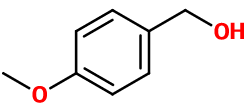
Photo credits: ScenTree SAS
| Company | Ingredient Name | ID | Comments | Naturality | Certifications | MOQ | Purity |
|---|---|---|---|---|---|---|---|
|
ANISIC ALCOHOL | ALCAN-1 |
Visit website

|
- | 10 grs | - | |
|
Anisyl Alcohol natural | - |
Visit website
|
Natural Aroma Chemicals | - | - | |
|
|
Para Anisyl Alcohol | - |
Visit website
|
Synthetic Aroma Chemicals | - | - | |
|
Alcool Anisique - 30 Gr | - |
Visit website
|
- | - | - |


General Presentation
-
CAS N° :
105-13-5 -
EINECS number :
203-273-6 -
FEMA number :
2099 -
FLAVIS number :
02.128
-
JECFA number :
871 -
Volatility :
Heart -
Price Range :
€€
Physico-chemical properties
-
Appearance :
Colorless liquid that solidifies at room temperature -
Density :
1,11 -
Refractive Index @20°C :
Donnée indisponible. -
Optical rotation :
Donnée indisponible. -
Vapor pressure :
Donnée indisponible. -
Flash Point :
113°C (235,4°F)
-
Molecular formula :
C8H10O2 -
Molecular Weight :
138,17 g/mol -
Log P :
Donnée indisponible. -
Fusion Point :
24°C (75,2°F) -
Boiling Point :
259°C (498,2°F) -
Detection Threshold :
Donnée indisponible.
Chemistry & Uses
Uses in perfumery :
Ansiyl Alcohol is used to bring a balsamic and fruity note to floral accords, by sweetening them.
Year of discovery :
Data not available.
Natural availability :
Anisyl Alcohol is found in nature in Anise EO (Pimpinella anisum), Vanilla Bourbon Absolute (Vanilla planifolia) and Vanilla Tahiti Absolute (Vanilla tahitensis), and in trace amount in Star Ansie EO (Illicum verum). Thus, it can be extracted in low quantity from these natural products.
Isomerism :
Anisyl Alcohol used in perfumery is para-Anisyl Alcohol. Meta-Anisyl Alcohol and ortho-Anisyl Alcohol also exist. These isomers are very poorly used in perfumery, and have an anisic smell, but less interesting for perfumery. The interest in Anisic Alcohol also relies on its availability on a natural state.
Synthesis precursor :
Anisyl Alcohol is not a precursor for the synthesis of another compound of olfactive interest.
Synthesis route :
Anisyl Alcohol is synthesized by catalytic hydrogenation of Anisic Aldehyde. This reaction consists in reacting the reagent with hydrogen, in the presence of a catalyst as platinium, or another metal as nickel or palladium.
Stability :
Aromatic compounds are chromophorous. This means that they may colour through time or in an alkaline medium.
Other comments :
Anisyl Alcohol is one of the 26 allergens used in perfumery, according to Annex III of the european cosmetic regulation 1223/2009. This means than it can't be used at more than 10 ppm in non-rinced products, and 100 ppm in rinced products, without mentioning its name on the product packaging.
Its smell is less vanillic than the one of Anisic Aldehyde and less fruity than the one of Anisyl acetate.
Labelling
Allergens :
This ingredient does not contain any allergen.
IFRA
IFRA 51th :
This ingredient is restricted by the 51th amendment
-
Restriction type :
RESTRICTION -
Cause of restriction :
DERMAL SENSITIZATION AND SYSTEMIC TOXICITY -
Amendment :
49
- Quantitative limit on the use :
-
Cat.1 Cat.2 Cat.3 Cat.4 Cat.5A B C DCat.6 0,0028 % 0,039 % 0,025 % 0,21 % 0,041 % 0,0055 % 0,033 % 0,002 %Cat.5A B C DCat.6 0,041 % 0,0055 % 0,033 % 0,002 %0,091 % Cat.7A BCat.8 Cat.9 Cat.10A BCat.11A BCat.12 0,033 % 0,033 %0,002 % 0,099 % 0,099 % 0,17 %0,002 % 0,002 %Cat.10A BCat.11A BCat.12 0,099 % 0,17 %0,002 % 0,002 %14 %
Annexe I :
Some regulated synthetic ingredients are found in nature and in certain proportions in natural ingredients. This presence in nature has to be taken into account when calculating limits of use recommended by the IFRA. In case you do not know these concentrations, you can use the ones estimated by the IFRA. Here they are :
| List of regulated compounds contained in this ingredient | |||
|---|---|---|---|
| Ingredient Name | Botanical Name | CAS N° | Estimated Concentration |
| Cassie absolute | Vachellia farnesiana (L.) Willd. | 8023-82-3 | 0,8 |
| Mimosa absolute | Acacia decurrens (Wendl.f.) Willd. | 8031-03-6 | 0,12 |
| Vanilla absolute | Vanilla planifolia | 8024-06-4 | 0,03 |
| Vanilla CO2 extract | Vanilla planifolia | 8024-06-4 | 0,02 |
| Vanilla oleoresin | Vanilla planifolia | 8024-06-4 | 0,7 |
| Vanilla tahitensis absolute | Vanilla tahitensis J.W. Moore | 953789-39-4 | 0,07 |
| Vanilla tahitensis CO2 extract | Vanilla tahitensis J.W. Moore | 953789-39-4 | 0 |
| Vanilla tincture | Vanilla planifolia | 8047-24-3 | 0,01 |